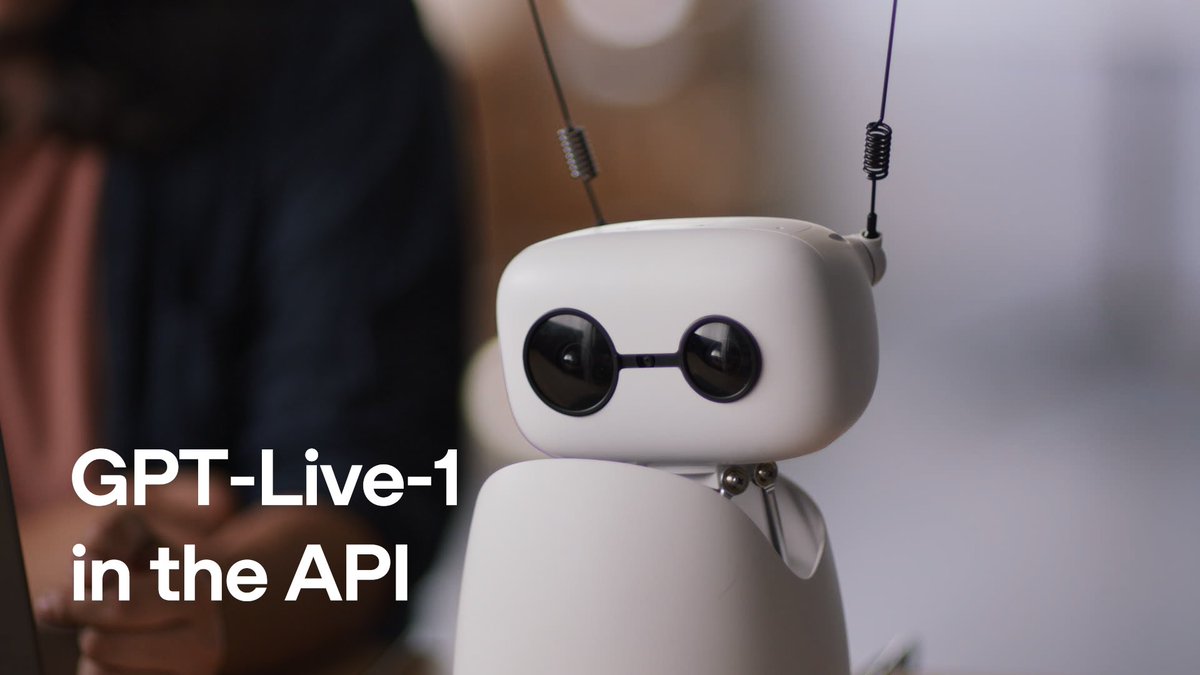
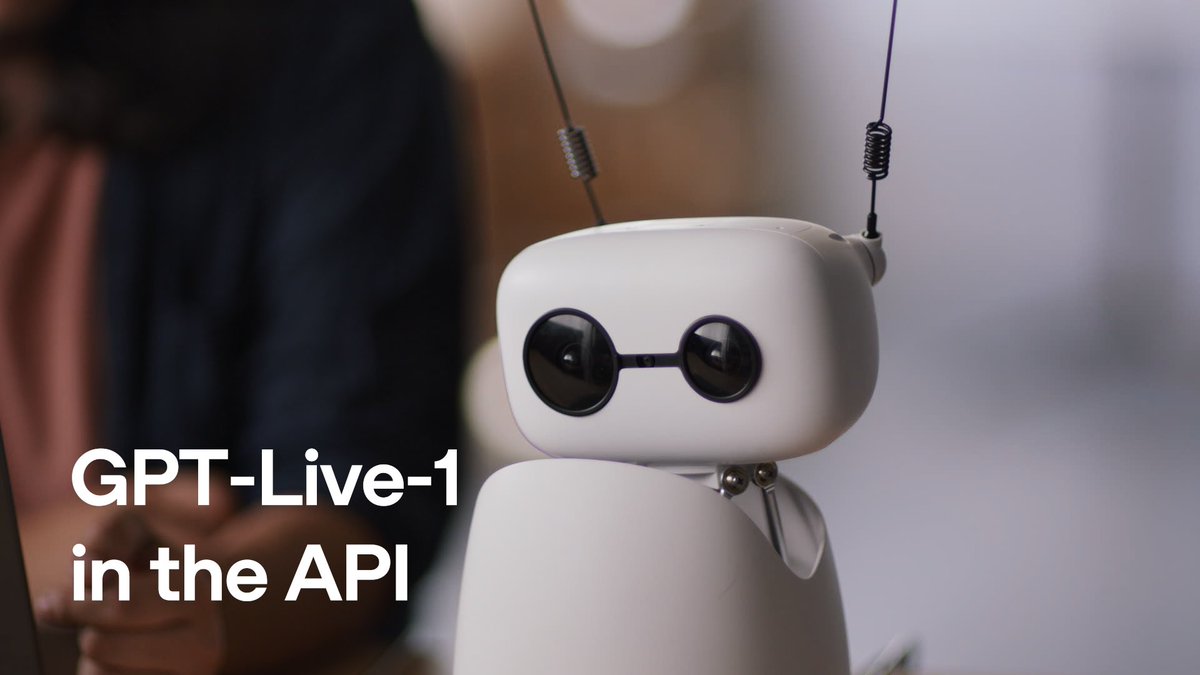
OpenAI demos a voice-driven store with GPT-Live-1.1, Decisions API and WebMCP
- Source
- x.com
- Publisher
- OpenAI
- Date

“Can we get those 40 welcome kits to San Francisco any sooner?” Here’s how we built a merch store you can talk to: • GPT-Live-1.1 reads out the rush fee and delivery estimate. • The Decisions API scores damage to a returned mug. • WebMCP lets any agentcall the store’s cart tools.

Context
OpenAI Developers posted a demo of a merch store that a customer can talk to, built from two of OpenAI's newer developer products and WebMCP, a proposed web standard, each doing a different job. The example request is whether 40 welcome kits can reach San Francisco sooner. In the post, GPT-Live-1.1 reads out the rush fee and delivery estimate, the Decisions API scores the damage on a returned mug, and WebMCP lets any agent call the store's cart tools.
GPT-Live-1.1 is the voice. OpenAI's model page describes it as a full-duplex model, one that can listen while it speaks, and says developers describe in plain language when it should hand a task to their own backend for reasoning or . The post does not say which part of the store works out the rush fee and delivery estimate that GPT-Live reads out. GPT-Live-1.1 reached the API on November 19, eight days before this demo.
The Decisions API answers a narrow question about some evidence without writing a response. According to OpenAI's guide, a request carries the evidence, which can include images, and named questions, and each answer comes back as a typed value. A predicate question returns the probability that a condition holds, a choice question picks one of the supplied options, and a score question rates the input against 2 to 10 ordered levels, which fits grading how badly a mug is damaged. The guide says it answers about 10 times faster than the Responses API, that GPT-Live can call it directly, and that the developer's , not the API, carries out whatever action the answer selects.
WebMCP is a proposed web standard that lets a page register actions, each with a name, a description and an input , for an AI agent to call directly instead of reading the screen and clicking. OpenAI's site tools documentation calls its version ChatGPT's implementation of the proposal, used by the built-in browser in the ChatGPT desktop app. Unlike an ordinary , the tools belong to the open page, so the agent works in the same live page and signed-in session as the user, and they can become unavailable when the page is closed or the user navigates away. OpenAI says it treats a site's tool definitions and results as untrusted and still asks for confirmation before actions such as purchases. In this store that means an agent could work the cart through tools the store's own page provides, though "any agent" in the post depends on the agent's browser supporting WebMCP. An earlier Intel item covers OpenAI's WebMCP build challenge.
The post lists these roles and nothing more. Its video was not transcribed or reviewed for this explanation, so how the three parts connect, whether the store is public, and whether its code is available are not established here.
- tool use — A model's ability to call external functions — run code, search the web, edit files — instead of only generating text.
- Application — Software arranged so that a person can use it; in this course, the software around a model that accepts your request, prepares the context and shows the reply.
- Schema — A written description of a data format: which fields exist, what kind of value each holds and which are required.
- MCP server — A program that provides tools, resources and prompt templates to an MCP client; it may run on the same machine as the application or remotely.