Nadella on Token Budgets, Headless Apps and Model Lock-In
- Source
- x.com
- Date

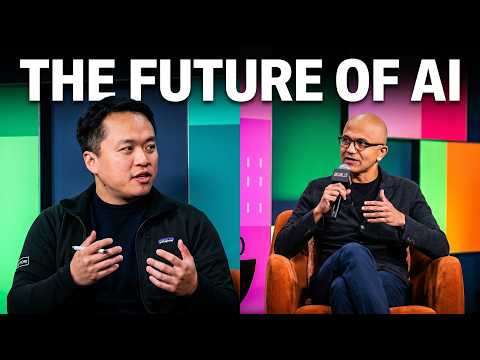
13 years after working at Microsoft, I had the pleasure to talk to @satyanadella at Ignite. My top 5 takeaways, lightly edited from his answers: 1. Can Microsoft catch up to the frontier labs? "This reminds me of a question when I was in Azure. People asked, 'Can you ever catch up with Amazon? Does anyone need a cloud other than Amazon?' My answer is the world will demand more than one cloud and model. What customers expect from [Microsoft] is flexibility and optionality, while delivering the tokens they need for their task with the economics in mind." 2. Do you have any advice for people who are anxious about how AI is changing work? From Satya: "My job is to turn that anxiety into restructuring Microsoft so we look like any new company. The new company looks like this: There's a founder. The founder has a token budget. Then the founder hires somebody, and they get a token budget too. All of Microsoft should look like that. All ICs are now managers of agents with a token budget. When people see that, I hope they say, oh, there's a path. The Copilot Cowork product is built by just 11 devs. And one developer builds and maintains the entire GitHub Copilot runtime." 3. What…

Context
In the takeaways Peter Yang posted from his conversation with Satya Nadella at Microsoft's Ignite conference, the Microsoft chief executive keeps returning to one idea: a company should treat any single AI model as replaceable and put its effort into what it builds around the model. Asked how companies avoid being locked into one model, Nadella said to assume "the next model drop causes you to replan." His suggestion is to log what your agents do, use those records to fine-tune a model (train it further on your own examples), and do it again when the next upgrade ships. He described the goal as turning "the model business into a database business," where the lasting asset is the company's own data rather than the model.
The same logic runs through his other answers. Asked whether Microsoft can catch up with the frontier labs, he compared it to Azure competing with Amazon and said the world will demand more than one cloud and model, with customers wanting flexibility and optionality. On safety, he said he once expected , meaning models reliably doing what their makers intend, to emerge as models scale, but that empirical results suggest maybe not. His answer is a trust architecture independent of the model, because the liability stays with the company, and he likes treating models as an insider risk, the category of threat that comes from someone already inside the organization with access.
He described how he wants work at Microsoft to change. Asked about anxiety over AI and jobs, he described a company where each person, starting with a founder, gets a , an allowance of AI model usage, which is metered in tokens, and every individual contributor becomes a manager of agents. He also said Microsoft's business apps are now "a headless plugin to Copilot," used by agents through Copilot rather than opened by a person, and that his own assistant now does more CRM lookups than he ever did.
Yang presents these as Nadella's answers, lightly edited by Yang, not a transcript, and the post links no recording. The lock-in and insider-risk points match what Nadella said in an earlier Pragmatic Engineer interview, where, in the newsletter's summary, he advised keeping the , memory and model uncoupled so each can be changed easily.
- alignment — The work of making AI systems actually pursue what their builders and users intend, rather than something subtly or dangerously different.
- token budget — A cap on how many tokens a task, session, or agent run may consume — the practical control on both cost and how long an agent will grind.
- agent harness — The scaffolding around a model that turns it into a working agent — the loop, the tools it can call, and the rules for when to stop.
- AI agent — An AI system that doesn't just answer once but works toward a goal in a loop — taking actions, reading the results, and deciding what to do next.
Checking sign-in…
Loading comments…