Ling-3.0-flash-Fin: Ant's open finance model benchmarked
- Source
- x.com
- Date

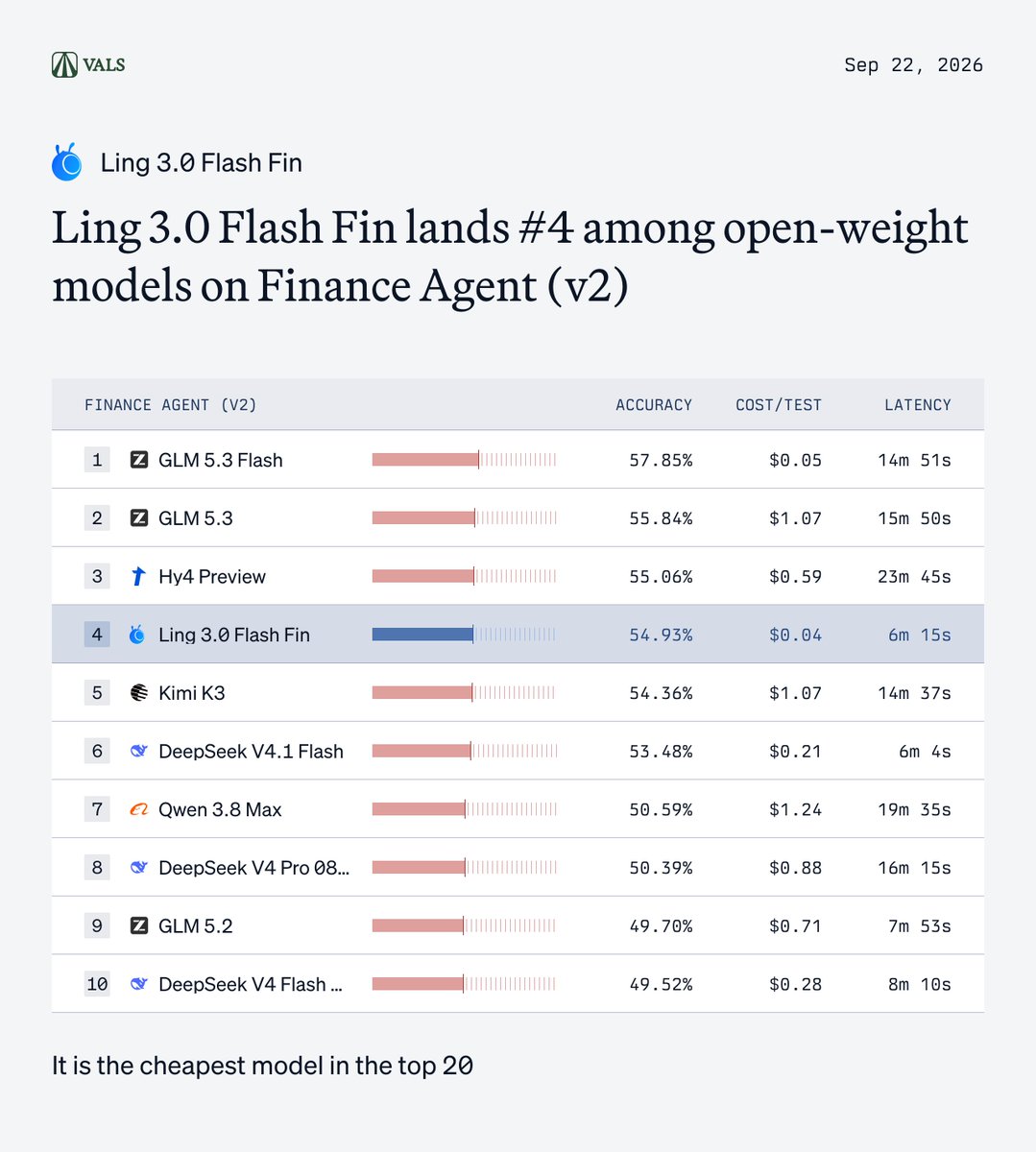
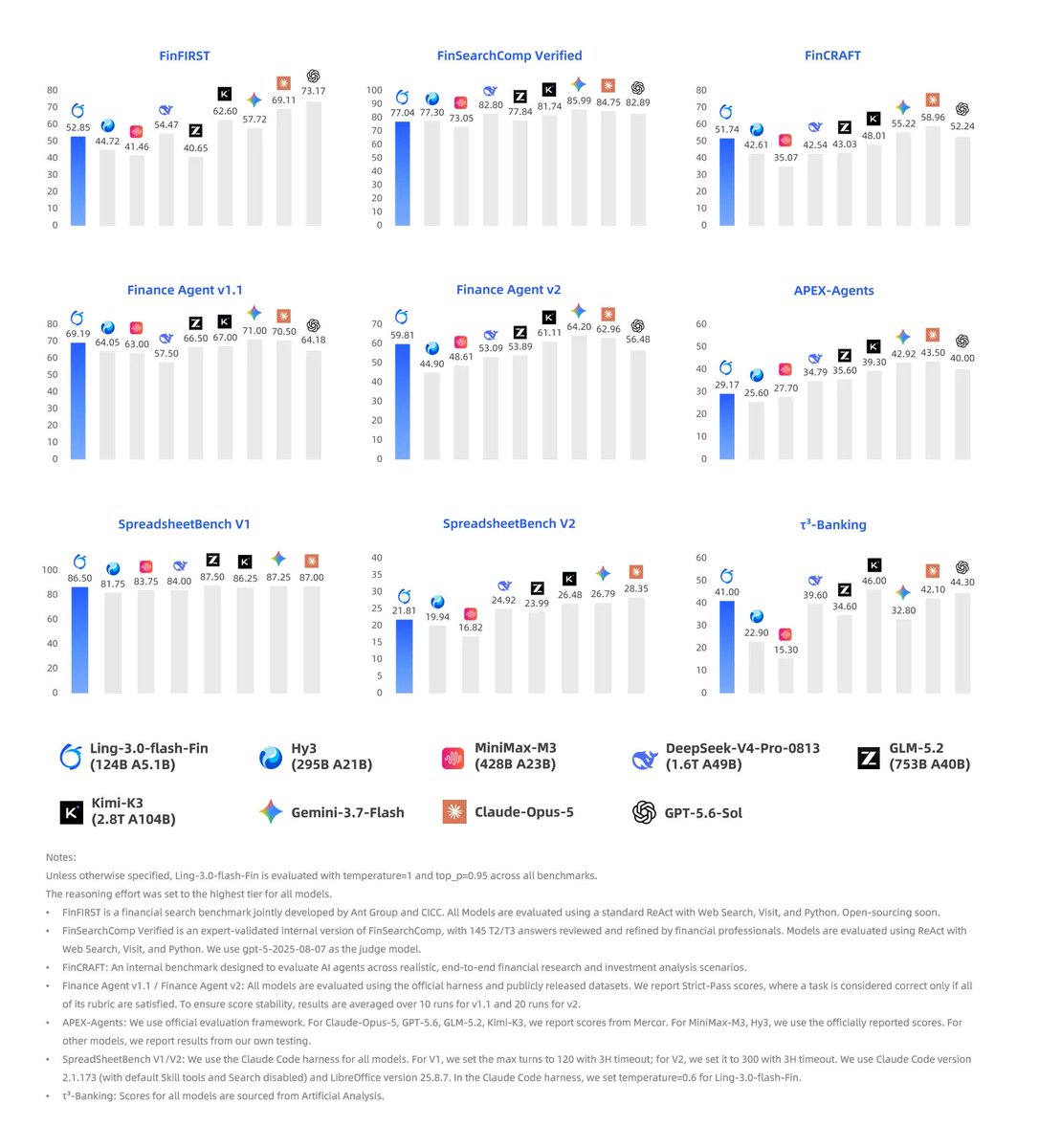
Ling-3.0-flash-Fin, Ant Group’s new finance-focused open weights model, scores 23 on the Artificial Analysis Intelligence Index and 24 on the Finance & Accounting Index, and is on the Intelligence vs. Active Parameter Pareto Frontier @AntLingAGI has released Ling-3.0-flash-Fin, a finance-focused model built on Ling-3.0-flash. Ant Group announced that it developed the model with financial institutions and industry experts to support financial research, including checking sources, building valuation spreadsheets and writing reports. This text-only model comes after their release of their image and video input-capable model Ling-3.0-flash-VL, which scored 25 on the Intelligence Index. Key results: ➤ Ling-3.0-flash-Fin matches MiniMax-M2.7’s Intelligence Index score with roughly half the active parameters. Both score 23, while Flash-Fin activates 5.1B parameters per token compared with MiniMax-M2.7’s 10B. ➤ Ling-3.0-flash-Fin matches Ling-3.0-flash-VL at 24 on the Artificial Analysis Finance & Accounting Index. Fin has higher business knowledge accuracy than VL (17% vs. 11%), but also higher business knowledge hallucination (33% vs. 19%) ➤ Ling-3.0-flash-Fin scores slightly below…

Context
Artificial Analysis, an independent benchmarking firm, scored Ling-3.0-flash-Fin at 23 on its Intelligence Index, the same as MiniMax's MiniMax-M2.7. Fin is Ant Group's finance-focused open-weights model, which Ant Ling built on its Ling-3.0-flash base and which Ant says it developed with financial institutions for tasks such as checking sources, building valuation spreadsheets and writing reports. The headline result is about efficiency. Fin has 124 billion parameters but activates 5.1 billion per , against MiniMax-M2.7's 10 billion, which puts it on Artificial Analysis's Pareto frontier of intelligence against active parameters: no model the firm has tested scores higher while activating as few parameters.
The finance tuning shows up less clearly than the name suggests. On Artificial Analysis's Finance & Accounting Index, Fin scored 24, the same as Ant's general, image-capable Ling-3.0-flash-VL. Fin answered more business-knowledge questions correctly (17% against 11%) but also hallucinated more on them (33% against 19%), so the gain in knowledge came with more wrong answers as well.
Against the same VL model, Fin was weaker on agentic work. It scored 1171 Elo against 1225 on GDPval-AA v2 and 967 against 986 on AA-Briefcase, both of which test professional tasks such as producing documents and spreadsheets. On AutomationBench-AA, which tests workflows across business apps while respecting , it reached 7% against VL's 16%, and both models scored 0% on Terminal-Bench v4.0. Fin also averaged about 67,000 output tokens per Intelligence Index task, about 3.2 times MiniMax-M2.7's 21,000, so the savings from fewer active parameters are partly spent on longer answers. Artificial Analysis's earlier results for the VL model give the baseline for those comparisons.
- token — The chunk of text a model reads and writes in — roughly three-quarters of a word — and the unit AI usage is billed in.
- guardrails — The checks around a model that block bad inputs and outputs — filters, validators, and permission rules the model itself can't override.
- mixture-of-experts — A model built from many specialist sub-networks where only a few activate per token, giving big-model capability at small-model running cost.

Checking sign-in…
Loading comments…