Moonshot opens Kimi K3.1 Pro weights: 2.8T MoE, 1M context
- Source
- huggingface.co
- Author
- Kimi_Moonshot
- Date
Context
Moonshot AI has published the weights of Kimi K3.1 Pro, the model it launched on October 23 with a promise to release the full weights by November 4. They arrived on that date. Moonshot announced the release on X, and the Hugging Face model card describes the same model: 2.8 trillion parameters, 104 billion of them active per token, and a of 1,048,576 tokens. The files can now be downloaded and run outside Moonshot's own apps and API. The card shows what that takes: serving a very large model with one of three recommended inference engines, handing the model's reasoning back to it in multi-turn use, and accepting a license of Moonshot's own whose terms the card does not spell out.
K3.1 Pro is a model. Instead of one block of weights that processes every token, it holds 896 expert sub-networks and selects 16 of them for each token; the card also lists 2 shared experts. That is why only 104 billion of the 2.8 trillion parameters are activated at a time: each token costs the computation of a much smaller model, but every expert must still be on hand, because different tokens select different ones. The weights are stored in MXFP4, a 4-bit number format, with activations (the intermediate values computed as the model runs) in 8-bit MXFP8. Moonshot used -aware training, meaning the model was trained with that reduced precision in place rather than compressed afterward. The card also changes how the model handles long inputs. Compared with Kimi K3, Moonshot replaced the full-attention layers, in which each token looks back at every earlier token, with Gated DeepSeek Sparse Attention layers, which attend to a selected subset, "for more efficient long-context modeling." Of the 93 layers, 69 use Kimi Delta Attention and 24 use the new sparse design. The model accepts text and images, the latter through a 401-million-parameter vision encoder.
For self-hosting, the card recommends three inference engines (the server software that loads the weights and answers requests): vLLM, SGLang and TokenSpeed, each with its own recipe or cookbook. It gives no hardware sizing; the only GPU models it names appear in a benchmark footnote. Teams that would rather not host it can call Moonshot's API at platform.kimi.ai as kimi-k3.1-pro, which Moonshot says offers OpenAI- and Anthropic-compatible interfaces. Either way, two usage rules apply. Thinking effort is set with a reasoning_effort field that accepts "low", "high" or "max", with "max" the default. In multi-turn conversations and tool calls, the model "requires the complete assistant message" to be passed back unchanged, including its reasoning_content and tool_calls, not only the visible reply. Kimi K3 came with a similar requirement to carry its earlier reasoning through a session. The weights are released under the Kimi K3.1 Pro License. The card names that license without summarizing it, so anyone planning a deployment has to read its terms separately.
The card's benchmark table is Moonshot's own and has not been independently verified. Unless noted otherwise, K3.1 Pro runs at maximum reasoning effort, often inside the Claude Code , while many rival scores are taken from leaderboards and other labs' reports. The results are mixed. Moonshot reports 65.7 on Terminal-Bench 4.0, against 66.4 for Claude Opus 5.5 and 58.2 for GPT-6 Astra, and the top score on SWE Marathon v1.1 at 51.7, against 46.3 for Opus 5.5. It trails on Program Bench, 31.5 against Opus 5.5's 65.0, and on HLE-Diamond, 39.4 against GPT-6 Astra's 65.8. Its cyber-security rows sit below the three Claude and GPT models listed: 74.7 on ExploitBench, where GPT-6 Astra scores 100, and 20.7 on ExploitGym, where those three range from 30.4 to 42.4. With the weights public, outside testers can now check these figures against the model itself; until they do, the table remains Moonshot's account.
- context window — The maximum amount of text a model can consider at once — its working memory for the current conversation or task.
- mixture-of-experts — A model built from many specialist sub-networks where only a few activate per token, giving big-model capability at small-model running cost.
- quantization — Shrinking a model by storing its numbers less precisely — like rounding — so it runs faster and fits on smaller hardware, at a small quality cost.
- agent harness — The scaffolding around a model that turns it into a working agent — the loop, the tools it can call, and the rules for when to stop.
 articleKimi K3.1 Pro ships with 1M context and open weights due Nov 4Kimi_Moonshot
 article[AINews] Kimi 3.1 Pro 104BA-2.8T: Fable-5.1-Class Open Weights narrows Closed-AI lead to 1 month... and Pro Highspeed API with 2-3× speedswyx .ai
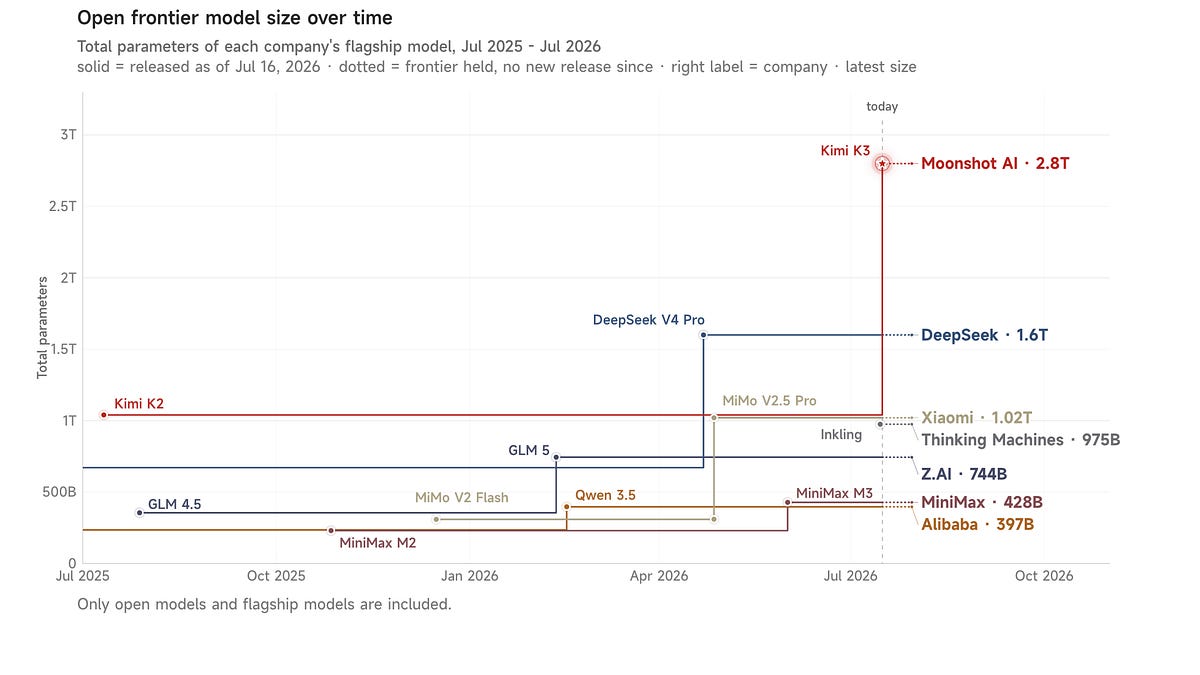 articleKimi K3 2.8T-A50B: the largest open model ever released; Opus 4.8-class at Sonnet 5 pricingLatent Space
Checking sign-in…
Loading comments…