Upstage ships Solar Mini 4, a 3B-active MoE for agent loops
- Source
- upstage.ai
- Author
- Upstage
- Date
Context
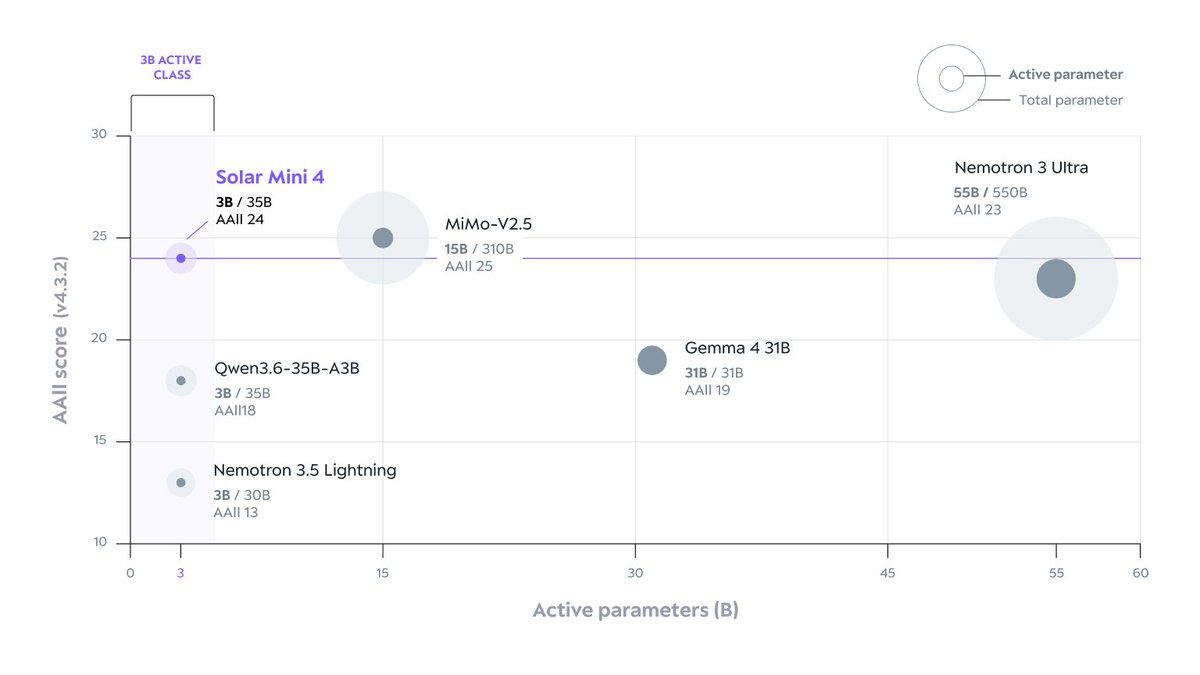
Solar Mini 4 is a new model from the Korean AI company Upstage, built for agent work that repeats the same kinds of steps many times: pulling facts out of documents, filling in structured formats such as JSON, and calling software tools. It uses a design, which splits the network into many sub-networks and sends each token through only a few of them. According to Upstage's launch post, that means only 3 billion of its 35 billion parameters do work on any given token, so each request takes far less computation than a model of full size. Upstage notes that all 35 billion weights still have to be loaded into memory; a version fits on one 80GB H100 GPU. Standard pricing is $0.10 per million input tokens and $0.40 per million output tokens.
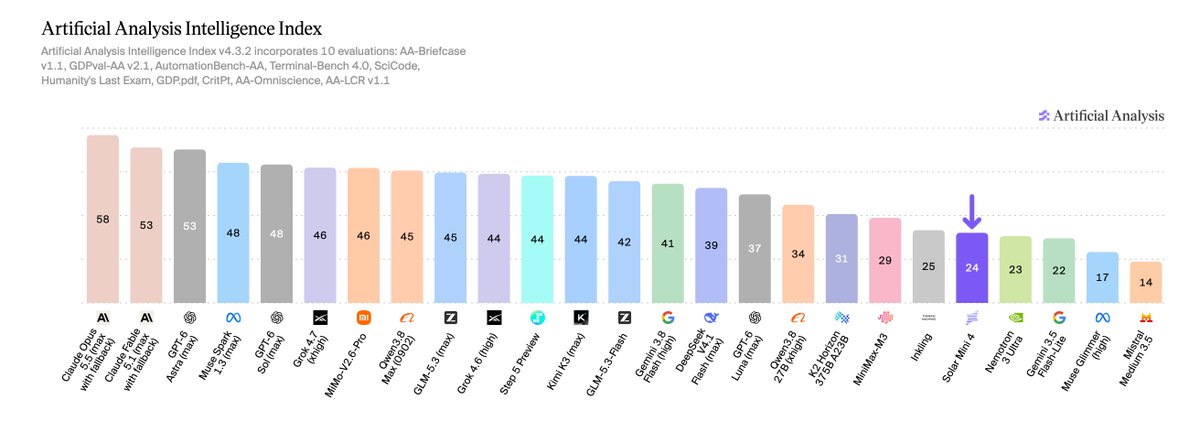
Cheap tokens do not guarantee a cheap task, and Upstage says so itself: an agent's bill also depends on how many tokens and turns it needs to finish. Its evidence that Solar Mini 4 wins on that measure is limited. In an initial internal test of three Korean-language tasks, each run three times, Upstage estimates 1,000 sets of the tasks would cost $1.25 with Solar Mini 4 against $2.20 with MiMo-V2.5, about 43% less, because MiMo used more tokens; Upstage adds that results may vary by workload. An outside measurement points the other way against a different rival. Artificial Analysis, whose Intelligence Index Upstage cites for the model's score of 24.1, the best among the 3-billion-active models in Upstage's comparison, reported that Solar Mini 4 costs roughly five times as much per task as GPT-6 Luna (max) despite similar per-token prices. The low price per token is established; a lower cost per finished task is so far shown only in Upstage's own small test.
- mixture-of-experts — A model built from many specialist sub-networks where only a few activate per token, giving big-model capability at small-model running cost.
- quantization — Shrinking a model by storing its numbers less precisely — like rounding — so it runs faster and fits on smaller hardware, at a small quality cost.
- context window — The maximum amount of text a model can consider at once — its working memory for the current conversation or task.
- tool use — A model's ability to call external functions — run code, search the web, edit files — instead of only generating text.

Checking sign-in…
Loading comments…