We have updated the Artificial Analysis Intelligence Index to v4.1.1 - this patc
- Source
- x.com
- Date

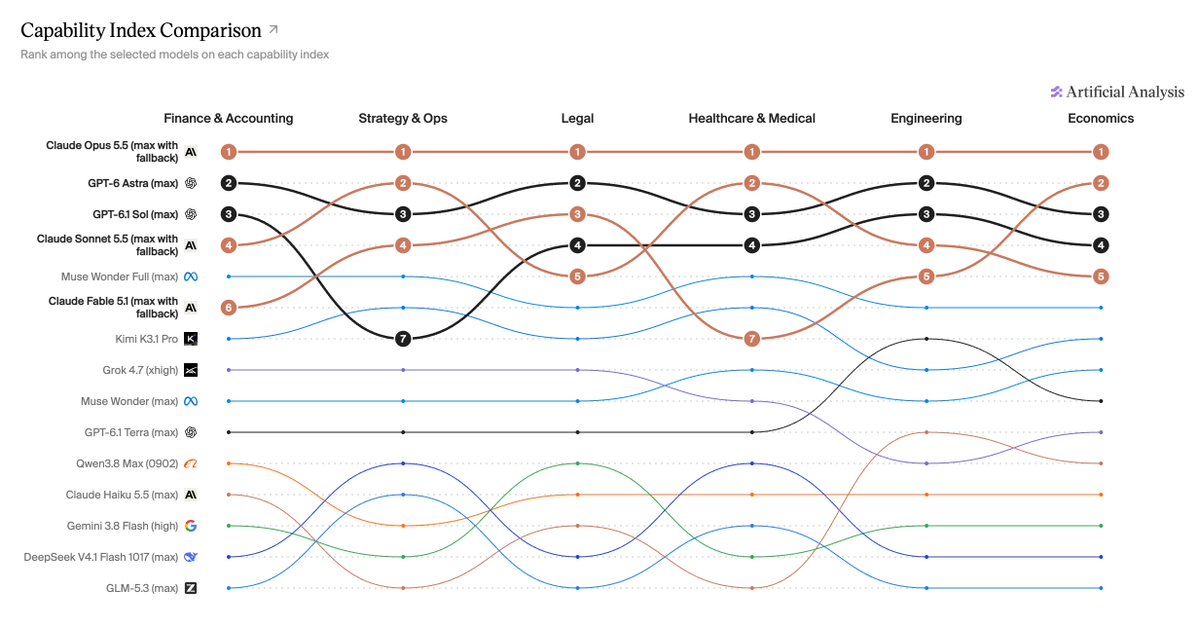
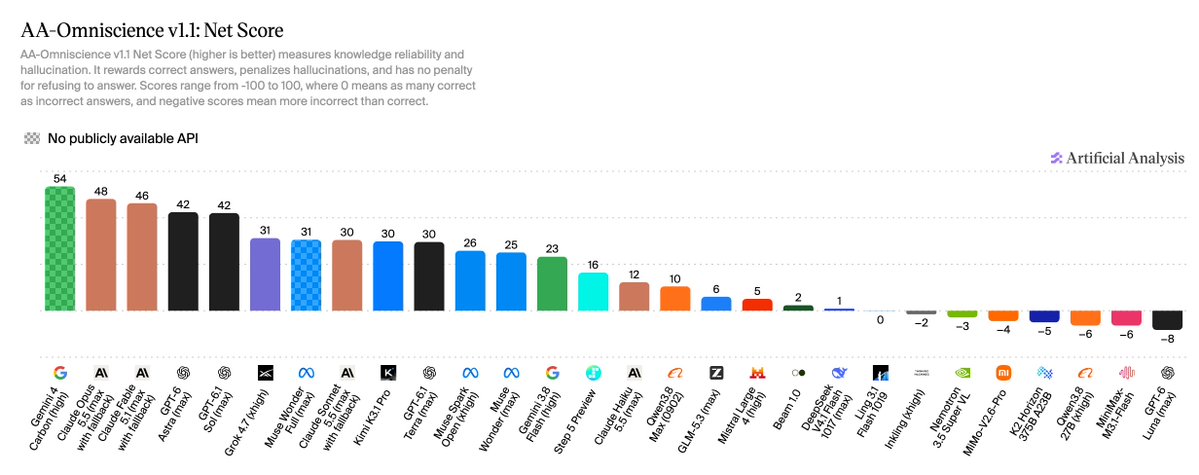
We have updated the Artificial Analysis Intelligence Index to v4.1.1 - this patch release upgrades our grader models, and brings the latest 𝜏³-Banking version to Artificial Analysis To keep the Artificial Analysis Intelligence Index the most useful synthesis metric for developers, we make regular updates to the included evaluations and our independent methodology. Today’s update is a minor one to keep our existing evaluation set as reliable as possible. Overall model rankings remain largely consistent, with a slight increase in many model scores due to improved grading robustness across the updated evaluations. Claude Opus 5 remains in the #1 position with an Index of 63. Key changes: ➤ 𝜏³-Banking now runs v1.0.1 from @SierraPlatform, updating to the latest upstream task versions and improved grader pipeline that resolves correctness errors in trajectories that recover from unhappy paths ➤ HLE, AA-LCR and AA-Omniscience are now graded by GPT-5.6 Luna (medium), replacing GPT-4o, Qwen3 235B A22B 2507, and Gemini 3 Flash Preview respectively. These checks are now unified under a more capable modern model, selected for strong agreement with human judgment in our grader…

Context
Many scores on the Artificial Analysis Intelligence Index rose in early August without any model changing, because the changed how it marks answers. Artificial Analysis, an independent benchmarking firm, combines a set of evaluations into the Index. Several of them accept free-form answers, so a second model acts as a judge and decides whether each response matches the reference. Version 4.1.1 replaced those judges and updated one agentic test, and the firm says most models moved by less than a point. Muse Spark 1.2 rose 2.7 points, the largest increase, and Claude Opus 5 stayed first at 63.
Two changes drove the movement. Humanity's Last Exam (hard expert-level questions), AA-LCR (reasoning across long document sets) and AA-Omniscience (factual knowledge and ) are now all judged by OpenAI's GPT-5.6 Luna at medium effort. It replaces three different judges, GPT-4o, Qwen3 235B and Gemini 3 Flash Preview, and the firm says it chose Luna for strong agreement with human judgment in its grader validation. Separately, τ³-Banking, an from Sierra in which a model handles a simulated bank customer using tools while following policies, moved to upstream version 1.0.1. The firm says its grader resolves correctness errors in runs where the hits a failed step and recovers. Artificial Analysis attributes the small increases to more robust grading: when a judge stops rejecting correct answers or properly credits a recovered run, the score rises with no change in what the model can do.
The practical consequence is that Index scores are comparable only within one version. Muse Spark 1.2 had launched a day earlier at 54; after the patch it sat near 57, and Artificial Analysis's cost-per-task comparison published hours later used the revised scores. A score quoted in July and one quoted after this patch can differ partly because of grading. The firm's methodology history now lists v4.1.1 as in force from August to September 2026; later versions dropped τ³-Banking, and the Index has since been rebuilt as version 5, so any comparison across months needs the version noted beside the number.
- benchmark — A standard public test set for comparing AI models — the shared scoreboards behind every "model X beats model Y" claim.
- hallucination — When a model states something false with full confidence — inventing facts, citations, or APIs that don't exist.
- eval — A repeatable test for AI quality — a set of tasks plus scoring — used the way software teams use test suites, because model output is too variable to judge by eyeballing.
- AI agent — An AI system that doesn't just answer once but works toward a goal in a loop — taking actions, reading the results, and deciding what to do next.
Checking sign-in…
Loading comments…