Exa 3.0 Dynamic Highlights Cuts Agent Search Tokens by 47%
- Source
- x.com
- Date

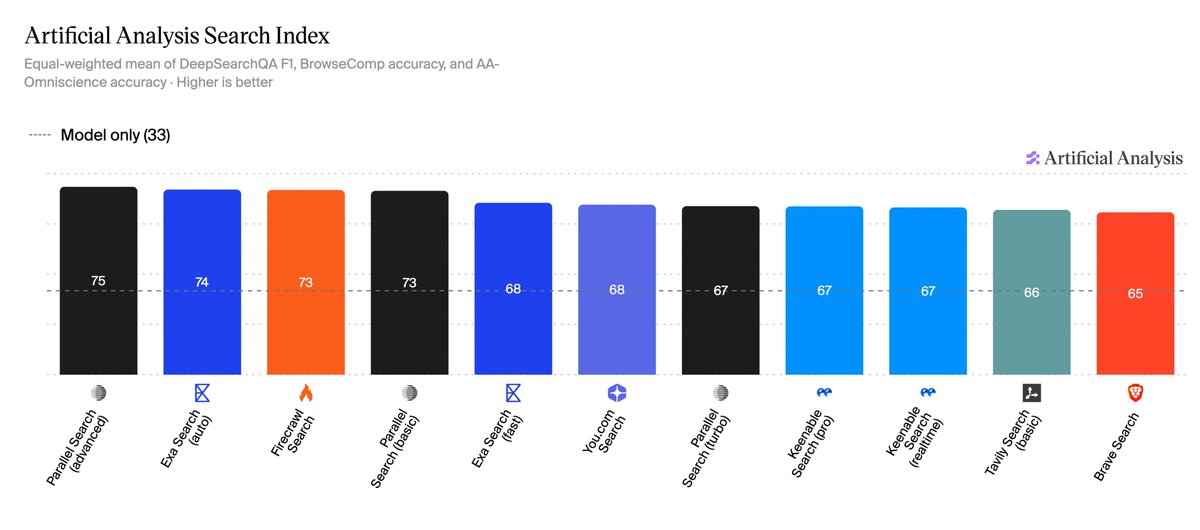
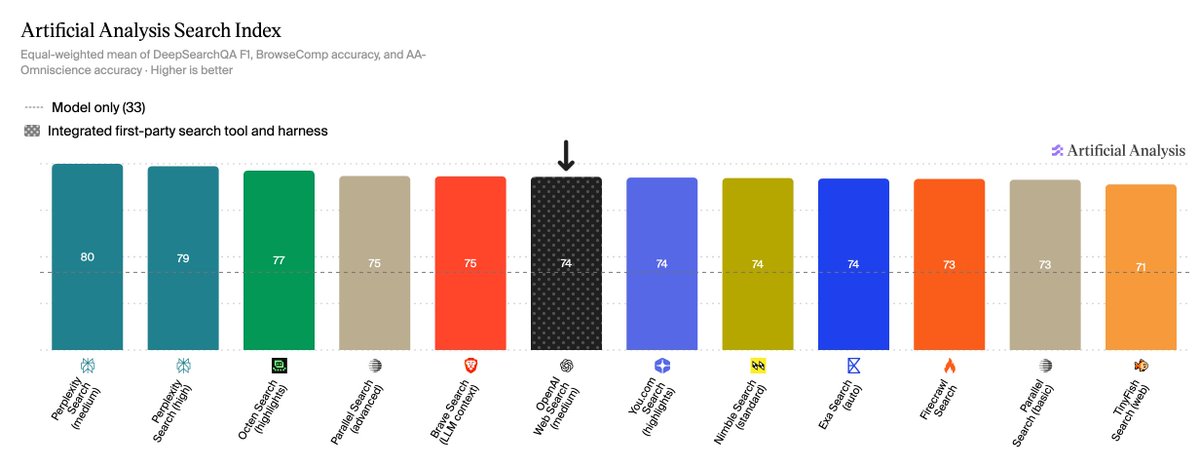
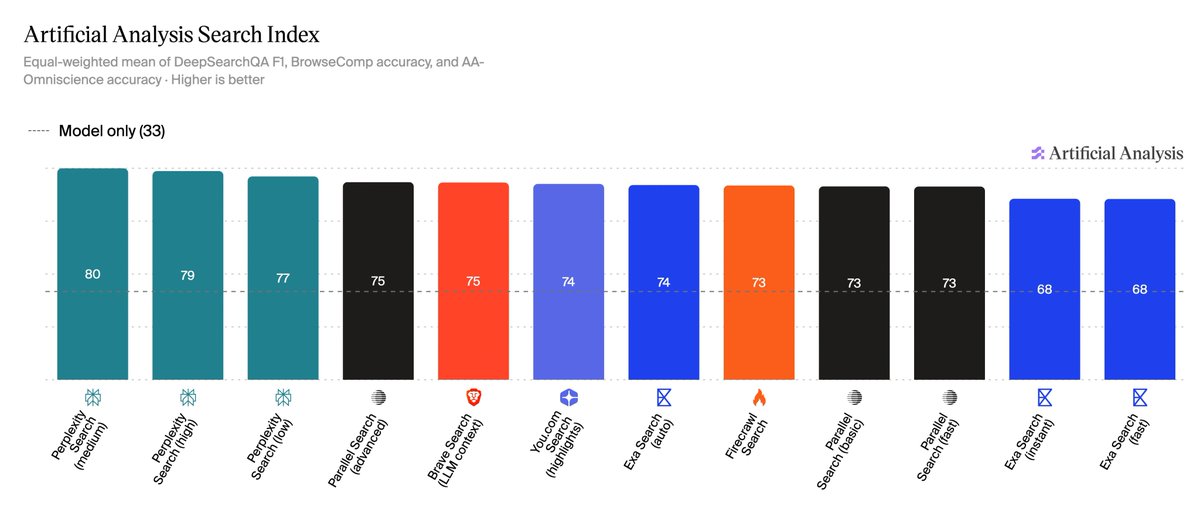
Exa has released Exa 3.0, scoring 80 on the Artificial Analysis Search Index in Dynamic Highlights mode, tying with Perplexity Search for the #1 spot @ExaAILabs has released a new Dynamic Highlights mode to its Search API. Given a search query and its results, Dynamic Highlights determines how much text to return from each page within a shared budget We benchmarked two Exa search types with Dynamic Highlights ahead of release: an upgraded auto mode, which balances search quality and speed, and a new lite mode, optimized for lower cost and latency. Both were evaluated using our Stirrup agent harness and GPT-5.6 Luna (medium) as the agent model Key benchmarking results for Exa Search with Dynamic Highlights: ➤ Ties for #1 on the Artificial Analysis Search Index: Exa Search (auto, Dynamic Highlights) scores 80, level with Perplexity Search (medium) in the #1 spot, while Exa Search (lite, Dynamic Highlights) scores 79. On DeepSearchQA, auto (85.6 F1) and lite (84.9 F1) rank 1st and 2nd respectively, 4 to 5 points ahead of Perplexity Search (medium, 80.8) ➤ Reduces search calls and token usage: Exa Search (auto, Dynamic Highlights) uses 7.6 searches per task, the fewest of any…

Context
The savings come from how the Artificial Analysis Search Index works. According to its methodology, every search provider is tested with the same : GPT-5.6 Luna at medium reasoning, running in Artificial Analysis's Stirrup with web search and fetch tools. The only thing that changes between runs is the search provider. Cost per task adds the search API's listed price to the cost of every token the model reads and writes. A search API that hands the agent less irrelevant text therefore lowers the bill even if its own price stays the same, a point the methodology itself makes.
Exa's new Dynamic Highlights mode targets exactly that. As the post describes it, the mode looks at a query and its results and decides how much text to return from each page, within one budget shared across all of them. In Artificial Analysis's run, Exa's auto mode with Dynamic Highlights averaged 7.6 searches per task, the fewest of any search API on the leaderboard, down from 9.4 with standard highlights. Tokens per task fell 47%, from 299k to 157k, and cost per task fell 21%, from $0.083 to $0.066.
The leaner did not cost quality on this . Exa auto with Dynamic Highlights scores 80 on the Search Index, level with Perplexity Search at medium for #1, and the cheaper lite mode scores 79 at $0.044 per task. Artificial Analysis says both modes sit on its cost-versus-capability Pareto frontier, meaning no other tested option scores higher for less. On DeepSearchQA, one of the index's three benchmarks, auto and lite rank first and second with F1 scores of 85.6 and 84.9, against Perplexity's 80.8. F1 is a score that rewards finding the right answers without padding the list with wrong ones. Perplexity reached the top spots earlier with settings that control how much content each result carries. Exa's mode turns that dial automatically for each query. Artificial Analysis benchmarked these modes ahead of release, and all of these figures come from that run.
- AI agent — An AI system that doesn't just answer once but works toward a goal in a loop — taking actions, reading the results, and deciding what to do next.
- agent harness — The scaffolding around a model that turns it into a working agent — the loop, the tools it can call, and the rules for when to stop.
- context window — The maximum amount of text a model can consider at once — its working memory for the current conversation or task.
- benchmark — A standard public test set for comparing AI models — the shared scoreboards behind every "model X beats model Y" claim.
Checking sign-in…
Loading comments…