Inkling 2 Mini
- Source
- thinkingmachines.ai
- Author
- jasondavies
- Date

Context
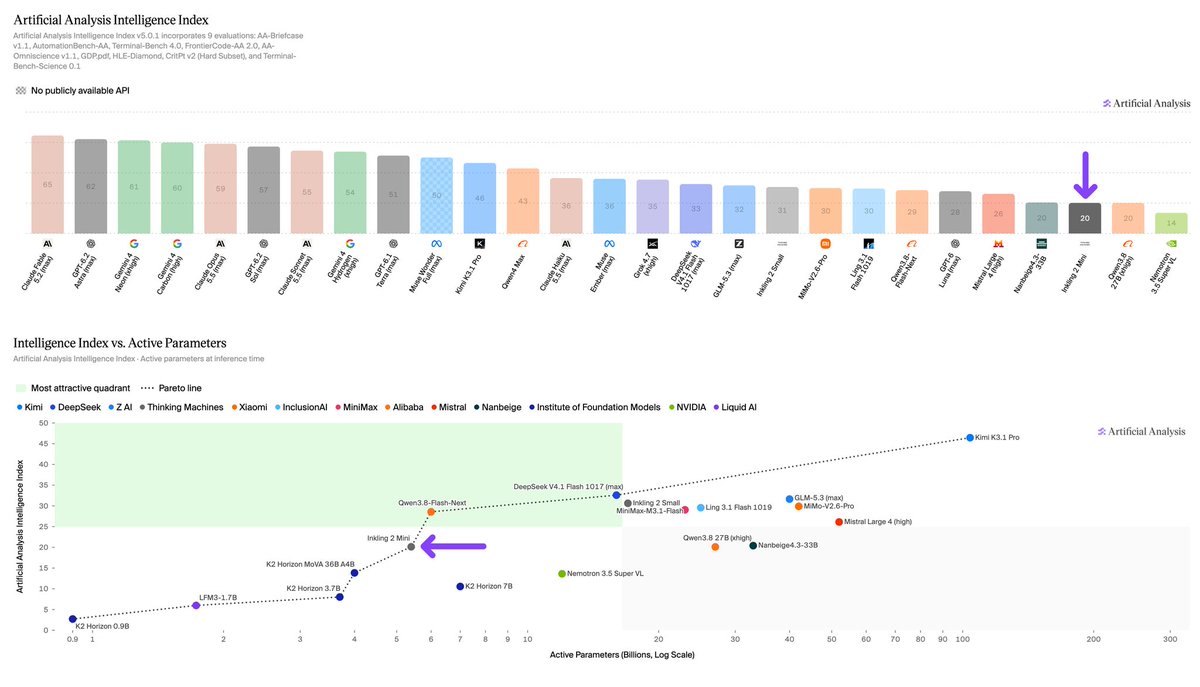
Thinking Machines has released Inkling 2 Mini, an open-weights model small enough to run on a well-equipped laptop. Its total memory footprint is about 20GB, the lab says it runs through Ollama on any Mac with at least 32GB of memory, and the weights are on Hugging Face, though the announcement does not name a license. Its central design idea is looping. The model stores 24 layers in four blocks of six, and the two middle blocks run three times for every token, so it does 48 layers of work while storing only 24. It is also a model, which activates only part of its weights for each token: it holds 26.4 billion parameters, uses 3.4 billion distinct ones per token, and counts 5.4 billion weight activations once the repeated layers are included.
Looping is how a model this size keeps up with larger ones. In the lab's test, a comparable model without looping needed 140% more computing power at run time to match the looped model's loss on 512,000-token agent transcripts, though it cost 7.5% less to train. In the lab's benchmark table the closest rival is Qwen's Qwen3.8-27B, and Inkling 2 Mini leads on most of the coding tests and on web research: 79.2% against 77.8% on , 48.2% against 42.2% on DeepSWE and 79.0% against 61.6% on the BrowseComp web-research test. Qwen leads on Terminal Bench, 73.0% to 71.6%, and on several tests of workplace tasks such as GDPVal-AA, and the two tie on the Artificial Analysis Intelligence Index, a score Artificial Analysis also reported.
The lab is direct about the limits. Looping adds reasoning work but not stored knowledge, which depends mostly on total parameter count, so extra loops did not help knowledge-heavy tests. On AA-Omniscience, which penalizes wrong answers, it scores -8.6 against Qwen's -6.4, and it avoids hallucinating on 63.4% of questions against Qwen's 71.4%. The page also says it is not the strongest small model for multi-turn chat or for instructions with many constraints. The evidence, mostly the lab's own benchmarks, supports it as a strong option for coding and agent work on a single machine and a weaker one where factual recall or long conversations matter. Its larger sibling, Inkling 2 Small, came out earlier in November.
- mixture-of-experts — A model built from many specialist sub-networks where only a few activate per token, giving big-model capability at small-model running cost.
- SWE-bench — The standard benchmark for AI coding agents: real GitHub issues from real repositories, scored by whether the agent's patch passes the project's own tests.
- transformer — The neural network architecture behind modern AI models, built on attention — letting every word directly consider every other word in parallel.
- quantization — Shrinking a model by storing its numbers less precisely — like rounding — so it runs faster and fits on smaller hardware, at a small quality cost.

Checking sign-in…
Loading comments…