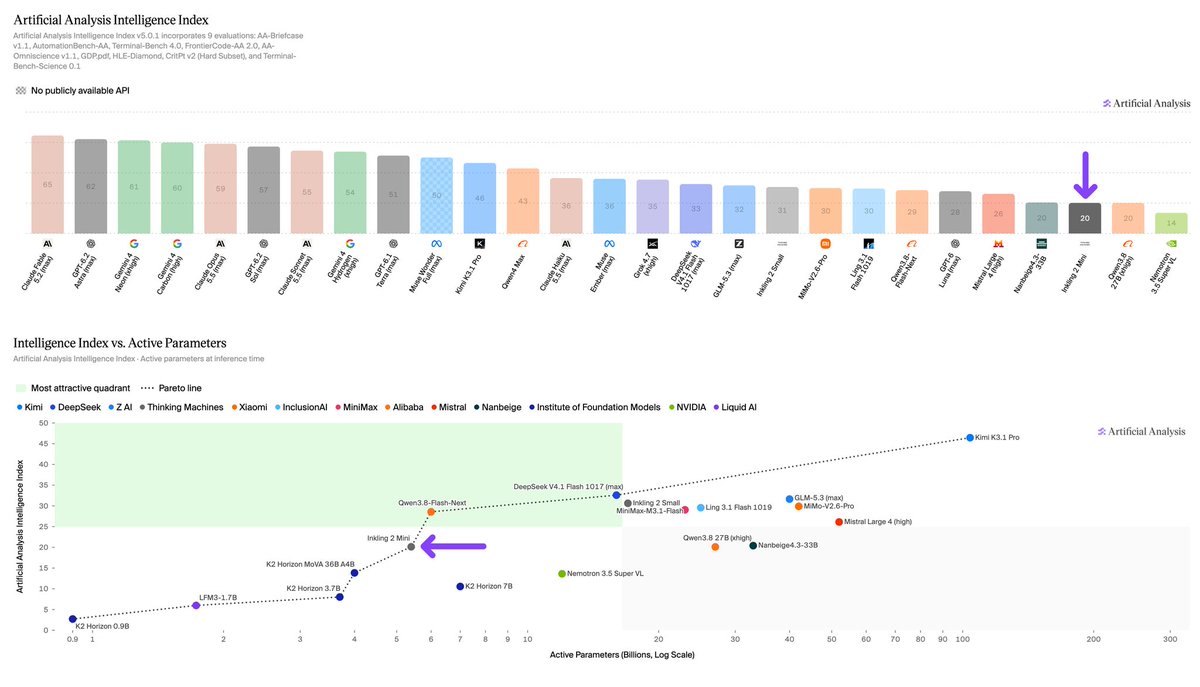
An Apache 2.0 model that runs on a MacBook matches larger 27B-33B models at about 6x lower cost per task and 4x faster. Its looped layers trade extra tokens for less compute, which changes local model choices.
Key takeaways · AI-distilled
Artificial Analysis says 12 of Inkling 2 Mini's 24 layers run three times per tokenThe chunk of text a model reads and writes in — roughly three-quarters of a word — and the unit AI usage is billed in.Full definition →. Its 5.4B active parameters count those three passes; only 3.1B unique weights are used per text token.
The loops add compute without adding output tokens, yet the model still writes more: about 152K output tokens per Intelligence Index task versus about 110K for Qwen3.8 27B, roughly 38% more for the same score.
Artificial Analysis measures compute as active parameters times tokens. On that proxy Inkling 2 Mini uses about 2.8x less compute than Qwen3.8 27B and about 5x less than Nanbeige4.3-33B, which puts it on the Pareto frontier.
Per Artificial Analysis, GPT-6 Luna (max) scores 28 on the index for $0.15 per task, versus 20 at $0.59 for Inkling 2 Mini, priced at Thinking Machines' first-party $0.15 input and $0.50 output per 1M tokens.
Terms in this piece · Glossary
mixture-of-experts — A model built from many specialist sub-networks where only a few activate per token, giving big-model capability at small-model running cost.
transformer — The neural network architecture behind modern AI models, built on attention — letting every word directly consider every other word in parallel.
context window — The maximum amount of text a model can consider at once — its working memory for the current conversation or task.
token — The chunk of text a model reads and writes in — roughly three-quarters of a word — and the unit AI usage is billed in.