Muse Spark 1.2 places Meta on the Cost per Task Pareto frontier, scoring 6 point
- Source
- x.com
- Date

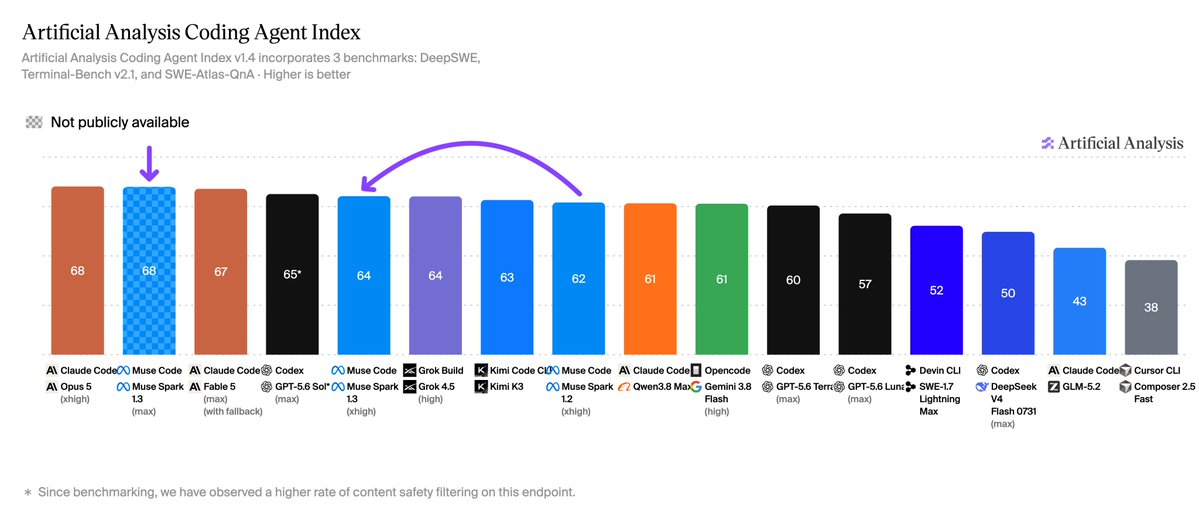
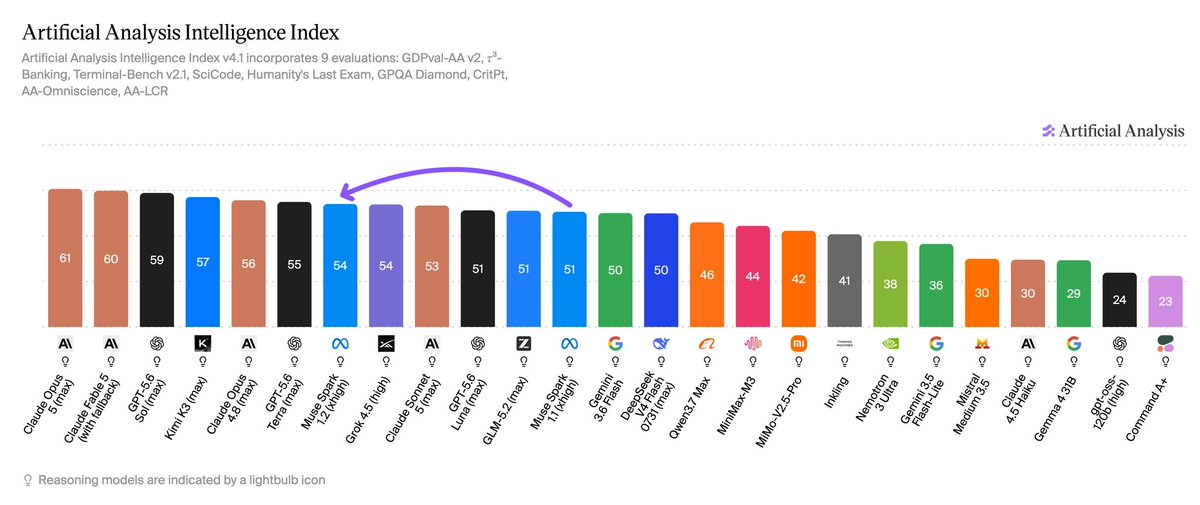
Muse Spark 1.2 places Meta on the Cost per Task Pareto frontier, scoring 6 points below Claude Opus 5 at ~1/6th of the cost At Meta's $1.25/$4.25 per 1M token pricing, Muse Spark 1.2 (xhigh) sits on the Pareto frontier of Intelligence Index vs Cost per Task. It delivers comparable intelligence to Claude Opus 4.8 (max, $2.03) at a fifth of the cost per task, and undercuts GPT-5.6 Sol (high, $0.55), GPT-5.6 Terra (max, $0.61), and Kimi K3 (max, $0.87). The nearest cheaper options are Grok 4.5 (high, $0.36) and GPT-5.6 Sol (medium, $0.37), and they all sit below it on the Index. The step up from Muse Spark 1.1 ($0.29 per task) comes at unchanged per-token pricing, with the increase driven by heavier token usage on agentic tasks.

Context
Meta's Muse Spark 1.2 kept the per- price of version 1.1 but costs more to finish a task, and Artificial Analysis still ranks it among the best-value models. The independent benchmarking firm reports cost per task: what it costs to run a model through the evaluations in its Intelligence Index, based on the tokens the model actually consumes at the provider's listed prices. Muse Spark 1.2 is priced at $1.25 per million input tokens and $4.25 per million output tokens, unchanged from 1.1, yet the firm's launch analysis put it at $0.40 per task against $0.29 for 1.1, about 38% more. The difference is volume: it used roughly 53% more input and 36% more output tokens per task, concentrated in an agentic knowledge-work .
Plot each model's Index score against its cost per task, and the Pareto frontier is the set of models that no other option beats on both at once. In this comparison, Muse Spark 1.2 at its xhigh reasoning setting sits on that line. The cheaper options it names, Grok 4.5 at $0.36 and GPT-5.6 Sol at medium effort at $0.37, score lower. It roughly matches Claude Opus 4.8 at max effort, which costs $2.03 per task, five times as much, and it scores 6 points below Claude Opus 5 at about a sixth of that model's cost. The labels xhigh, high, medium and max are effort settings: the same model allowed to reason longer usually scores higher and costs more, so each setting is plotted separately.
The scores behind that position had just been revised. Hours earlier, Artificial Analysis moved its Index to version 4.1.1, which changed the models that grade several evaluations, and Muse Spark 1.2 gained 2.7 points, more than any other model. At launch the firm had scored it 54 against Claude Opus 5's 61; 54 plus 2.7 is about 57, which matches the six-point gap to Opus 5's revised 63. For agentic workloads, the lesson is to budget by cost per task rather than by the per-token price list: an upgrade at an unchanged price list can raise the bill, and in this case the model stayed on the frontier anyway, with no cheaper option in the comparison scoring higher.
- token — The chunk of text a model reads and writes in — roughly three-quarters of a word — and the unit AI usage is billed in.
- eval — A repeatable test for AI quality — a set of tasks plus scoring — used the way software teams use test suites, because model output is too variable to judge by eyeballing.

Checking sign-in…
Loading comments…