Hill-climbing Inkling 2 Mini inference on one RTX PRO 6000
- Source
- huggingface.co
- Publisher
- Niels Rogge
- Date
Context
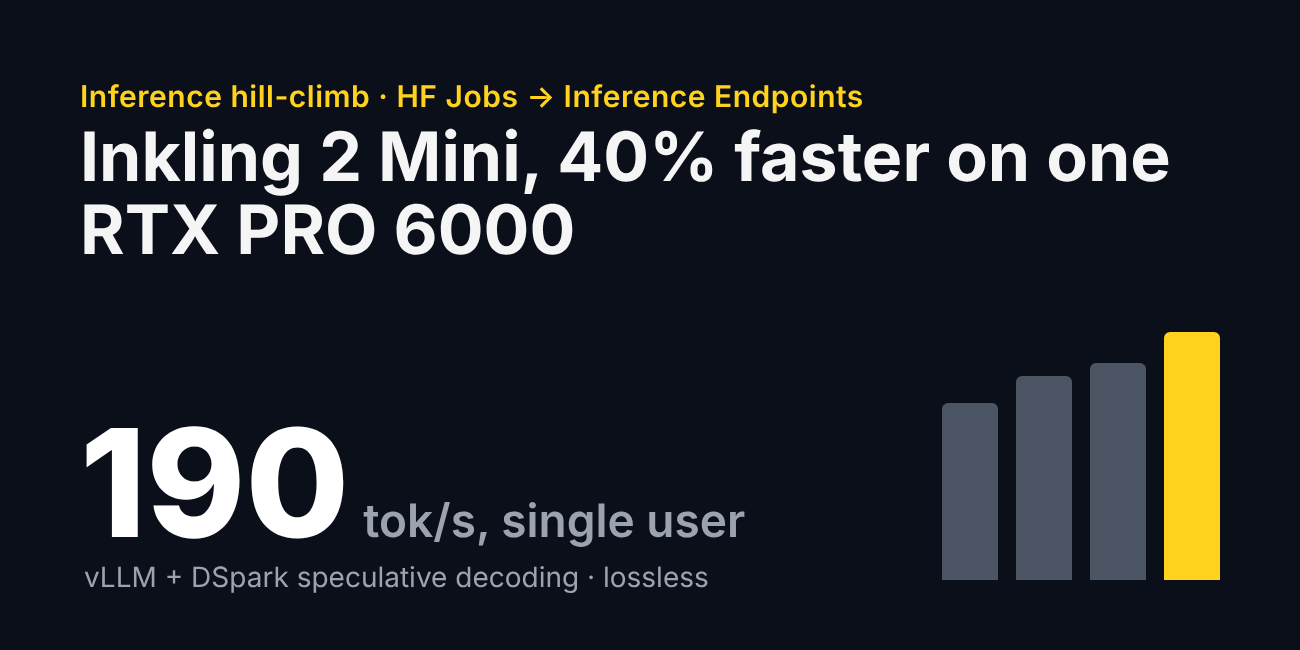
Hugging Face's Niels Rogge reports that a , given a strict experimental routine and an afternoon of cloud GPU jobs, raised single-user generation speed for Thinking Machines' open-weights Inkling 2 Mini on one NVIDIA RTX PRO 6000 96GB card from 136 to 190.6 tokens per second, about 40% faster, and that this is close to the most the card's memory can deliver (Hugging Face). The published serving recipes for the model target NVIDIA's B200 and GB300 data-center GPUs, leaving out this card, which backs a Hugging Face Inference Endpoint at $2.75 an hour. With eight users at once, total throughput rose from about 570 to 716 tokens per second.
The routine mattered as much as the agent. It required measuring the hardware and estimating its theoretical limits first, changing one setting at a time, running every candidate between two control runs and keeping it only if it beat both without making other measurements worse, and logging dead ends. Across 46 valid runs, the gain came from two changes. Switching the serving engine from SGLang to a nightly build of vLLM took speed from 136 to 157 tokens per second. Turning on with DSpark, a small draft model bundled with the checkpoint that guesses several tokens ahead so the main model can check them in one pass and keep the ones it agrees with, added the rest. Because the main model approves every token, outputs at 0 were byte-identical with and without speculation on all six test prompts. The controls caught a false win: SGLang varied by about 4.5% between identical runs, enough to make one flag look like a 4% gain until repeat runs ruled it out.
The ceiling follows from Inkling 2 Mini's looped design. The model stores 24 layers but runs the middle 12 three times, so every token makes 48 layer visits and the card must read about 5.6GB of weights for each token. At the roughly 1,469GB per second the agent measured, that caps plain generation near 256 tokens per second. Speculation changes the arithmetic for a mixture-of-experts model like this one, which normally uses 8 of each layer's 128 experts per token: checking eight positions at once touches about 40% of each layer's experts instead of about 6%. With about 2.3 tokens accepted per step, the post puts the limit near 201 tokens per second, so 190.6 is about 95% of it, and further gains would need a drafter whose guesses are accepted more often or a check that touches fewer experts. To fit beside the drafter, the deployed setup caps at 262,144 tokens rather than the model's 1 million, and it passed retrieval tests at up to about 250,000 tokens.
- Hugging Face had a coding agent tune Inkling 2 Mini on one RTX PRO 6000. Single-user decode rose from about 136 to 190.6 tok/s and 8-user throughput from about 570 to 716 tok/s, from moving to vLLM nightly, enabling DSpark with 7 drafts and two memory flags.
- The bandwidth math explains the ceiling: verifying 8 speculative positions on this MoE reads about 40% of each layer's experts instead of 6%, so at about 2.3 accepted tokens per step the ceiling falls to about 201 tok/s, and 190.6 is roughly 95% of it.
- Draft settings were constrained: both engines reject draft counts below the checkpoint's fixed block size, and greedy draft sampling ran 9 to 11% slower than probabilistic sampling at the model's default temperature of 1.0.
- vLLM's DSpark setup only started on 96 GB after capping --max-model-len at 262144 and setting --gpu-memory-utilization 0.85. The 1M-token KV cache and vLLM v0.34.0's new 1.0 default otherwise left no room for the 5 GiB drafter.
- Repeat controls mattered: across identical speculative runs SGLang varied about ±4.5% while vLLM stayed within 0.4%, enough that one SGLang flag looked like a 4% win until fresh control runs failed to reproduce it.
- Agent mode — A mode in which one agent can inspect, edit, run commands, and iterate toward an outcome.
- speculative decoding — A speed trick where a small model drafts several tokens ahead and the big model verifies them in one pass, often doubling generation speed.
- Sampling controls — Parameters that shape how deterministic or varied model generation becomes.
- Context and context window — Context is the information available for a generation; the context window is the capacity available to hold it.