Ming-Image-0.1-Design tops open-weights image models for UI/UX design
- Source
- Artificial Analysis
- Date

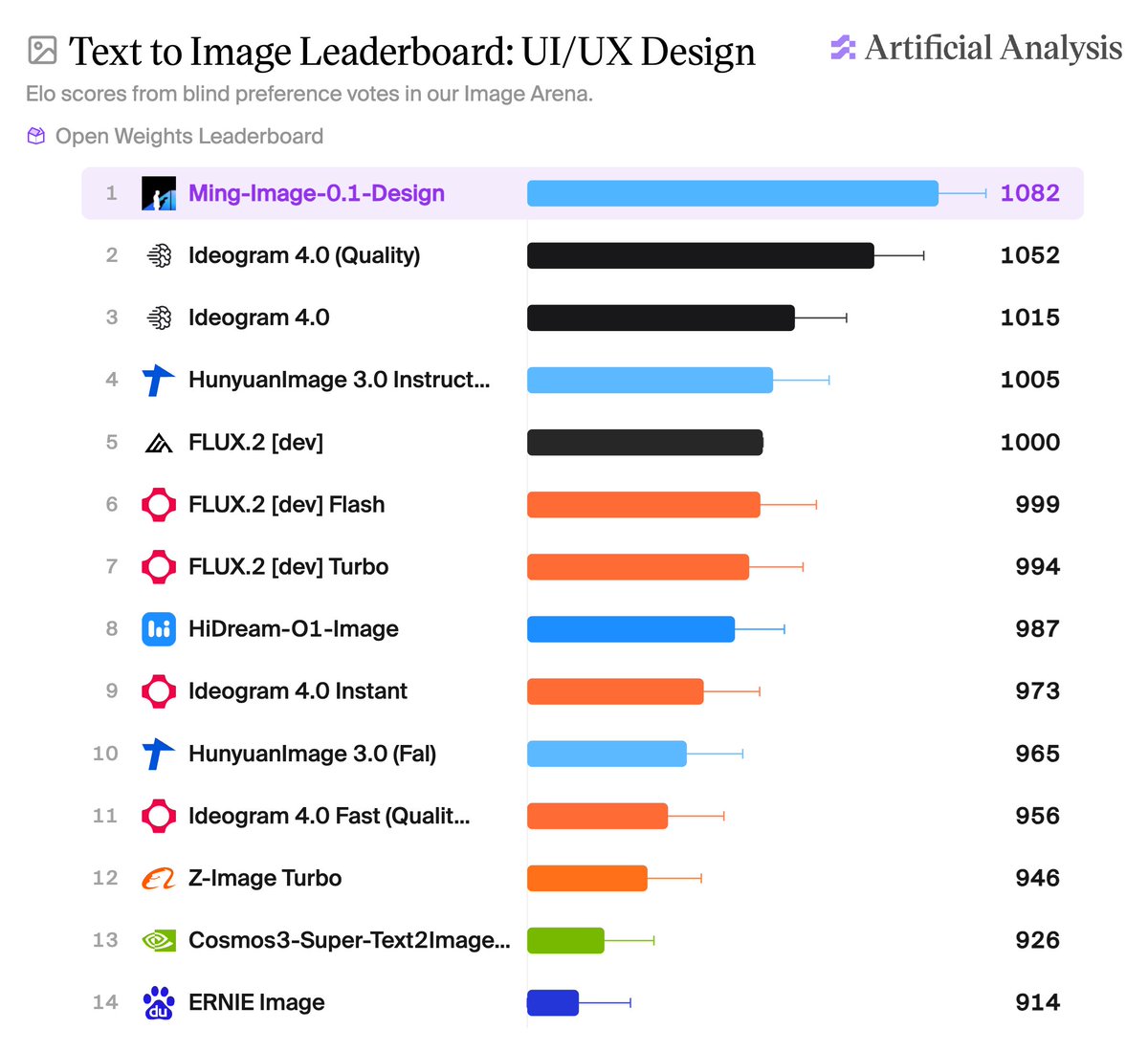
inclusionAI's Ming-Image-0.1-Design is the #1 open weights model for UI/UX Design on the Artificial Analysis Text to Image Leaderboard, ranking #17 amongst all models in the category Ming-Image-0.1-Design is a 6B parameter Text to Image model from inclusionAI, Ant Group's AI initiative. It is built for UI, infographics, posters and other text-rich visual designs, supports RGBA output with transparent backgrounds, and is released with open weights under the MIT licence. We evaluated it at 2K resolution with 12 inference steps, the settings inclusionAI recommends. Ming-Image-0.1-Design stands out in our evaluation of UI/UX design capabilities for Text to Image models. It ranks #17 of 81 models in UI/UX Design, compared with #45 of 160 on the overall Text to Image Leaderboard. Among open weights models, it is the new leading model for UI/UX Design use cases. Congratulations to @AntLingAGI on the release! See below for our analysis and example outputs of Ming-Image-0.1-Design in the Artificial Analysis Image Arena 🧵

Ming-Image-0.1-Design excels at UI/UX Design compared with its overall performance Its UI/UX Design Elo is 88 points above its overall Elo, the largest gap across our 10 Text to Image use cases. Productivity & Knowledge Work is next, at 48 points above. ➤ UI/UX Design covers UI mockups across app, web, in-car and spatial surfaces. ➤ Productivity & Knowledge Work covers diagrams, infographics, charts and slides.
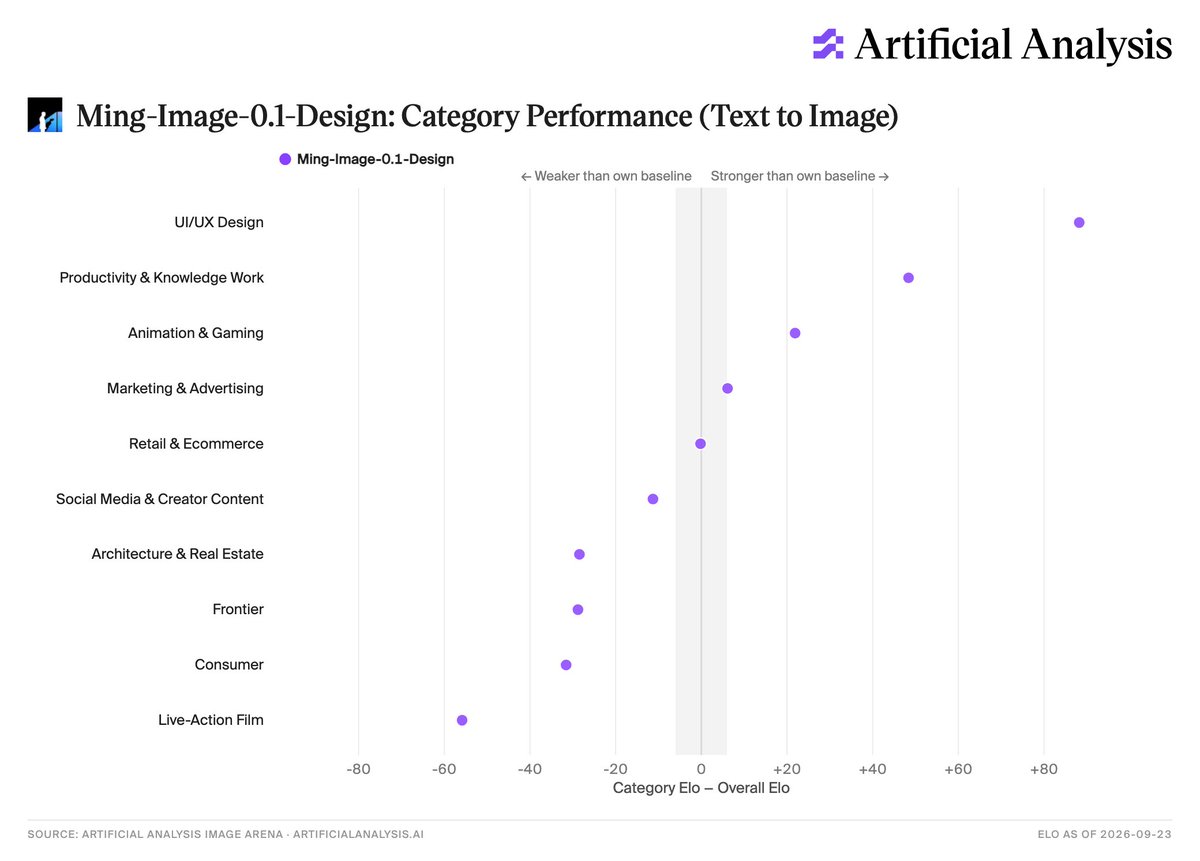
Ming-Image-0.1-Design's standout capability is Layout, where it is the highest ranked open weights model at #19 of 67. Our Text to Image taxonomy measures 9 capabilities, the individual skills that go into making an image. Ming-Image-0.1-Design is also the highest ranked open weights model in Text Rendering, at #23 of 65. ➤ Layout covers flows, arrows, blocks, visual hierarchy and multi-panel compositions. ➤ Text Rendering covers long text, small text, symbols and artistic lettering.


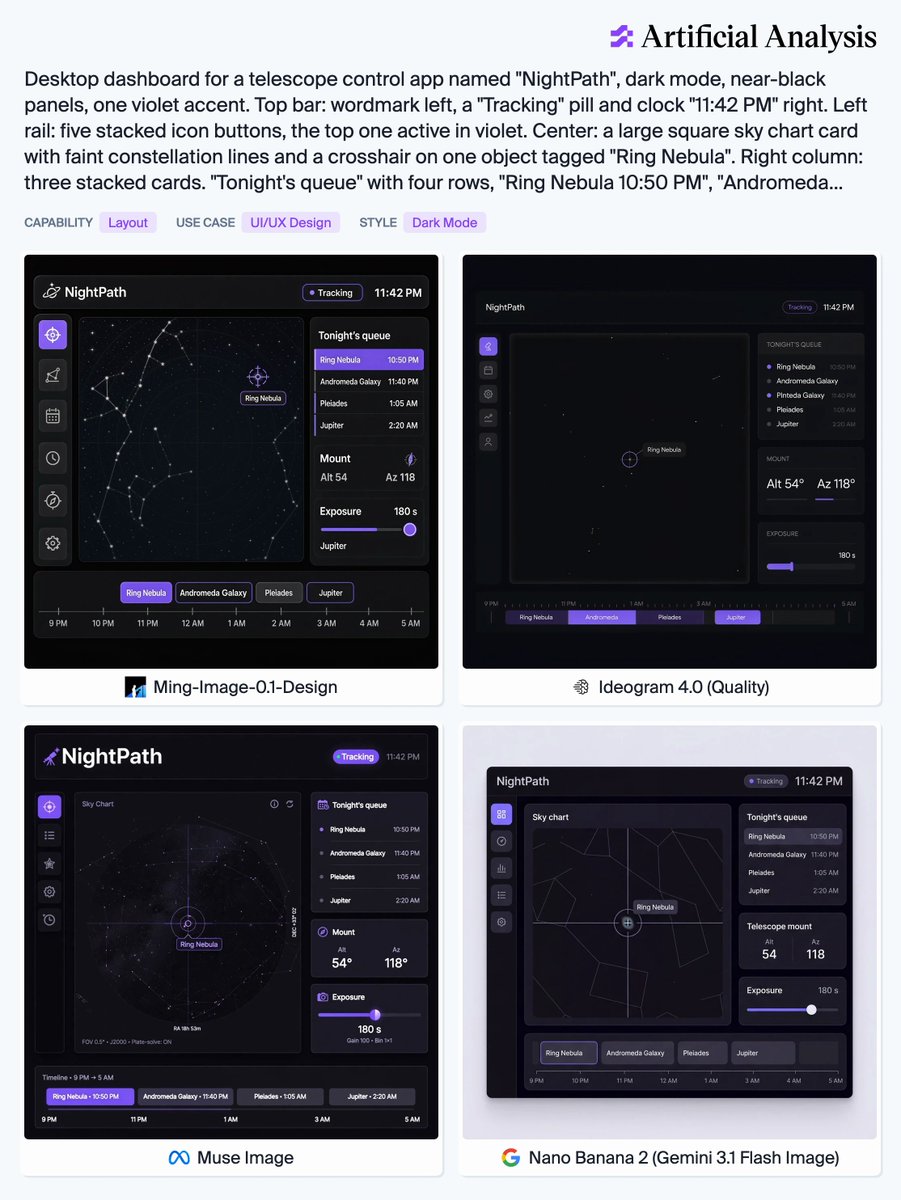
This translates to Ming-Image-0.1-Design's performance in UI/UX Design, from mobile app screens to desktop dashboards. UI/UX Design is the use case where it sits closest to the frontier, followed by Marketing & Advertising and Productivity & Knowledge Work. ➤ Marketing & Advertising covers ad creatives, campaign visuals, posters and brand imagery. ➤ Productivity & Knowledge Work covers diagrams, infographics, charts and slides.


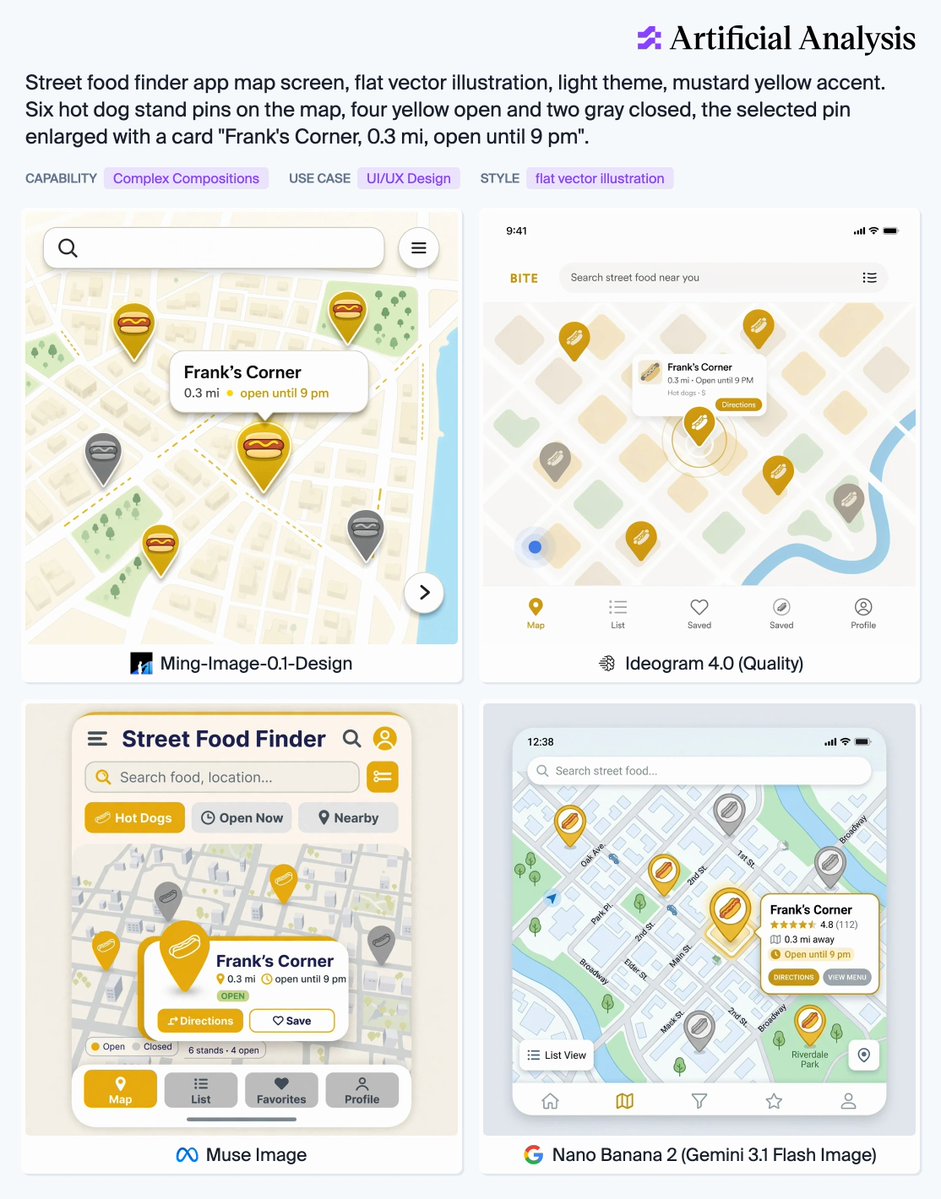
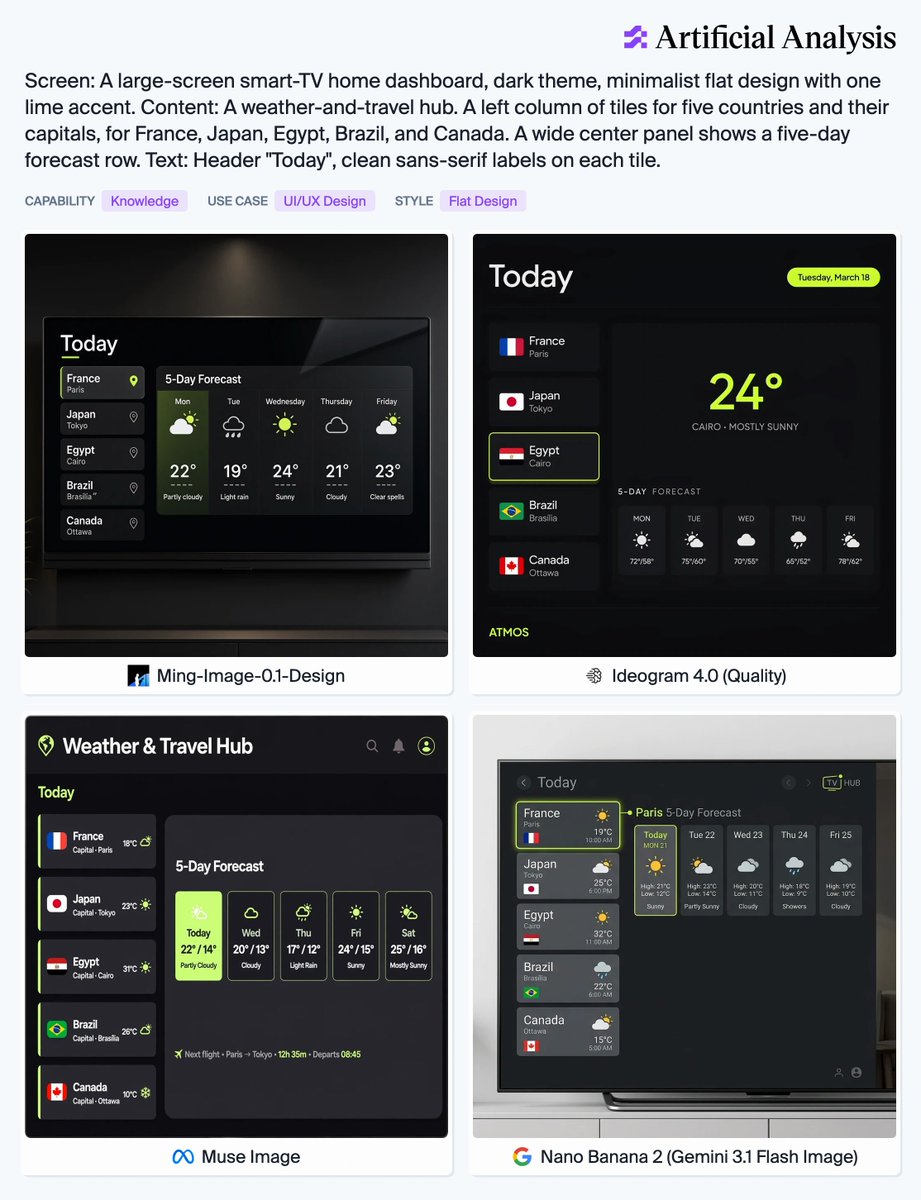
- Ming-Image-0.1-Design is a 6B-parameter text-to-image model from inclusionAI, Ant Group's AI initiative, released with under MIT, built for UI, infographics and posters, and able to output RGBA images with transparent backgrounds.
- Artificial Analysis ranks it #17 of 81 models for UI/UX Design but #45 of 160 overall; its UI/UX Elo sits 88 points above its overall Elo, the largest gap across the 10 use cases measured, followed by Productivity & Knowledge Work at +48.
- Its strongest capability is Layout (flows, arrows, visual hierarchy, multi-panel compositions), where it is the top open-weights model at #19 of 67; it also leads open-weights models in Text Rendering at #23 of 65.
- Artificial Analysis tested it at 2K resolution with 12 steps, the settings inclusionAI recommends.
- open weights — A model whose trained parameters are published for anyone to download and run — unlike API-only models you can access but never possess.
- inference — Running a trained model to get answers — the phase where AI is actually used, as opposed to trained.
Gives builders an MIT-licensed, open-weights image model that specifically leads at generating UI mockups, dashboards, and text-heavy visuals, an area where open models have historically lagged closed ones.
Checking sign-in…
Loading comments…