Ming-3.0-tts Tops Open-Weights TTS on Pronunciation Robustness
- Source
- x.com
- Date

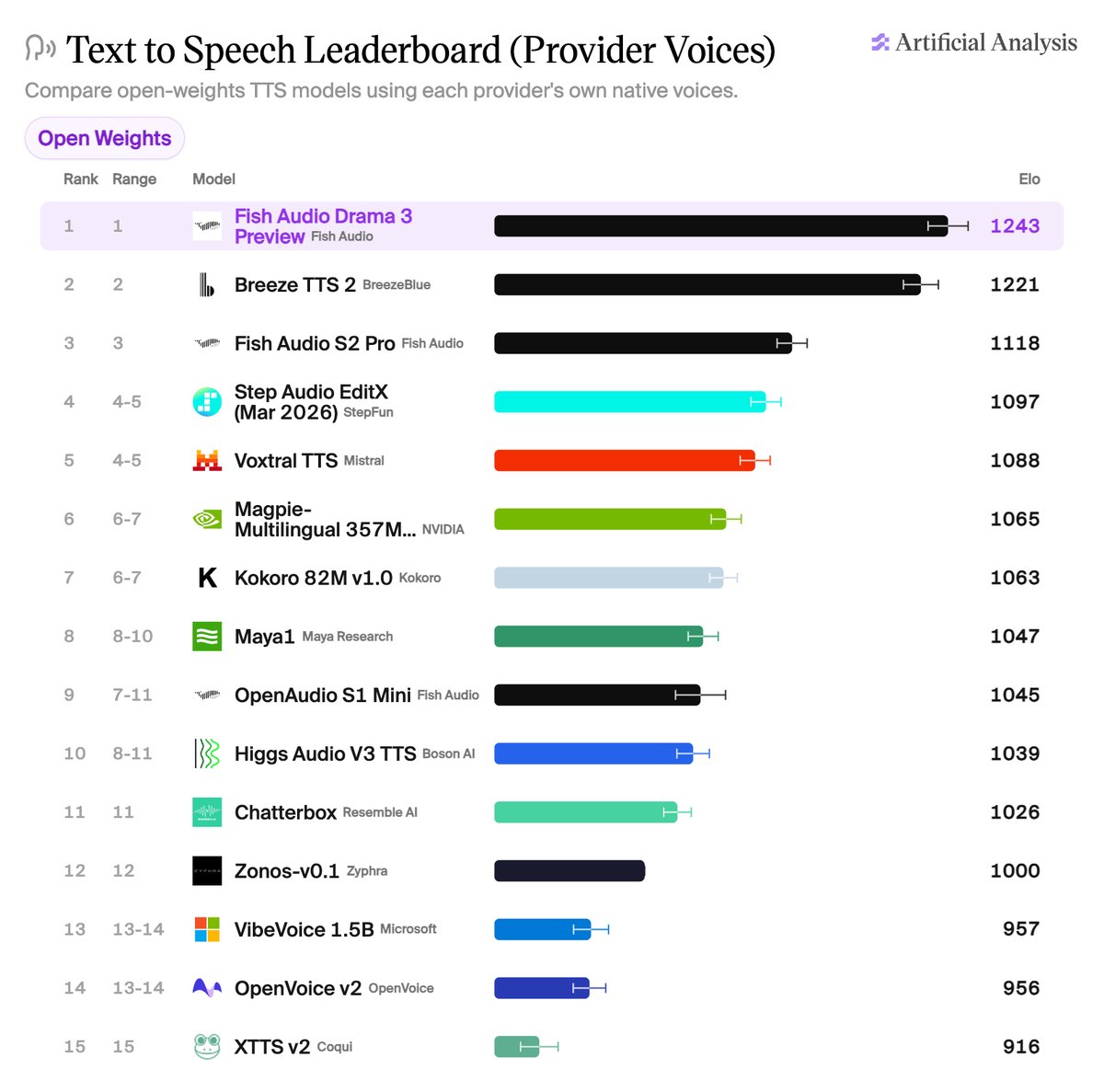
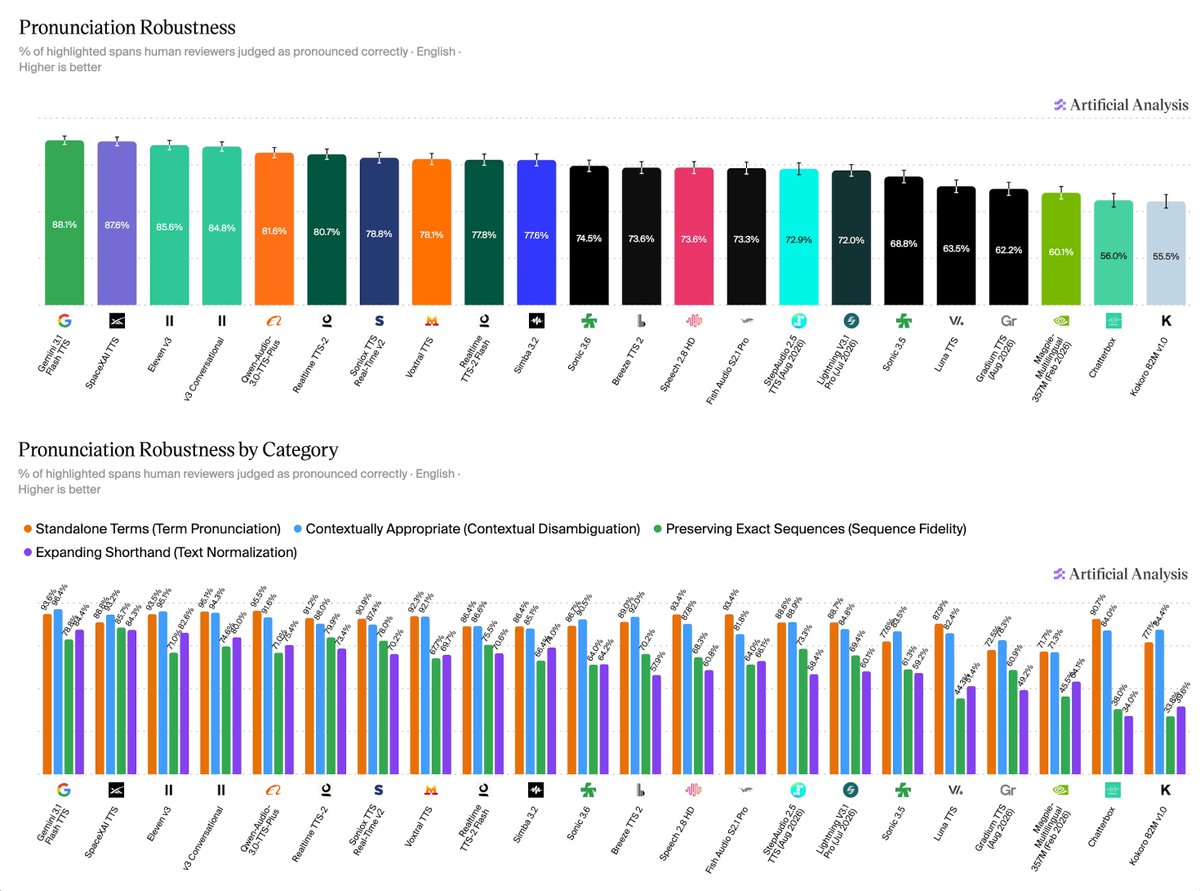
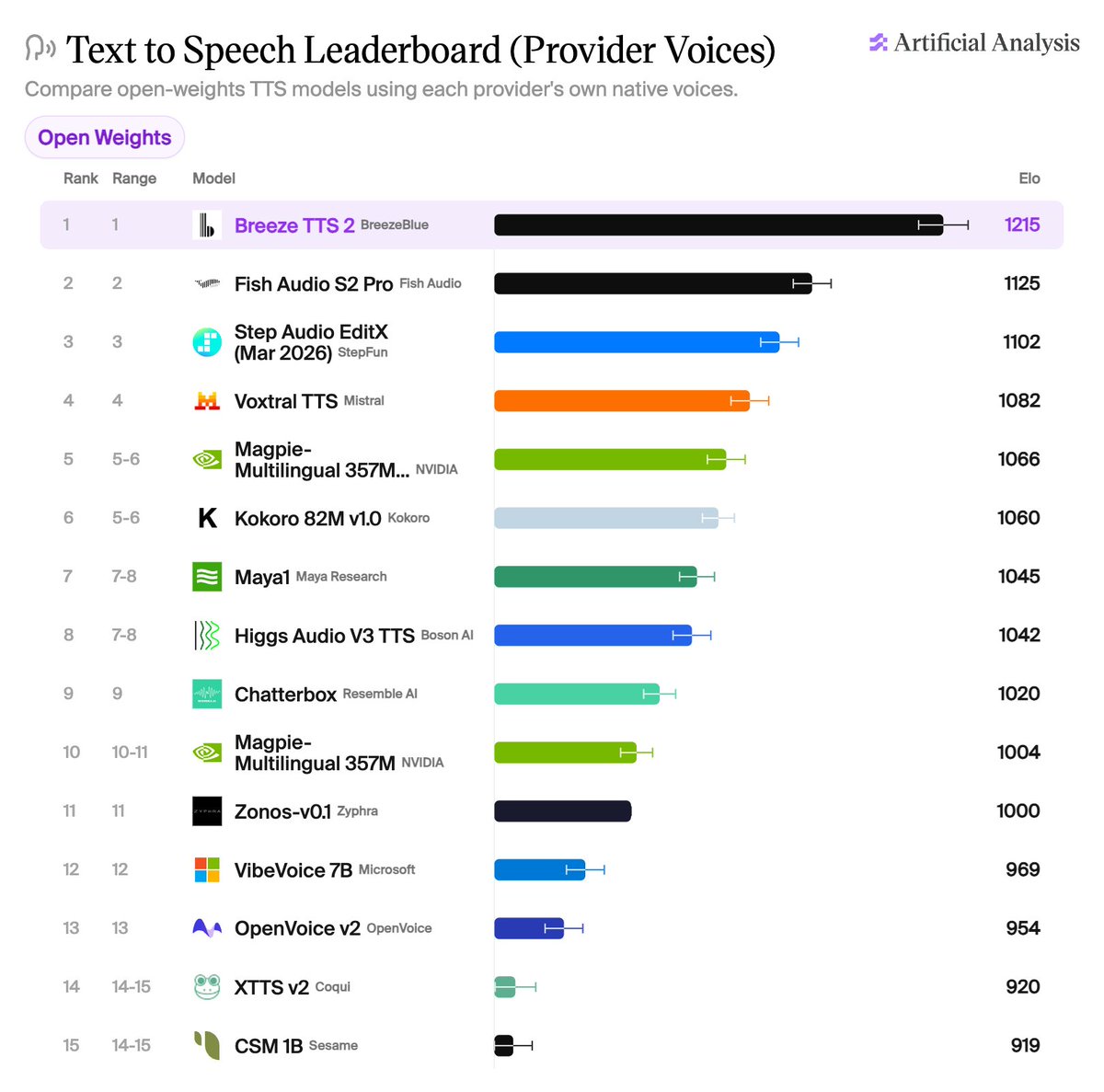
Ant Group's Ming-3.0-tts is the new #1 open weights model in the Artificial Analysis Controlled Voice TTS Arena and takes the #1 spot on our Pronunciation Robustness leaderboard, level with Fish Audio's Drama 3 Preview and ahead of Eleven v4 Ming-3.0-tts is the new open weights Text to Speech model from @AntLingAGI's team, a dense 0.5B parameter model with preset voices and stateless voice cloning. Weights are available on Hugging Face under the MIT License: Ming-3.0-tts-0.5B, alongside a 7.9B mixture-of-experts variant, Ming-3.0-tts-tiny. Key takeaways: ➤ Pronunciation Robustness: Ming-3.0-tts scores 93.2%, ranking #1 of 31 models, level with Fish Audio Drama 3 Preview at 93.2% and ahead of Eleven v4 at 91.7%. It ranks #1 in Expanding Shorthand and Preserving Exact Sequences. ➤ Controlled Voice: Ming-3.0-tts is the #1 open weights model with an Elo of 1,069 (+16/-16) across 1,827 appearances, ahead of Drama 3 Preview at 1,059 and Breeze TTS 2 at 1,019. It ranks #13 overall. ➤ Provider Voice: Ming-3.0-tts has an Elo of 1,188 (+15/-15) across 1,957 appearances, ranking #3 among open weights models behind Drama 3 Preview at 1,245 and Breeze TTS 2 at 1,220, and #19 overall. ➤…

Context
Artificial Analysis reports that Ming-3.0-tts, a text-to-speech model from Ant Group's Ant Ling team, is now the top open-weights model on two of its three text-to-speech leaderboards (Artificial Analysis on X). The model is small, a dense 0.5B-parameter network with preset voices and voice cloning, and its weights are published on Hugging Face under the MIT license, alongside a 7.9B variant. The headline is that a model this size competes with commercial systems, but only on some kinds of test.
Its strongest result is on Pronunciation Robustness, a Artificial Analysis introduced to measure whether speech models pronounce challenging text, such as numbers, codes and names, correctly, complementing its arena rankings of which voices listeners prefer. Ming-3.0-tts scores 93.2% there, first of 31 models, level with Fish Audio's Drama 3 Preview and ahead of ElevenLabs's Eleven v4 at 91.7%. Artificial Analysis also ranks it first in two of the benchmark's categories, which it calls Expanding Shorthand and Preserving Exact Sequences. Drama 3 Preview had taken the lead on this board the week before, so the open-weights top spot is now shared.
The other two boards are Elo rankings of listener preference from Artificial Analysis's arena. On the Controlled Voice board, where every model speaks the same cloned voices so that the comparison reflects the model rather than the choice of voice (Artificial Analysis), Ming-3.0-tts leads open-weights models with an Elo of 1,069, give or take 16, from 1,827 appearances, just ahead of Drama 3 Preview at 1,059, but it ranks 13th overall. On the Provider Voice board it scores 1,188, third among open-weights models behind Drama 3 Preview at 1,245 and Breeze TTS 2 at 1,220, and 19th overall. Listeners still prefer a dozen or more systems, mostly closed ones, over it; what sets it apart is accuracy on hard-to-read text at a very small size.
- mixture-of-experts — A model built from many specialist sub-networks where only a few activate per token, giving big-model capability at small-model running cost.
- benchmark — A standard public test set for comparing AI models — the shared scoreboards behind every "model X beats model Y" claim.
Checking sign-in…
Loading comments…