Independent eval: Gemini 4 Argon vs Opus 5.5 and gpt-6.1-sol
- Source
- x.com
- Publisher
- Siqi Chen
- Date

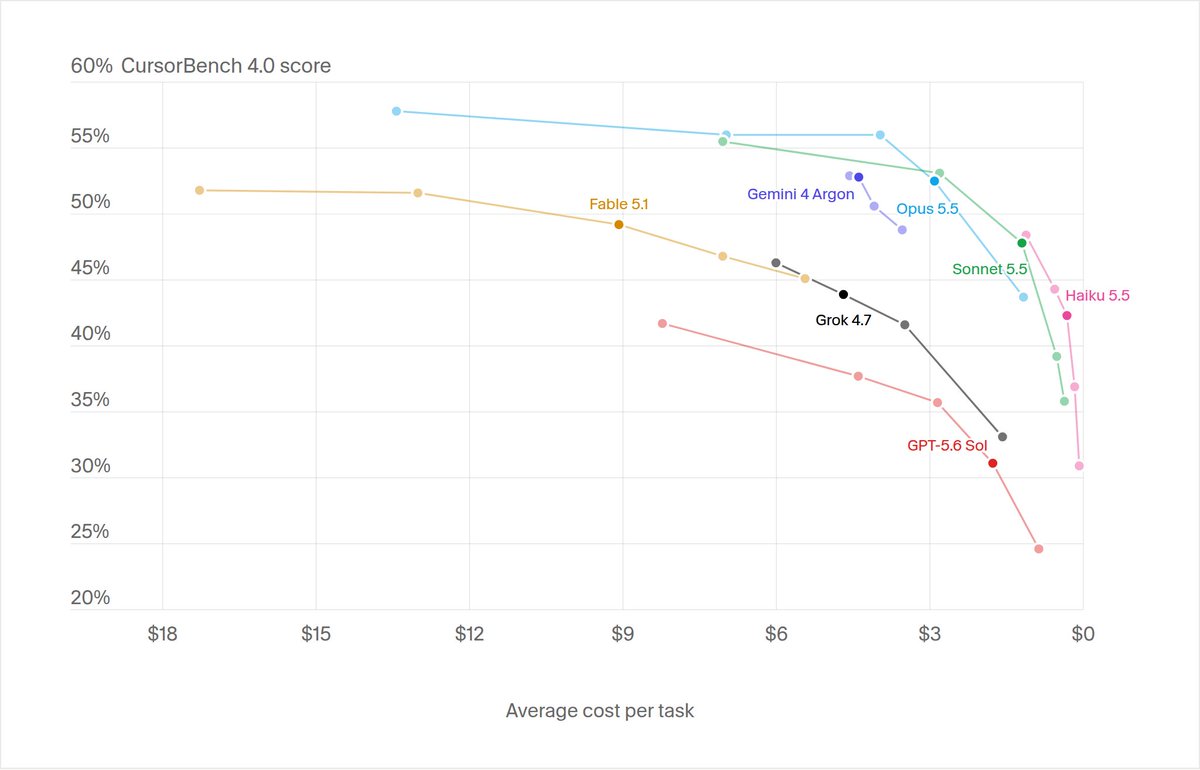
ran gemini 4 argon on the same internal https://t.co/QhA9tU0Lhp evals - comparable to opus 5.5 in terms of cost efficiency (assuming introductory pricing), but 2X slower gpt-6.1-sol still 3x more cost efficient than either (though slower than opus 5.5 in this run) https://t.co/L7Nujsclt5

Context
Siqi Chen reran his internal for cfo.ai, which he describes in a reply as mostly building with "our spreadsheet engine," on Google DeepMind's newly released Gemini 4 Argon (post). The attached table covers eight cases. GPT-6.1 Sol and Opus 5.5 passed all eight and Gemini 4 Argon passed seven; total cost was $3.34, $10.34 and $10.08 respectively, which works out to $0.42, $1.29 and $1.44 per passed case. Those per-case costs are the basis for his summary that Gemini 4 Argon is comparable to Opus 5.5 on cost efficiency and that GPT-6.1 Sol is about three times more cost-efficient than either.
On speed, Gemini 4 Argon's trial took 5,532 seconds of wall-clock time against 2,806 for Opus 5.5, the roughly twofold gap he reports, and 80.8 minutes of model time against 27.7; GPT-6.1 Sol took 3,788 seconds. Chen notes that the comparison assumes Gemini 4 Argon's introductory pricing, which OpenRouter listed at $2 per million input and $10 per million output tokens at launch, so the cost picture can change when that pricing ends. Eight cases from one company's workload, in a single run, are a narrow sample: one more pass or failure would move a model's cost per passed case substantially.
- eval — A repeatable test for AI quality — a set of tasks plus scoring — used the way software teams use test suites, because model output is too variable to judge by eyeballing.
- Model — A computational system that uses learned patterns to produce an output from information supplied to it.
- Token — A piece of text, such as a word, part of a word or a punctuation mark, that a language model represents as numbers and handles as a unit.