What software fundamentals still buy you when the agent writes the code
- Source
- x.com
- Publisher
- Andrew Ng
- Date

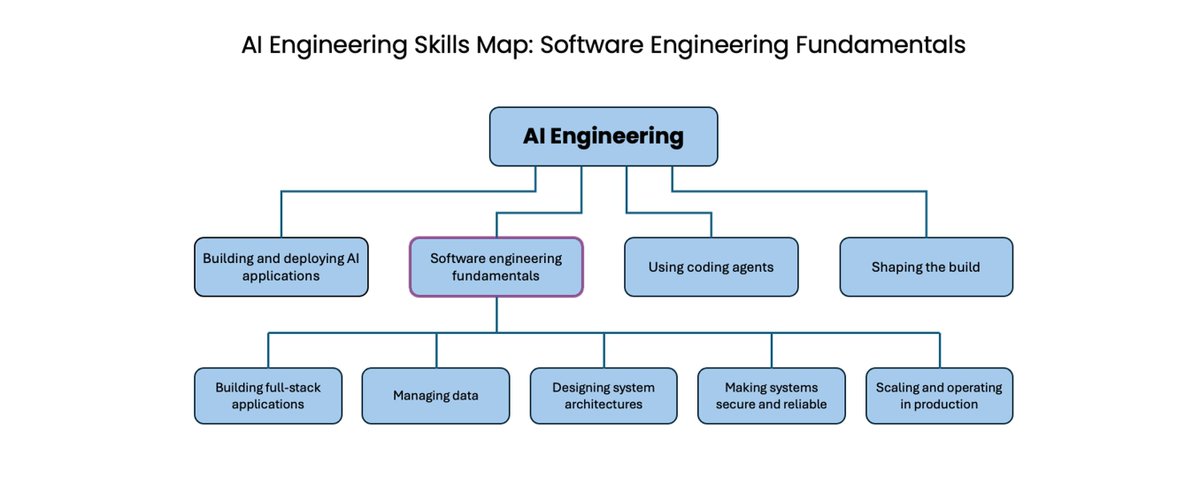
How have software engineering fundamentals changed with agentic coding? Here is our AI Engineering Skills map for software engineering fundamentals. https://t.co/cnRLj43DLs
Context
A can write the code, but in Andrew Ng’s view it will not make the right tradeoffs for an unless the developer knows which tradeoffs exist and steers it. In this August 2026 article, he writes that a novice who vibe codes without software fundamentals can create simple applications, but the agent often makes bad tradeoffs in latency, availability, consistency, reliability, maintainability, simplicity or cost, because the developer did not know those choices were there to make.
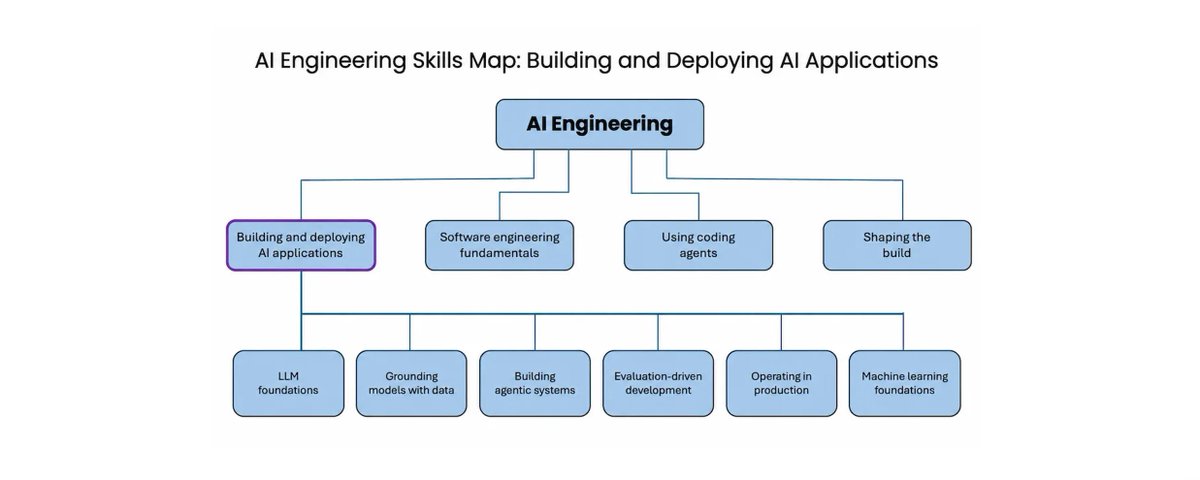
The article covers the software engineering branch of the AI Engineering Skills map he wrote about earlier, and follows his article on building and deploying AI applications, which ended by promising a post on software engineering. He lists five areas: building full-stack applications, managing data, designing system architectures, making systems secure and reliable, and scaling and operating in production.
Data gets special because, he writes, it is a foundation that is relatively hard to change, even when agents help with migrations. Thinking through how the data will be accessed tells you what to store and for how long and which kind of storage fits, and those choices affect speed, scalability, availability, reliability and cost. An AI system also takes its input from that data, so a poorly chosen data architecture leaves the AI not knowing what it doesn’t know. Ng concludes that memorizing syntax is becoming obsolete but that developers who deeply understand how software works vastly outperform those who vibe code without that understanding. He attributes the list to his team’s study of AI engineering skills, but the article does not present that study’s data.
- Agent mode — A mode in which one agent can inspect, edit, run commands, and iterate toward an outcome.
- Application — Software arranged so that a person can use it; in this course, the software around a model that accepts your request, prepares the context and shows the reply.
- attention — The mechanism that lets a model weigh which earlier words matter for the word it's currently processing — the core operation of a transformer.
- Context and context window — Context is the information available for a generation; the context window is the capacity available to hold it.