Artificial Analysis Decision Index benchmarks classifier-style models
- Source
- x.com
- Publisher
- Artificial Analysis
- Date

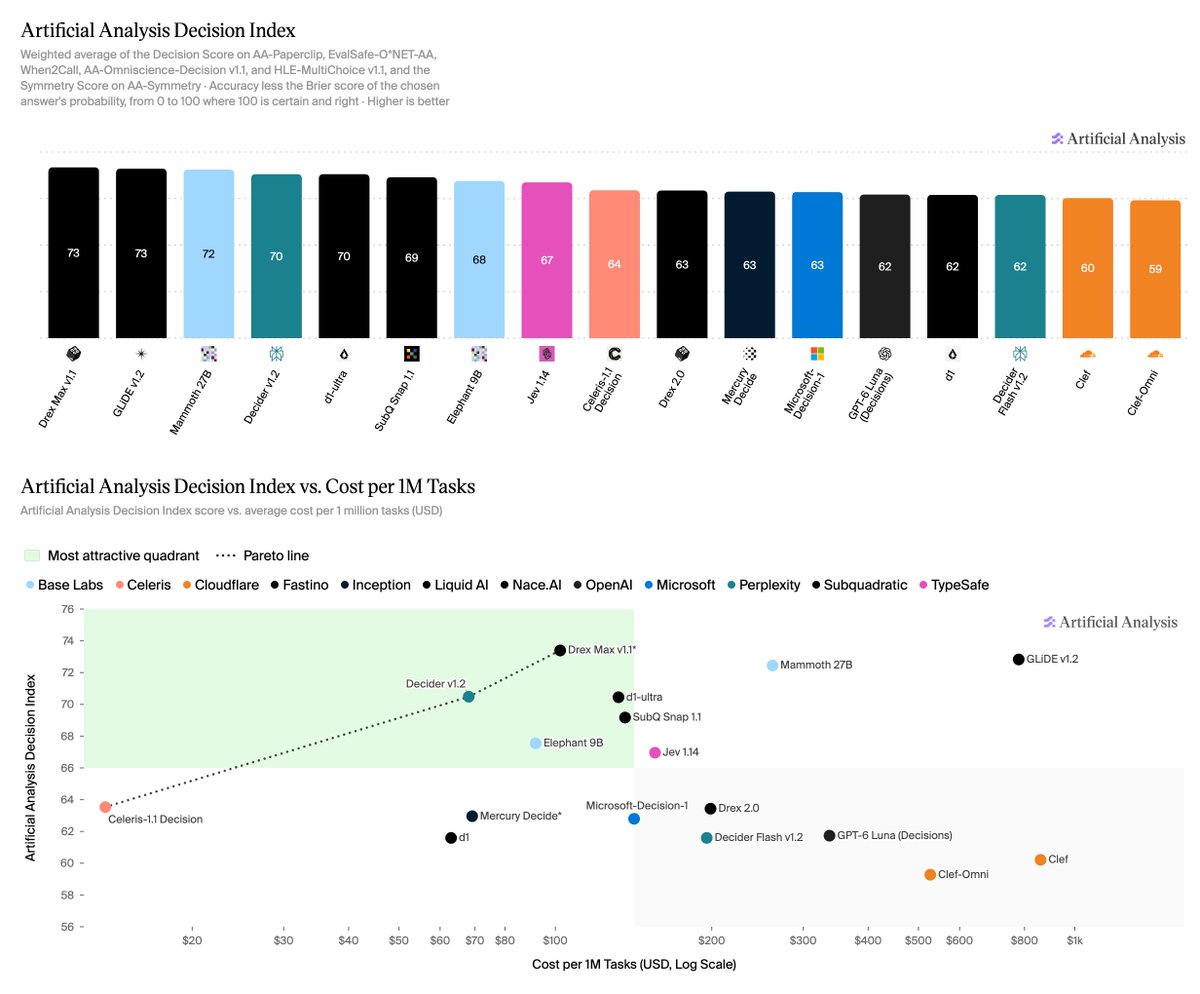
Introducing the Artificial Analysis Decision Index, benchmarking decision models across classification, tool calling, knowledge and reasoning. Jev leads among decision models; language models such as Claude Haiku 5.5 still deliver higher accuracy, but at much higher cost and latency Decision models deliver structured answers or classifications with associated probabilities, offering faster responses and lower costs than using language models. The Artificial Analysis Decision Index v1.0 compares the capability, cost, and speed of decision models and also compares to language models. Benchmarks in the Artificial Analysis Decision Index v1.0: ➤ AA-Omniscience-Decision: A private dataset of 500 questions adapted from the proprietary AA-Omniscience benchmark, measuring decision models’ knowledge and tendency to hallucinate ➤ HLE-MultiChoice: 513 text-only multiple-choice questions from Humanity’s Last Exam, testing decision models’ reasoning capabilities ➤ When2Call: A tool-calling benchmark from NVIDIA, testing whether models can correctly decide to call a tool, request clarification, decline to answer, or respond directly, evaluating capabilities relevant to agentic workflows…

Context
A decision model does not write free-form text. It picks an answer or classification and attaches a probability to it, which makes it faster and cheaper to run than a for jobs like sorting requests or deciding whether to call a tool. Artificial Analysis's new Decision Index measures how much capability that trade gives up, using four tests that cover safety classification, tool-calling decisions, factual knowledge and multiple-choice reasoning. TypeSafe's Jev 1.13 led the decision models with a score of 58. Three days later, Artificial Analysis reported that Liquid AI's d1-ultra had taken first place (later coverage). For comparison, Anthropic's Claude Haiku 5.5, a language model tested in its Low configuration, scored 61, but it took 1.4 seconds per task against Jev's 0.13 and cost $184 per million tasks against $42.
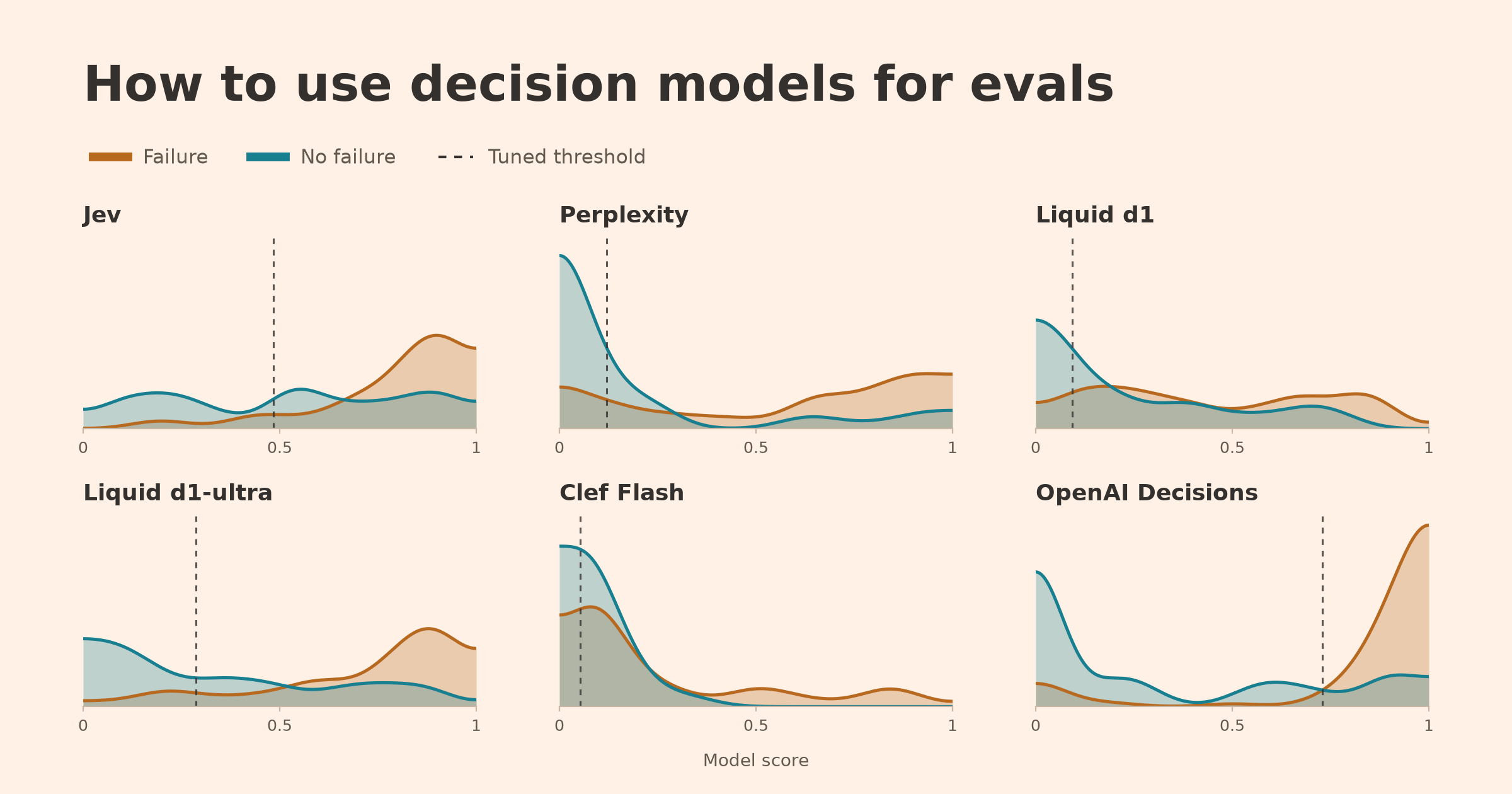
The combined score hides where the gap sits. Artificial Analysis reports that leading decision models perform comparably to language models on classification and , while language models substantially outperform them on knowledge and reasoning. The models' probabilities split the same way. A well- model that gives an answer 80% probability is right about 80% of the time. On the knowledge and reasoning tests, accuracy fell below the stated probability at almost every level for every decision model, while most were relatively well calibrated on classification and tool calling. That makes decision models a cheap fit for sorting and routing, where both their answers and their confidence held up in these tests, and a poor substitute for a language model when the task depends on what the model knows or how it reasons.
- Large language model — A model trained on large amounts of data to process and generate language.
- tool use — A model's ability to call external functions — run code, search the web, edit files — instead of only generating text.
- calibration — How well a model's confidence matches reality — a calibrated model saying "90% sure" is right about 90% of the time.
- Latency — The time between asking for a result and having it, including the model's generation time, tool calls, retries and any queueing.