Liquid AI d1-ultra tops the Artificial Analysis Decision Index
- Source
- x.com
- Date

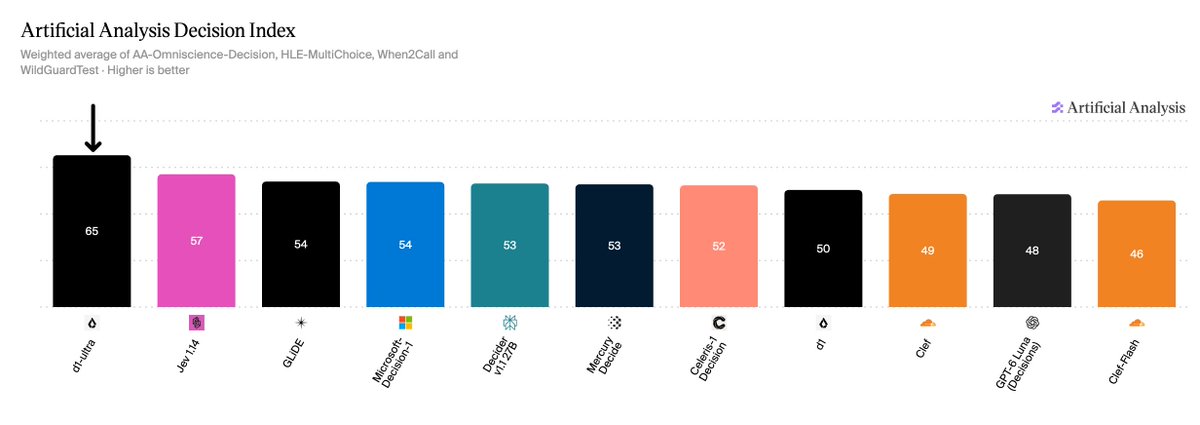
Liquid AI has released d1-ultra, taking the #1 position on the Artificial Analysis Decision Index v1.0, supported by a reduction in hallucinations d1-ultra is the new decision model from @liquidai and follows on from their release of d1 earlier this month. It is priced at $0.042 per 1M input tokens compared to $0.02 per 1M input tokens for d1. Like d1, d1-ultra is billed only on input tokens. Key takeaways: ➤ d1-ultra leads the Artificial Analysis Decision Index v1.0 with a score of 65: d1-ultra scores 65, ahead of the recently released Jev 1.14 at 57 and GLiDE and Microsoft-Decision-1 at 54 ➤ d1-ultra’s score of 65 is driven by a much lower hallucination rate on AA-Omniscience-Decision: d1-ultra’s non-hallucination rate on AA-Omniscience-Decision is 85%, up substantially compared to d1 at 2%. The non-hallucination rate is the share of questions not answered correctly where the model chose "I don't know" and measures how well a decision model can judge its own knowledge in knowing when not to answer. While d1-ultra’s hallucination rate decreases, so does its accuracy (% questions correct). It achieves an accuracy of 32%, down 9 points compared to d1 (41%) ➤ d1-ultra has the third lowest Time per Task of any decision model: d1-ultra achieves a Time per Task of 92 ms, the third lowest of decision models measured, behind Jev 1.14 at 78 ms per task and Celeris-1 Decision at 63 ms per task ➤ d1-ultra offers comparable pricing to other decision models at $32 per 1M tasks: At $32 per 1M tasks, d1-ultra is comparably priced to Celeris-1 Decision ($32 per 1M tasks) and Microsoft-Decision-1 ($31 per 1M tasks), more than double the price of d1 and Mercury Decide at $15 per 1M tasks but less than half the price of GPT-6 Luna (Decisions) at $79 per 1M tasks
d1-ultra achieves the highest non-hallucination rate on AA-Omniscience-Decision at 85%, more than double the second-highest rate of 40% by Microsoft-Decision-1. Abstaining more compared to d1 leads to a lower accuracy of 32% compared to d1’s 41%.

d1-ultra leads When2Call at 93% accuracy, achieves equal first place with GLiDE on WildGuardTest with an average F1 of 95%, and equal second place with Decider V1.1 27B on HLE-MultiChoice with an accuracy of 15%.

d1-ultra achieves a time per task of 93 ms per task and at $32 per 1M tasks is comparably priced to Celeris-1 Decision ($32 per 1M tasks) and Microsoft-Decision-1 ($31 per 1M tasks).

Liquid AI's d1-ultra scores 65 on the Decision Index with an 85% non- rate, but accuracy drops to 32% from 41%. Engineers routing or classifying with cheap decision models can weigh against accuracy at $32 per 1M tasks.
- Artificial Analysis ranks d1-ultra first on Decision Index v1.0 at 65, ahead of Jev 1.14 (57) and GLiDE and Microsoft-Decision-1 (54), with the lead driven mainly by fewer hallucinations.
- Of the questions d1-ultra does not answer correctly, it says "I don't know" on 85%, versus 2% for the earlier d1 and 40% for the next-best model, but its accuracy falls to 32% from d1's 41% because it abstains more.
- At about 92 ms per task and $32 per 1M tasks, d1-ultra is priced like Celeris-1 Decision and Microsoft-Decision-1, more than double d1 and Mercury Decide ($15), and under half of GPT-6 Luna Decisions ($79).
- Beyond the index, Artificial Analysis reports d1-ultra leads When2Call at 93% accuracy, ties GLiDE on WildGuardTest at 95% average F1, and ties for second on HLE-MultiChoice at 15%.
- hallucination — When a model states something false with full confidence — inventing facts, citations, or APIs that don't exist.
- calibration — How well a model's confidence matches reality — a calibrated model saying "90% sure" is right about 90% of the time.

Checking sign-in…
Loading comments…