CL-bench: frontier models solve just 17.2% of in-context tasks
- Source
- x.com
- Date

New Research & Open Source: We are releasing CL-bench, a systematic benchmark to advance Context Learning. To deliver real-world utility, LMs must transition from static parameter memorization to dynamic reasoning within complex contexts. Addressing this challenge, Tencent HY and Fudan University have jointly released a new paper, "CL-bench: A Benchmark for Context Learning". This is the first research output from Vinces Yao (@ShunyuYao12)’s team since he joined Tencent. This release also signals the official launch of the Tencent HY Research, a blog dedicated to sharing our frontier insights and innovations. 🌐 Project Page: https://t.co/B3x5nZgnGE 📖 Blog:


Why CL-bench? Most benchmarks test what a model remembers, but real-world high-value tasks like coding in massive private repositories or real-time financial analysis demand what a model can learn on the fly. We define this as "Context Learning". This is the ability to leverage new knowledge beyond pre-training. While humans learn from context naturally, even frontier models show significant gaps. CL-bench shifts the focus toward how models reason and resolve tasks using information provided in-context.
To bridge the gap between benchmarks and reality, CL-bench features: -500 complex contexts & 1,899 expert-curated tasks. -31,000+ rigorous validation rules. -Pure Contextual Reasoning: Tasks require models to apply new knowledge NOT found in pre-training but provided exclusively within the context. Our evaluations of ten frontier models find that models solve only 17.2% of tasks on average, revealing that LMs have yet to achieve effective context learning, which poses a critical bottleneck for tackling real-world, complex context-dependent tasks.
Our goal is to move LMs beyond leaderboard chasing toward true utility. By open-sourcing CL-bench, we aim to enable the community to make LMs more intelligent and advancing their deployment in real-world scenarios.
Context
CL-bench tests whether models can apply unfamiliar information supplied with a task. Announced by Tencent with Fudan University, it includes 1,899 tasks built around 500 contexts containing new rules, procedures or specialized knowledge, checked by more than 31,000 rubrics. Paper.
The researchers report an average solve rate of 17.2% across ten evaluated models. A task counts as solved only when a model-based verifier finds that the answer passes every associated rubric. The figure therefore measures strict, complete success on this , not the fraction of individual facts a model gets right. Evaluation method and results.
- benchmark — A standard public test set for comparing AI models — the shared scoreboards behind every "model X beats model Y" claim.
- eval — A repeatable test for AI quality — a set of tasks plus scoring — used the way software teams use test suites, because model output is too variable to judge by eyeballing.
- context window — The maximum amount of text a model can consider at once — its working memory for the current conversation or task.
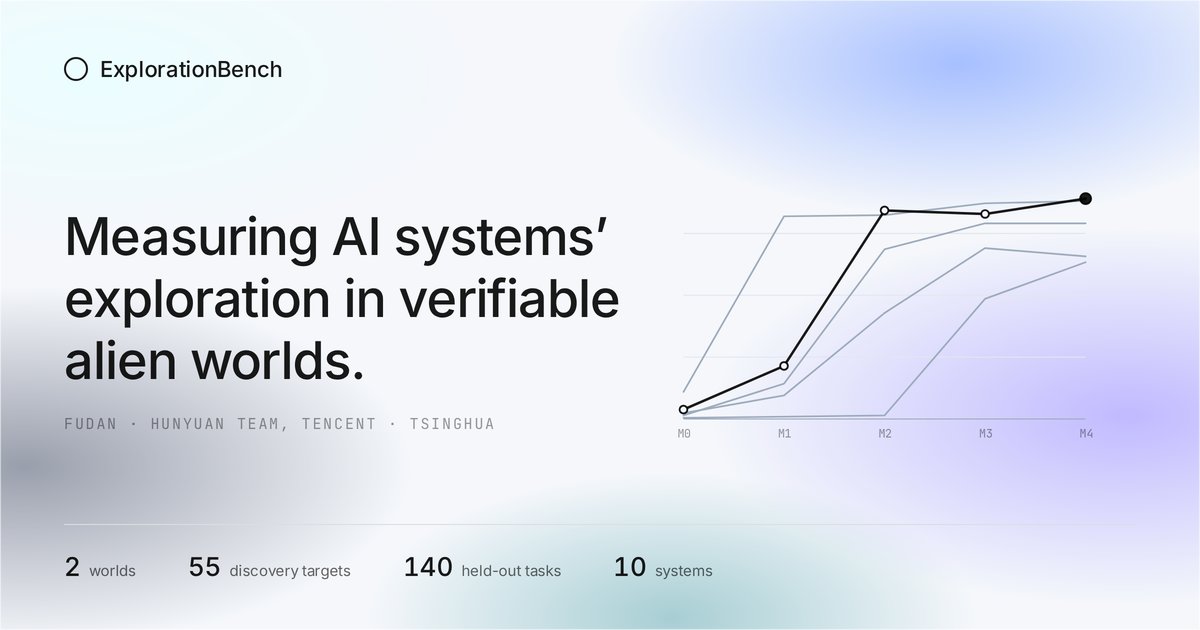 articleExplorationBench: Feedback and Self-Designed Probes Drive Agent Discovery
 postHy Image3.5 preview is live. 🚀 Professional-grade image generation, +30% win…
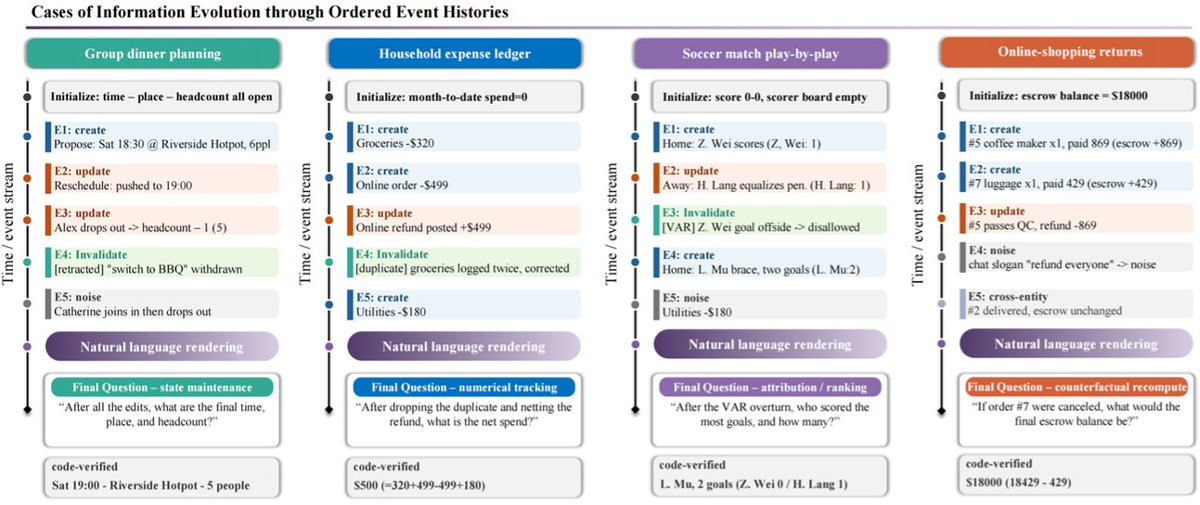 postTencent Hunyuan's EvolveScaler trips up frontier models on evolving facts
 postTencent Hunyuan open-sources AuK, a unified speech generation and editing model
 postTencent opens Hy3: 256K context, 40% cheaper inference, agent-tunedTencent 腾讯
 postPlanningBench puts LLM planning under automated verificationTencent Hy
 articleEvalDetectBench: A Benchmark for Measuring Evaluation Awareness in Frontier Language ModelsXinning Li, Kemunto Ochwang'i, Aryasomayajula Ram Bharadwaj, Alexandra Souly, Robert Kirk
Checking sign-in…
Loading comments…