PlanningBench: verifiable planning tests where whole-plan success lags
- Source
- arxiv.org
- Author
- Tencent Hy
- Date
Context
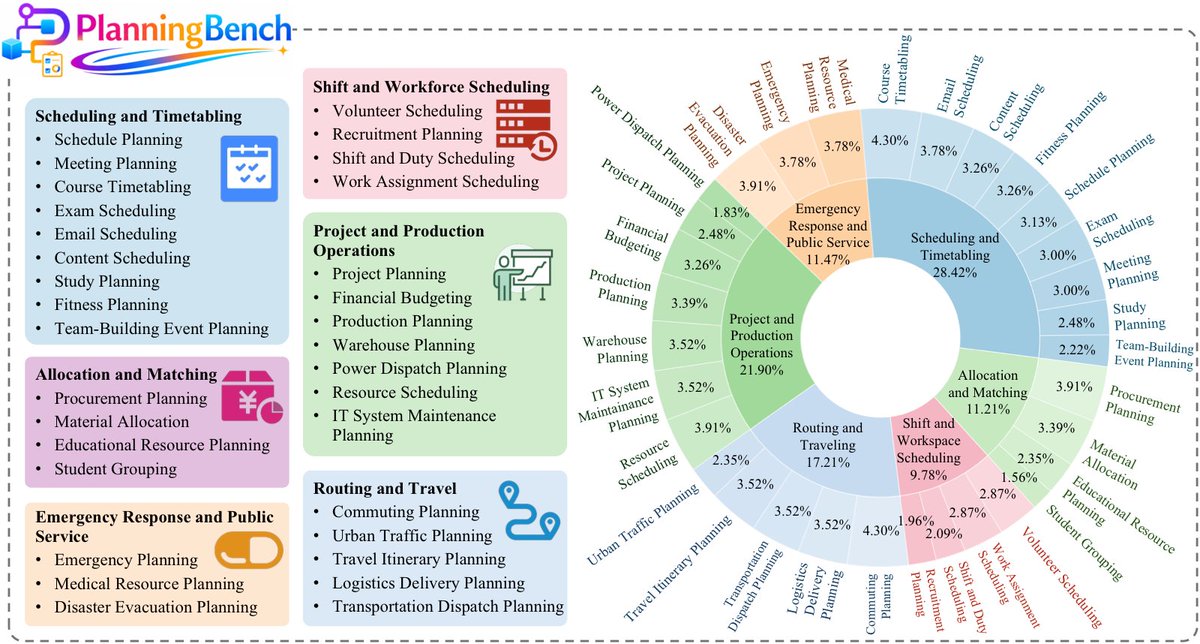
PlanningBench, from Tencent's Hunyuan team and Renmin University's Gaoling School of , asks whether a can produce a plan that is right as a whole, not just mostly right. Each problem is a self-contained text task, such as a timetable, a resource allocation or a route, that comes with a verification checklist covering its constraints, output conditions and objectives. The paper scores models two ways. All-pass counts a response only if it satisfies every checklist item. Avg-pass gives partial credit for the share of items satisfied. The gap between the two is the finding.
On the 467-instance evaluation set, with GPT-oss-120b judging each output against its checklist, the strongest model the authors tested, GPT-5.4-xhigh, satisfied 92.35% of checklist items on average but fully solved only 63.17% of problems. GPT-5.4-medium reached 90.03% Avg-pass yet only 58.09% All-pass, and Seed-2.0-pro-high 84.02% against 44.33%. The authors read this as models getting most local requirements right while a few critical errors break the plan. Their error analysis points the same way. Wrong calculations or assignments account for 60.9% to 83.5% of semantic errors across models, while format and structure problems account for only 0.7% to 3.4%.
The problems are generated rather than collected. A taxonomy of six planning families and more than 30 task types feeds a loop in which a Generator writes a problem, a Responder tries it, and a Critic checks the answer. Whenever the Responder fully solves a problem, the pipeline shifts toward harder constraints. Twenty annotators then audit the output, and in the audited batch 86.15% of samples needed no revision or only minor revision. The GitHub release contains only the 467 evaluation instances and says they should be treated as test data. The paper's training experiments, in which reinforcement learning on 300 separate PlanningBench instances improved results on outside planning benchmarks, used data that is not part of this release.
- Artificial intelligence — Computing concerned with abilities such as recognizing patterns, interpreting language and making decisions.
- Large language model — A model trained on large amounts of data to process and generate language.
- Constraint — A requirement a setup must meet regardless of how well it performs otherwise, such as where documents may be sent or a date by which the work must be done.
- Instruction — A statement in the context that tells the model how to behave or what to do; module 3's first layer.


 articleCL-bench: frontier models solve 17.2% of context-learning tasksTencent Hy
 articleTREK: A Travel Reasoning and Evaluation Kit for LLM Agents in Complex Trip PlanningJinhu Qi, Wentao Zhang, Siu Man Ng, Feiyang Xu, Yanyu Chen, Yaoman Li, Irwin King
 articleWhen Planning Problems Become Hard for LLMs: Separating Structural Complexity from Semantic InterpretabilityMayukh Debnath, Adeyinka Adedigba, Rammohan Mallipeddi