Inside GLM-5V-Turbo: dual-teacher vision distillation and 30-task RL
- Source
- x.com
- Date

GLM-5V-Turbo Tech Report: Toward a Native Foundation Model for Multimodal Agents This report summarizes the main improvements behind GLM-5V-Turbo across model design, multimodal training, reinforcement learning, toolchain expansion, and integration with agent frameworks. These developments lead to strong performance in multimodal coding, visual tool use, and framework-based agentic tasks. https://t.co/5mCu2VHZlI
On the agentic side: Toolchain expansion and framework integration - The model chains multimodal tools, including search, cropping, annotation, and web reading, within a perception, planning, and execution loop. GLM-5V-Turbo then integrates with Claude Code and OpenClaw as a vision-language controller, bridging high-level reasoning with browser and file system execution. Multimodal deep research and content creation - Autonomous cycles of planning, multimodal reading, and synthesis across heterogeneous sources. Extracts textual and visual evidence in tandem, then produces structured outputs: interleaved reports, slide decks, and document-style write-ups.
We also introduced a new benchmark for "think with image, deep search with image." Models must crop, magnify, and re-examine image regions through multi-step tool calls, not parametric recall. https://t.co/v3t9pYwcmZ
What we learned by building GLM-5V-Turbo: 1. Perception remains foundational. Many high-level failures begin with the model not seeing accurately enough. 2. Hierarchical optimization works better than monolithic end-to-end training. Distributed optimization across perception, single-step actions, and trajectory planning yields more stable agentic capability. 3. End-to-end agent tasks need clear specification, reliable verification, and controlled evaluation. Without these, realistic settings are too open-ended to produce reusable optimization signals.
Context
Z.ai's GLM-5V-Turbo report treats visual perception as a foundation for agents that act on images, documents and interfaces. Its CogViT vision component learns from two teacher models: SigLIP2 supplies representations of image meaning, while DINOv3 supplies texture features. In the first training stage it learns to reconstruct those teachers' features for masked, hidden image regions, followed by contrastive . The technical report describes this sequence.
The wider model then undergoes joint reinforcement learning across more than 30 task categories spanning perception, reasoning and agentic capabilities. Z.ai's announcement thread states the design argument: many high-level failures begin with the model not seeing accurately enough, so perception is treated as foundational. The thread presents this as the team's own lesson, not an independently tested result.
- pretraining — The first, biggest phase of building a model: training it on enormous amounts of text so it learns language, facts, and reasoning in general.
- distillation — Training a small, cheap model to imitate a big one's outputs, keeping much of the capability at a fraction of the cost.
- multimodal — A model that works with more than text — reading images, audio, or video, and sometimes generating them too.
- benchmark — A standard public test set for comparing AI models — the shared scoreboards behind every "model X beats model Y" claim.
 postWe’re sharing how GLM-5.3 helped build and optimize the inference infrastructure serving GLM-5.3-Flash.
- postGLM-5 lands in Zhipu's Coding Plan Pro as pricing shifts
 articleZ.ai details GLM-5.3's leap in exploit analysis and staged release
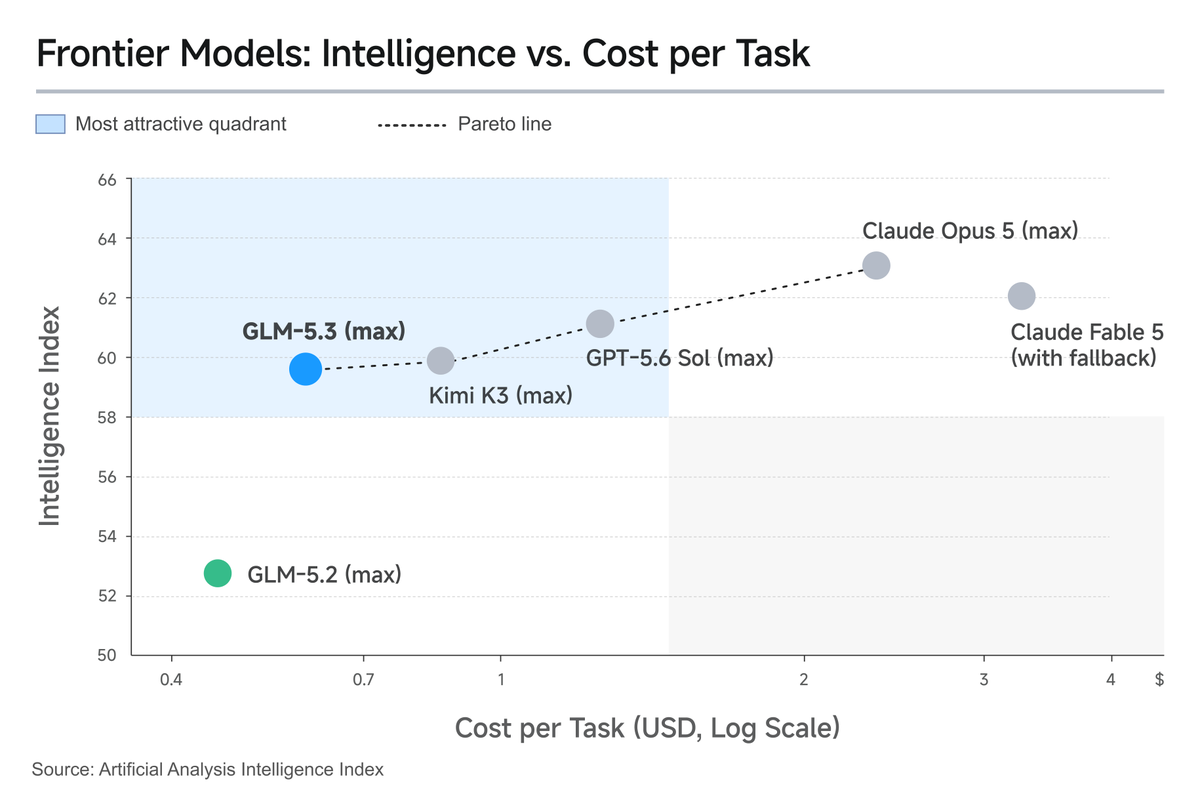 postGLM-5.3 API launches for coding and cybersecurity agentic tasks
Checking sign-in…
Loading comments…