DeepSeek Ships V4.1-Flash With Native Vision, Smaller KV Cache
- Source
- x.com
- Date
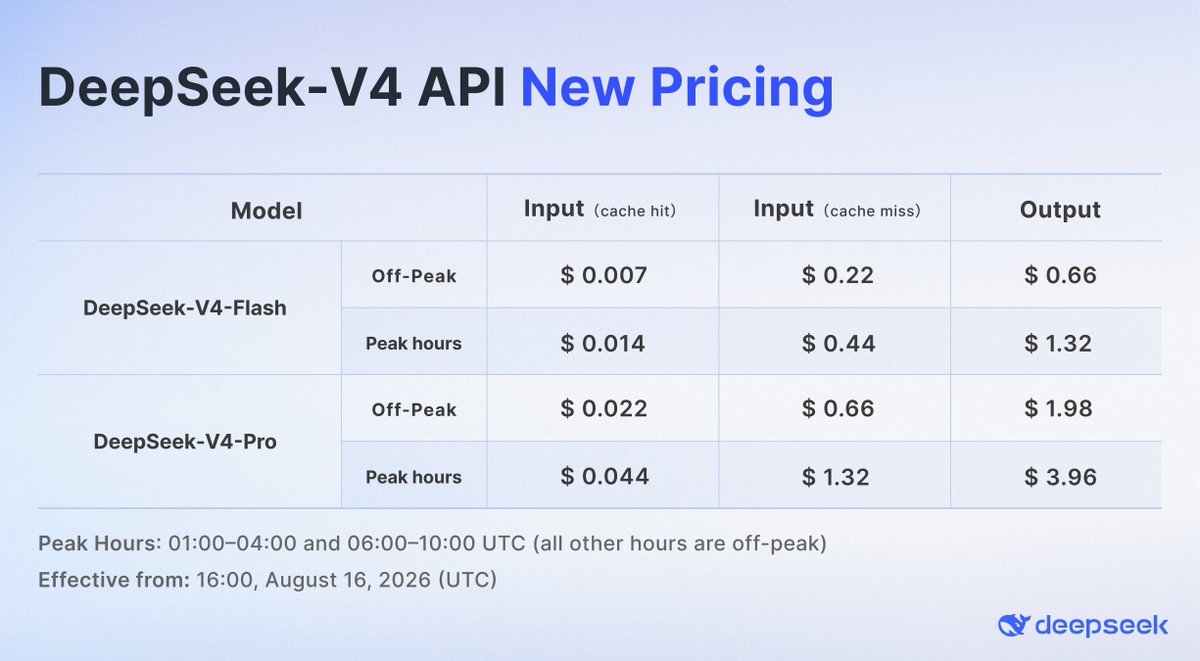
DeepSeek shipped V4.1-Flash, a 552-billion-parameter mixture-of-experts model built on a new causal encoder-decoder split, 8 billion active parameters handling input and 16 billion handling output, with native multimodal vision support built in rather than bolted on. The headline change is memory footprint: the new architecture cuts KV cache to one quarter of the prior generation's HBM usage and one eighth of its SSD storage. Since cache-hit costs dominate the inference bill for agent workloads that repeatedly reuse large contexts, a smaller KV cache translates directly into lower serving cost at the same throughput, not just a benchmark number. The model is live now on DeepSeek's API as deepseek-flash, with lower published pricing than the prior generation. For teams running high-volume agent pipelines with long, reused contexts, V4.1-Flash is worth benchmarking against current defaults specifically on cache-hit cost rather than raw quality, since that is where DeepSeek is claiming the actual improvement.

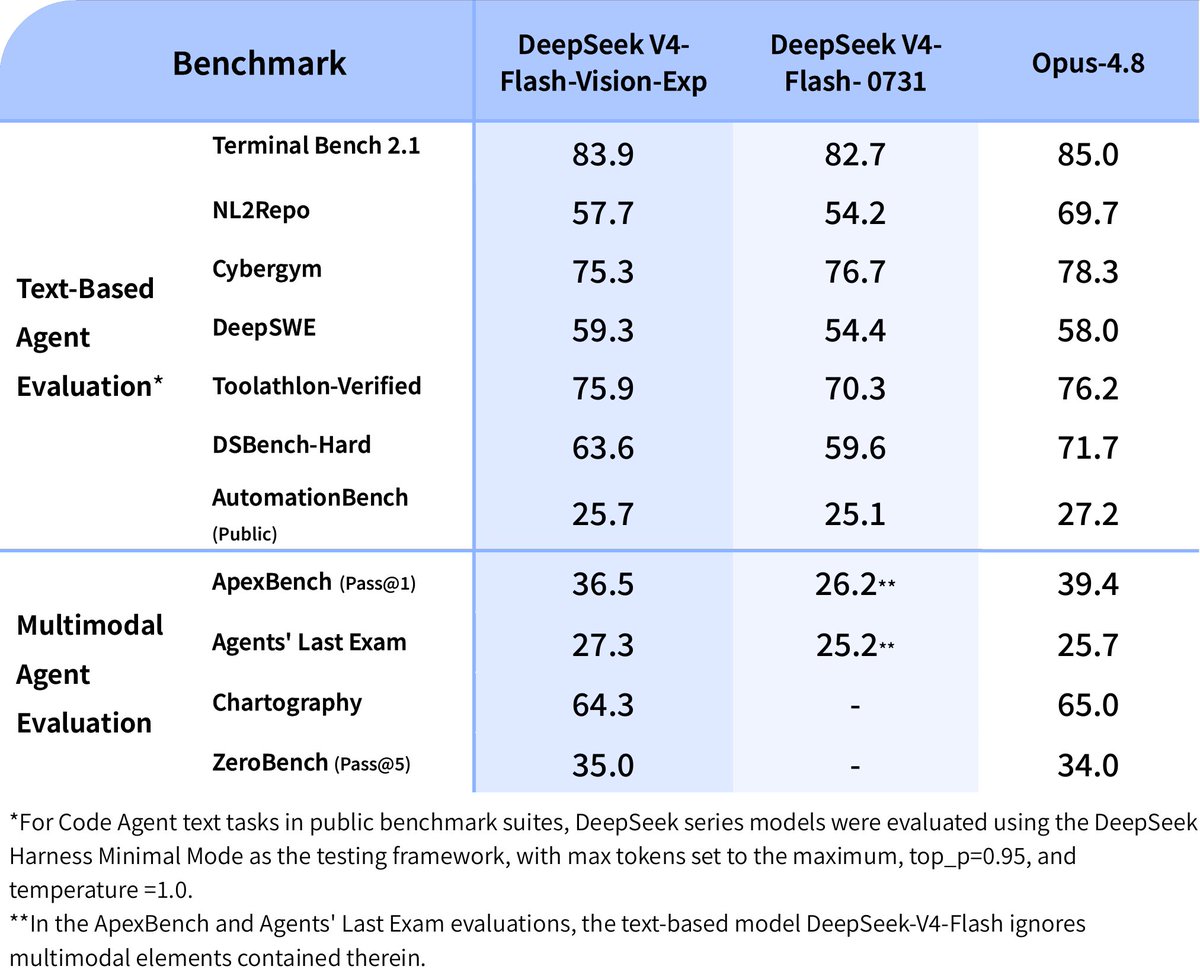
🚀 Introducing DeepSeek-V4.1-Flash: smarter, faster, more efficient. 🔹 Introducing the smallest model in our new architecture family, with native visual understanding. 🔹 Designed for greater capability, faster inference, higher throughput, and scaling to larger models. 1/6

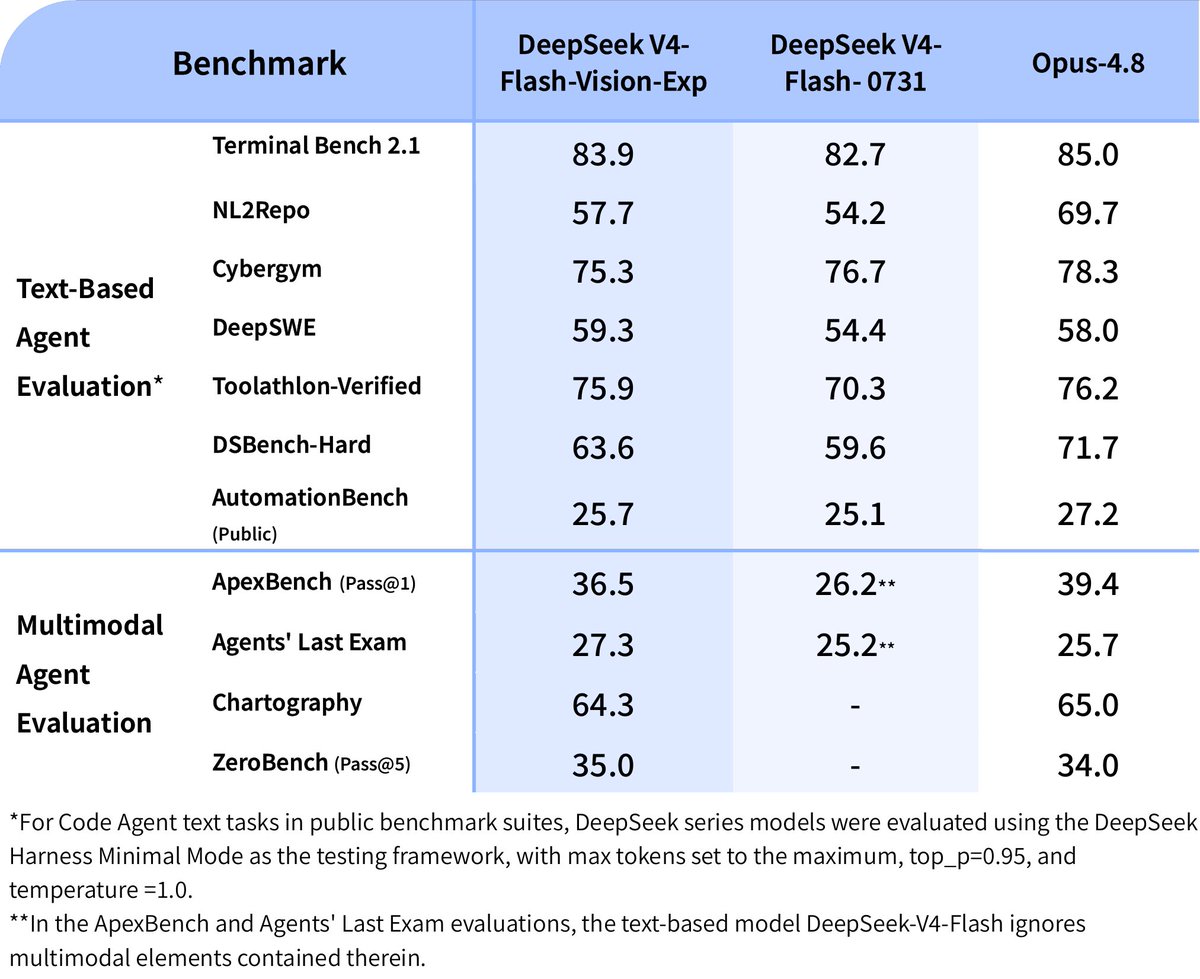
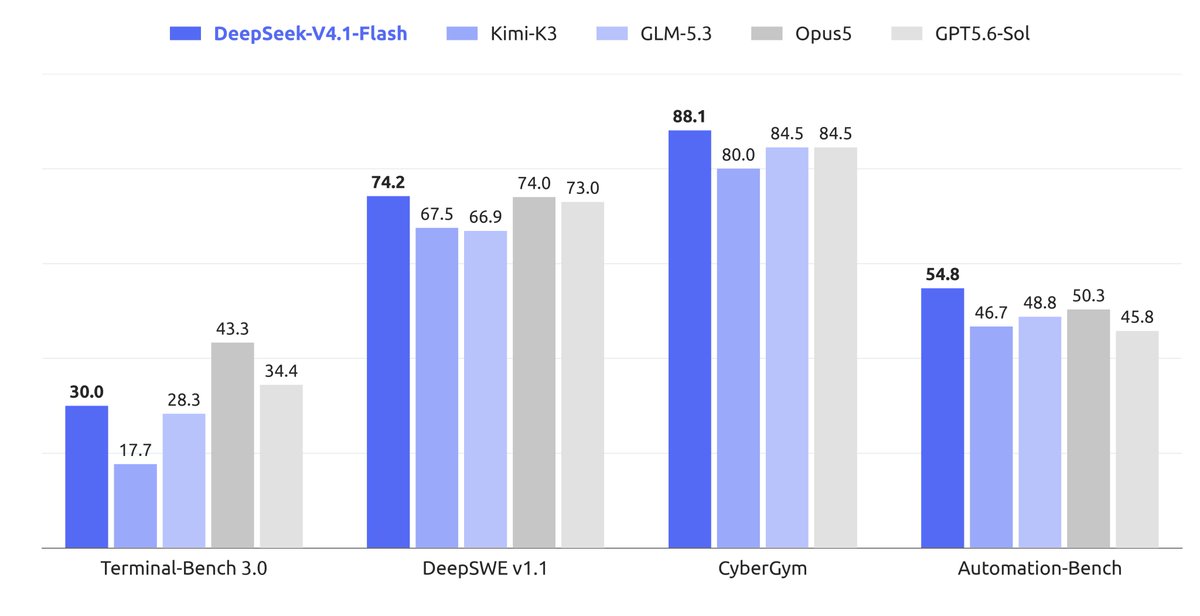
🧠 Asymmetric architecture. More intelligence, less cost. 🔹 552B-parameter MoE. 🔹 New Causal Encoder–Decoder architecture: just 8B active parameters for input, 16B for output. 🔹 New pre-training methods + larger-scale RL post-training deliver benchmark results ahead of flagship models, including DeepSeek-V4-Pro. 2/6

💾 Smaller KV cache. Bigger savings. Compared with the previous generation, V4.1-Flash’s KV cache needs just: 🔹 1/4 the HBM 🔹 1/8 the SSD storage Cache-hit charges often account for a large share of agent costs. Compressing the cache cuts those costs significantly. 3/6

⚡ V4.1-Flash is now live on the DeepSeek API with native multimodal support. Set your model to deepseek-flash. 🔹 V4-Flash & V4-Flash-Vision-Exp are retired. For compatibility, deepseek-v4-flash and deepseek-v4-flash-vision-exp temporarily route to V4.1-Flash. 🔹 Tests by multiple parties put V4.1-Flash ahead of V4-Pro on performance, cost, speed & total runtime. We’re phasing out V4-Pro. 🔹 Starting at 04:00 UTC on Sept 14, 2026, all deepseek-v4-pro requests will route to V4.1-Flash at V4.1-Flash rates. This will continue until V4.1-Pro launches. 🤝 Official partners @WorkBuddy_AI (including Codebuddy) & @opencode now fully support V4.1-Flash. Try it today! 4/6
Context
DeepSeek introduced V4.1-Flash on September 10 as the smallest model in a new architecture family, with native visual understanding. It describes a 552-billion-parameter model with a causal encoder-decoder design that uses 8 billion active parameters for input and 16 billion for output.
DeepSeek's cost argument centers on memory. It says V4.1-Flash's , the stored state a model reuses across a conversation, needs a quarter of the high-bandwidth memory and an eighth of the SSD storage of the previous generation, and that because cache-hit charges often account for a large share of costs, compressing the cache cuts those costs significantly. This is the company's own framing, separate from Artificial Analysis's separate benchmarking of the same model.
It also says V4-Flash is retired, and that from 04:00 UTC on September 14, 2026, deepseek-v4-pro requests will route to V4.1-Flash at V4.1-Flash rates until a V4.1-Pro launches.
- mixture-of-experts — A model built from many specialist sub-networks where only a few activate per token, giving big-model capability at small-model running cost.
- KV cache — The memory a model keeps about text it has already read, so generating each new token doesn't require reprocessing the whole conversation.
- AI agent — An AI system that doesn't just answer once but works toward a goal in a loop — taking actions, reading the results, and deciding what to do next.
- multimodal — A model that works with more than text — reading images, audio, or video, and sometimes generating them too.


Checking sign-in…
Loading comments…