BotPsy: On-Device Personal Assistant with a Sub-Billion-Parameter Agentic Language Model
- Source
- huggingface.co
- Date
Context
BotPsy-0.8B is a small language model from Tether AI Research, built to work as a personal assistant that runs on the user's own device rather than in the cloud. It is a fine-tuned version of Qwen's Qwen3.5-0.8B, and its job is : instead of answering from memory, it writes structured requests to functions an app provides, such as web search, a calendar, email or device settings, and the app carries them out. The announcement pitches running a model this small locally as a way to avoid the cost, privacy exposure and dependence on outside providers that come with cloud models. The weights are on Hugging Face under the Apache 2.0 license, along with GGUF files at full (BF16), 8-bit and 4-bit precision for llama.cpp and Tether's QVAC SDK.
The team trained it in four stages. Supervised fine-tuning came first, teaching the model to imitate example tool-use conversations, including cases where no tool should be called. Next came from three specialist Qwen3.5-4B "teacher" models: the small model writes its own answers and a teacher grades every token. Two rounds of reinforcement learning followed, rewarded by rules that give partial credit for getting the tool name, argument names and argument values right. According to the post, the first stage improved tool use but pushed general knowledge and instruction following below the base model, and the distillation stage was there mainly to recover them.
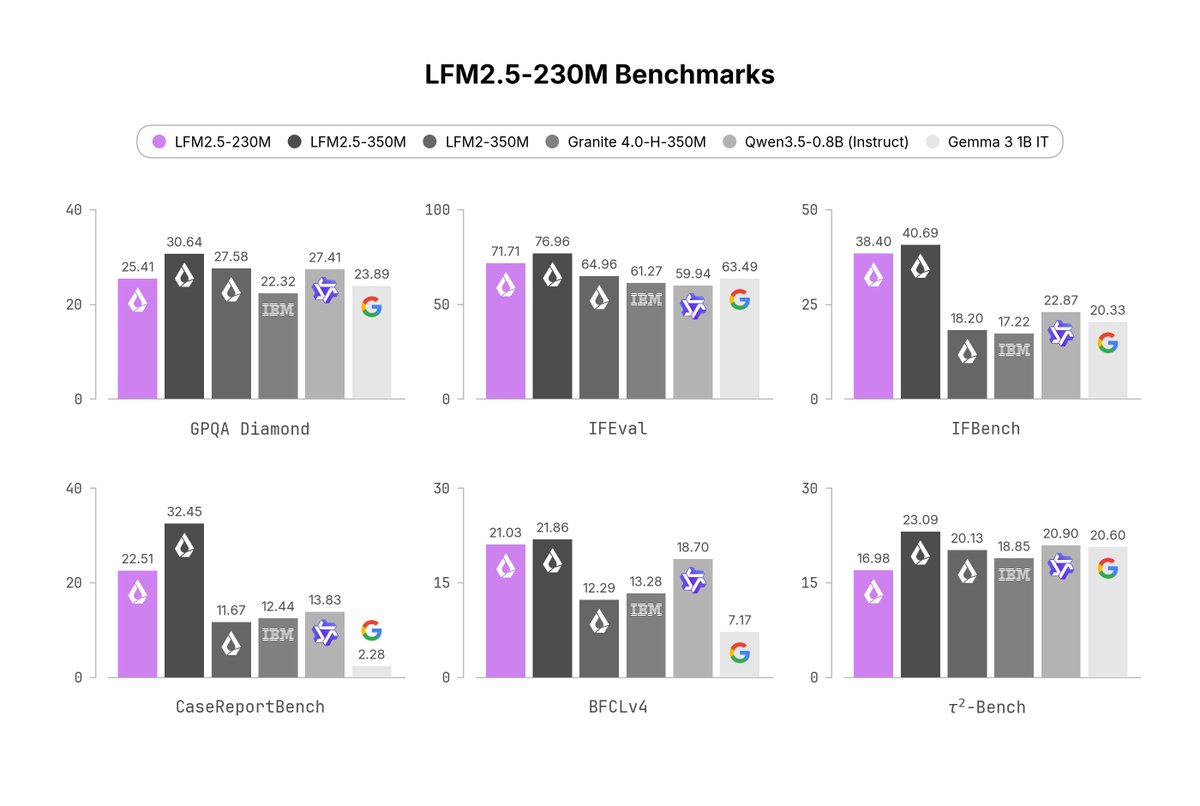
The results are Tether's own runs against four other models of 2 billion parameters or fewer, all in reasoning mode. Across six tool-use and benchmarks BotPsy averages 45.0 out of 100, against 24.7 for its base model and 38.8 for Qwen3.5-2B-Think, a model 2.5 times its size. It scores highest on five of the six; on Claw-Eval the 2B model leads, 48.9 to 46.5. It also scores 86.1 on a test of declining when no suitable tool exists, the best of the group, and the post reports unsafe responses in automated red-teaming falling to 21% from its base model's 36%. The other comparison models are MiniCPM5-1B-Think and LFM2.5-1.2B-Think, from Liquid AI's LFM2.5 family.
The same post is direct about the limits. Absolute scores on hard tasks stay low: 4.5 out of 100 on the BrowseComp-Plus deep-research benchmark, and 39.5 on complex multi-step scenarios against 75 on single tool calls. General knowledge remains well below the 2B model (38.1 against 59.9 on GPQA Diamond), so the authors say BotPsy is designed to look facts up with tools rather than act as a knowledge model. It was trained and tested mainly in English, and scores much lower in Hindi and Russian. The authors also say it is not intended for high-stakes decisions or for "applications involving money, personal information, health and other sensitive topics," even though their list of suitable domains includes finance, email and messaging. No independent evaluation of these numbers was available.
- Tether AI Research reports its 0.8B BotPsy, post-trained from Qwen3.5-0.8B, roughly doubles its base on agentic benchmarks (BFCL v4 23.4 to 44.0, tau-bench 23.2 to 51.5) and beats the 2.5x larger Qwen3.5-2B-Think on five of six, in the team's own evals.
- Training ran in four stages: supervised fine-tuning on tool-use trajectories, on-policy distillation from three specialist 4B teachers to recover knowledge lost in SFT, then two RL rounds with partial credit for matching tool names, argument names and values.
- BotPsy is better at declining and at stopping: it scores 86.1 on BFCL's tests, where no suitable tool exists, and its IFBench reasoning loops fall from 22.9% to 1.4% versus its base model.
- The team lists clear limits: multi-step research stays weak (15 on complex retrieval scenarios, 4.5 on BrowseComp-Plus), Hindi and Russian lag far behind English, and the model is not meant for money, health or other high-stakes decisions.
- In automated red-teaming the authors report unsafe responses falling from 36% for the base model to 21%, and from 46% to 31% under prompt-injection attacks, the case that matters for agents reading untrusted tool output.
- tool use — A model's ability to call external functions — run code, search the web, edit files — instead of only generating text.
- distillation — Training a small, cheap model to imitate a big one's outputs, keeping much of the capability at a fraction of the cost.
- AI agent — An AI system that doesn't just answer once but works toward a goal in a loop — taking actions, reading the results, and deciding what to do next.
- hallucination — When a model states something false with full confidence — inventing facts, citations, or APIs that don't exist.
Checking sign-in…
Loading comments…