Liquid AI's 230M model runs agentic tool calls on a Raspberry Pi
- Source
- x.com
- Date

Introducing LFM2.5-230M: our smallest model yet, built to run fast anywhere (CPUs, NPUs, and GPUs) to enable agentic tasks on phones, robots, home and network automation devices. > 230M parameters, built on the LFM2 architecture > Pre-trained on 19T tokens, with a 32K context extension > Post-trained with distillation from LFM2.5-350M > 213 tok/s decode speed on Galaxy S25 Ultra (CPU) > 42 tok/s on a Raspberry Pi 5 (CPU) > Competes with and often beats models more than twice its size on instruction following, data extraction, and tool use. > use it for large-scale data extraction pipelines or lightweight on-device agentic workloads. 🧵

CPU Performance: LFM2.5-230M is considerably faster than similar-sized attention-based and hybrid models. On a @raspberry Pi 5 and a @Qualcomm Snapdragon Gen4 (@Samsung Galaxy S25 Ultra), it delivers the highest prefill and decode throughput in its class while keeping the smallest memory footprint. It is available today on all platforms: > llama.cpp (GGUF) for edge > MLX for Apple Silicon > vLLM and SGLang for GPU serving > ONNX for cross-platform (2/n)

As an early look at ongoing work, we deployed LFM2.5-230M on a Unitree G1, running entirely on-device on its onboard @nvidia Jetson Orin. The model acts as a skill-selection layer, taking in natural-language instructions and decomposing them into sequences of tool calls. After a quick fine-tune, "Hold still for 2s, walk forward at 1 m/s for 3 m, hold a one-leg kneel for 5s, walk back at 0.5 m/s for 3 m" becomes a structured multi-step plan automatically. (3/n)

GPU Performance: For production-grade enterprise deployments, we have also developed an internal GPU inference stack that delivers extremely low-latency serving. We benchmark it against other small models running on SGLang, and across all concurrency levels, LFM2.5-230M achieves considerably lower end-to-end latency. (4/n)

Context
Liquid AI's LFM2.5-230M is intended to translate instructions into tool requests on small local devices. The company describes an early robotics application in which a fine-tuned version turns a natural-language instruction about waiting, walking and kneeling into an ordered sequence of tool calls. Release thread.
Its role in that application is selecting and sequencing existing skills. Keeping that language-processing step on the robot provides a way to interpret instructions using onboard computing. The example gives the small model a bounded job with structured outputs; the announcement presents the robot deployment as ongoing work, without reporting a general task-success rate.
- context window — The maximum amount of text a model can consider at once — its working memory for the current conversation or task.
- distillation — Training a small, cheap model to imitate a big one's outputs, keeping much of the capability at a fraction of the cost.
- agent skill — A reusable instruction file that teaches an agent how to do one job well — the procedure, the tools, and what counts as done.
- fine-tuning — Taking a trained model and training it a bit more on your own examples so it gets better at one specific job.
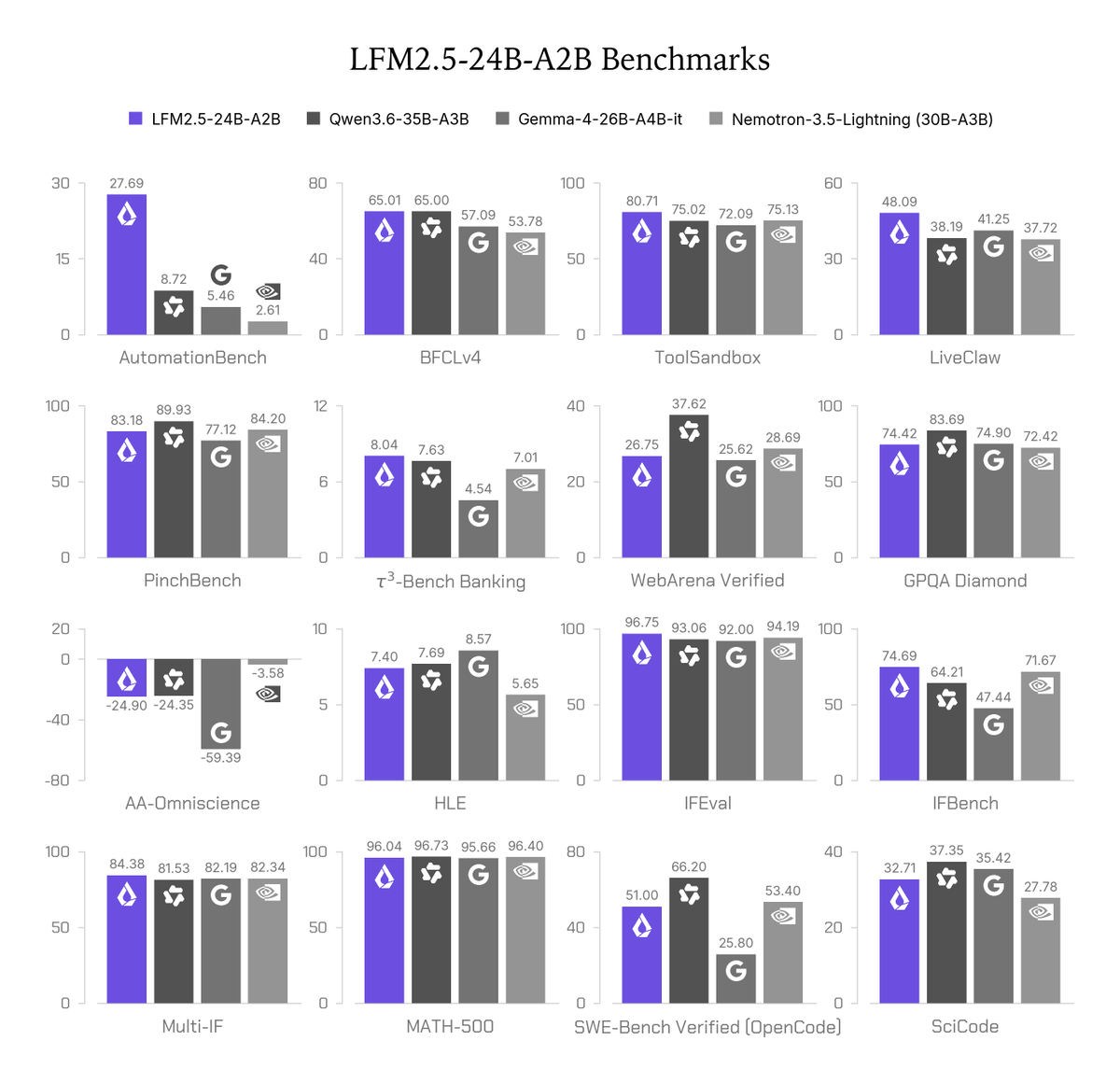 postLiquid AI ships LFM2.5-24B-A2B open weights for local agents
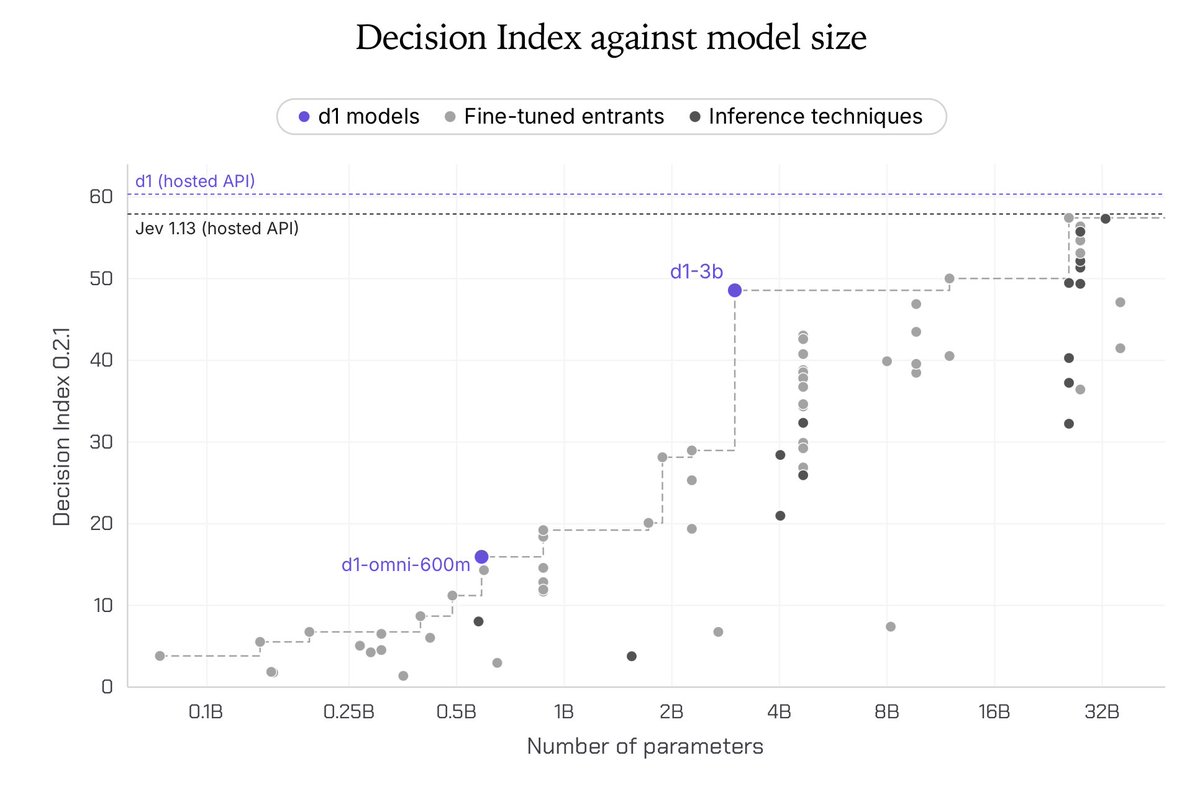 postToday we release Open d1: two open-weight multimodal models in our d1 decision…
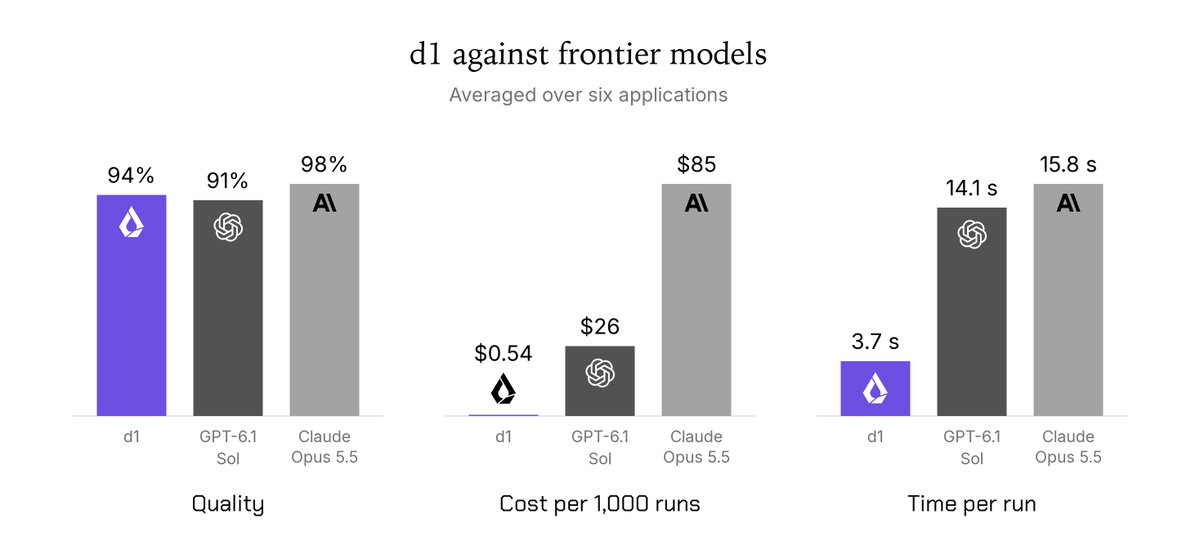 postLiquid AI's d1 decision model adds vision at a fraction of frontier cost
 articled1 is now available on @vercel AI gateway!We worked with the amazing vercel…

Checking sign-in…
Loading comments…