➤ Leaderboard: ➤ Methodology: ➤ Stirrup, our open-source agent harness: Search A
- Source
- x.com
- Publisher
- Artificial Analysis
- Date
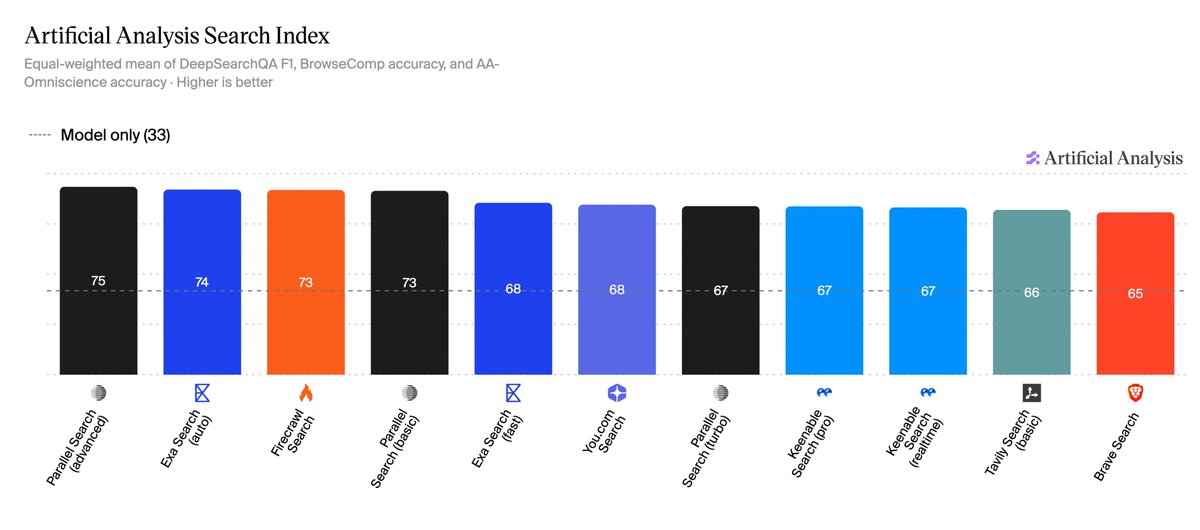
Announcing the Artificial Analysis Search Index, benchmarking how search API providers perform on quality, cost, and speed when used by an agent. We are initiating coverage with Parallel, Exa, Firecrawl, You (dot) com, Tavily, Keenable, and Brave Search is one of the most important tools for agents. Search providers make different choices about how they search, rank, and package results, and those choices change what the model reads and how it acts. We are expanding our benchmarking coverage to search APIs, so developers can pick a search provider on measured quality, cost, and speed. Each provider result pairs a search API provider with the same model, GPT-5.6 Luna (medium). The model runs inside Stirrup, our open-source agent harness, with tools for searching and fetching pages from the web - only the search provider behind the search tool changes. At launch, the leaderboard covers 11 results across 7 search providers, and we’ll keep expanding coverage as we look to provide the most accurate and comprehensive benchmarking of search providers for AI agent usage. Key elements of the Artificial Analysis Search Index: ➤ Three equally weighted benchmarks: the Search Index is the average of DeepSearchQA (900 broad research questions that need many searches, graded with an F1 score over answer items), BrowseComp (a 200-sample hard subset of facts that need multi-hop browsing), and AA-Omniscience (a 600 question private subset, balanced across 6 domains) ➤ Same agent, different search provider: the agent has 25 turns available to complete each task. Its web search tool returns the search provider's native response payload (with content modes standardized to snippets), with a maximum of 10 results and contamination sources filtered out ➤ Model-only baseline: we compare search agent results to the same model answering single-shot without tools, showing how much each provider lifts the model above its internal knowledge ➤ Cost and Time per Task: we aggregate the time and cost spent on both model inference and search. This is key - search APIs have different cost and latency structures, but these can be offset where they help an agent use fewer turns and save on costly language model inference Key results: ➤ Parallel, Exa, and Firecrawl have the strongest overall performance, with Artificial Analysis Search Index scores of 75, 74, and 73 respectively at launch ➤ All search providers tested substantially improve knowledge-based benchmark performance: the model only baseline scores 33 on the Search Index, while search-included provider results score between 65 and 75 ➤ Focused search results reduce spend on model inference: Parallel Search (advanced) search costs more per task than Parallel Search (basic) but less per task in total ($0.084 vs $0.11). Higher quality results cut the model's token use by over 40% in this case, more than offsetting increased search costs while reaching higher benchmark scores ➤ Fast search calls do not guarantee fast tasks: Parallel Search (turbo) has the fastest average search calls among Parallel's tiers (0.51s per query vs 1.03s for Parallel Search (basic)) but the basic tier scores higher on quality (73 vs 67) and the two land close on total time per task

➤ Leaderboard: https://t.co/9YAVImvolL ➤ Methodology: https://t.co/t1q98tB0w7 ➤ Stirrup, our open-source agent harness: https://t.co/44YUDLBz3b Search API providers can contact us to be included in the benchmark: https://t.co/DqjVJYK90Q
Context
Artificial Analysis launched its Search Index on August 18, 2026 to rank web search APIs, the services AI agents call to look things up, by how much they improve a model's answers. As the launch thread and methodology describe it, every result pairs one search provider with the same model, GPT-5.6 Luna (medium), inside Stirrup, the company's open-source . The model has 25 turns to search, open pages and submit an answer. The grader, the limit of 10 results per search and every other setting stay fixed, so the search provider is the only thing that changes.
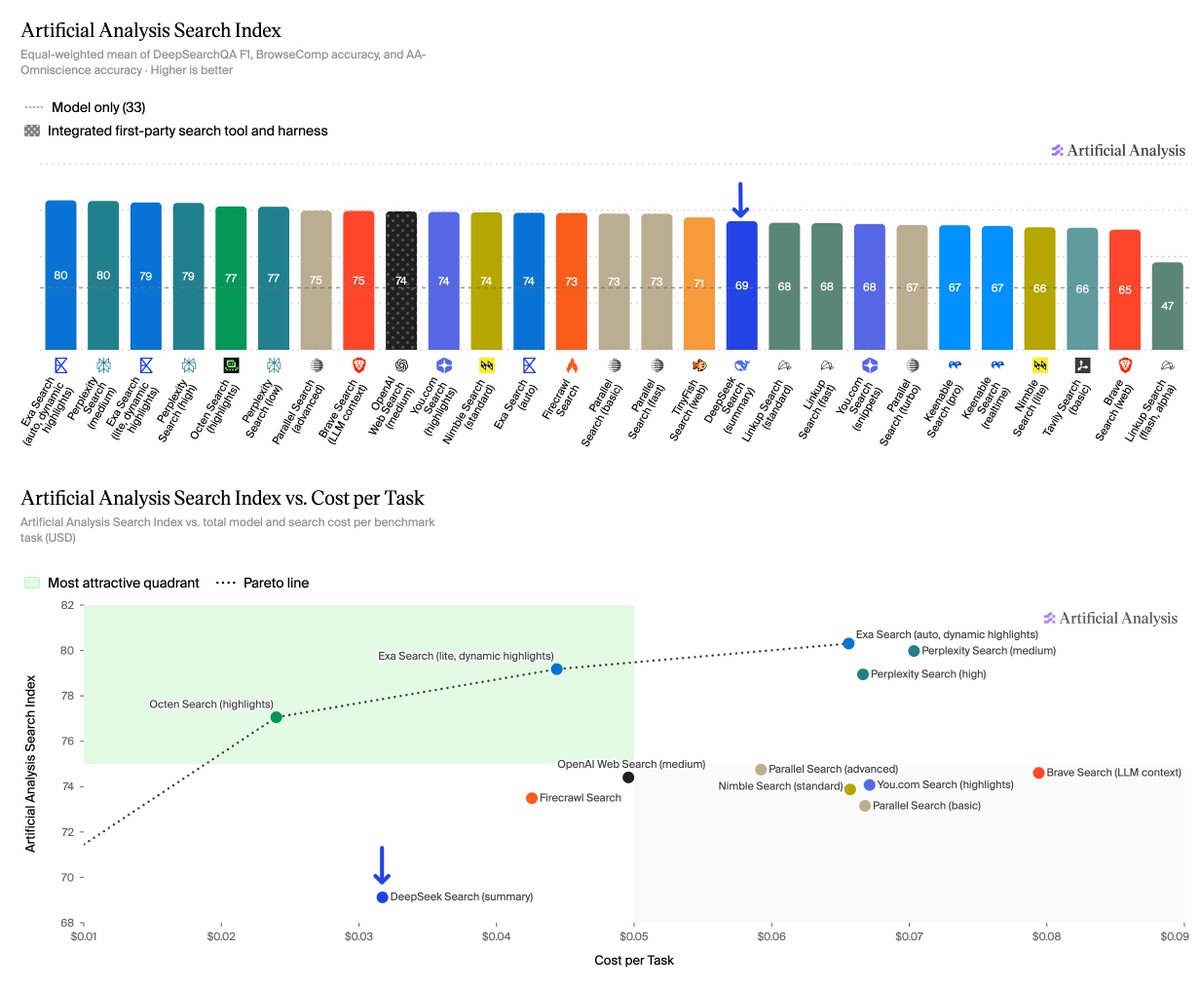
The index is the plain average of three question sets: 900 DeepSearchQA research questions whose answers are lists and take many searches, a hard 200-question subset of BrowseComp, whose facts must be tracked down across several pages, and 600 private factual questions from AA-Omniscience. The same model answering once with no search tools scores 33. At launch every provider scored between 65 and 75, led by Parallel, Exa and Firecrawl at 75, 74 and 73, so having search mattered far more than which provider supplied it.
Cost is counted per task, not per search. Each task's cost adds the model's cost to the provider's list price for the searches the model chose to run, because poor results can make the model search more often and spend more tokens reasoning. The launch thread's example: Parallel's advanced tier ran up higher search fees per task than its basic tier but cost less per task in total, $0.084 against $0.11, because its results cut the model's token use by over 40%.
The leaderboard has changed since launch. As collected in early November, with data dated October 19, 2026, it covered 26 search products across 14 providers, up from 11 results across 7 providers at launch. Exa Search (auto, dynamic highlights) and Perplexity Search (medium) led at 80, and Parallel Search (advanced) scored 75. Search fees were the larger part of the cost for 10 of the 12 results shown; Exa's top configuration, for example, cost $53.17 in search fees and $10.60 in model tokens per 1,000 tasks. Every score reflects one model in one , and the methodology itself says the strongest provider for a given task may not be the highest-scoring one, advising teams to weigh quality gained, cost added and added against the no-search baseline.
- Harness engineering — Designing the full environment and feedback system around an agent.
- Token — A piece of text, such as a word, part of a word or a punctuation mark, that a language model represents as numbers and handles as a unit.
- Harness — The software that sends a model its context, recognizes tool calls, runs or refuses them, returns results and keeps the record.
- Latency — The time between asking for a result and having it, including the model's generation time, tool calls, retries and any queueing.