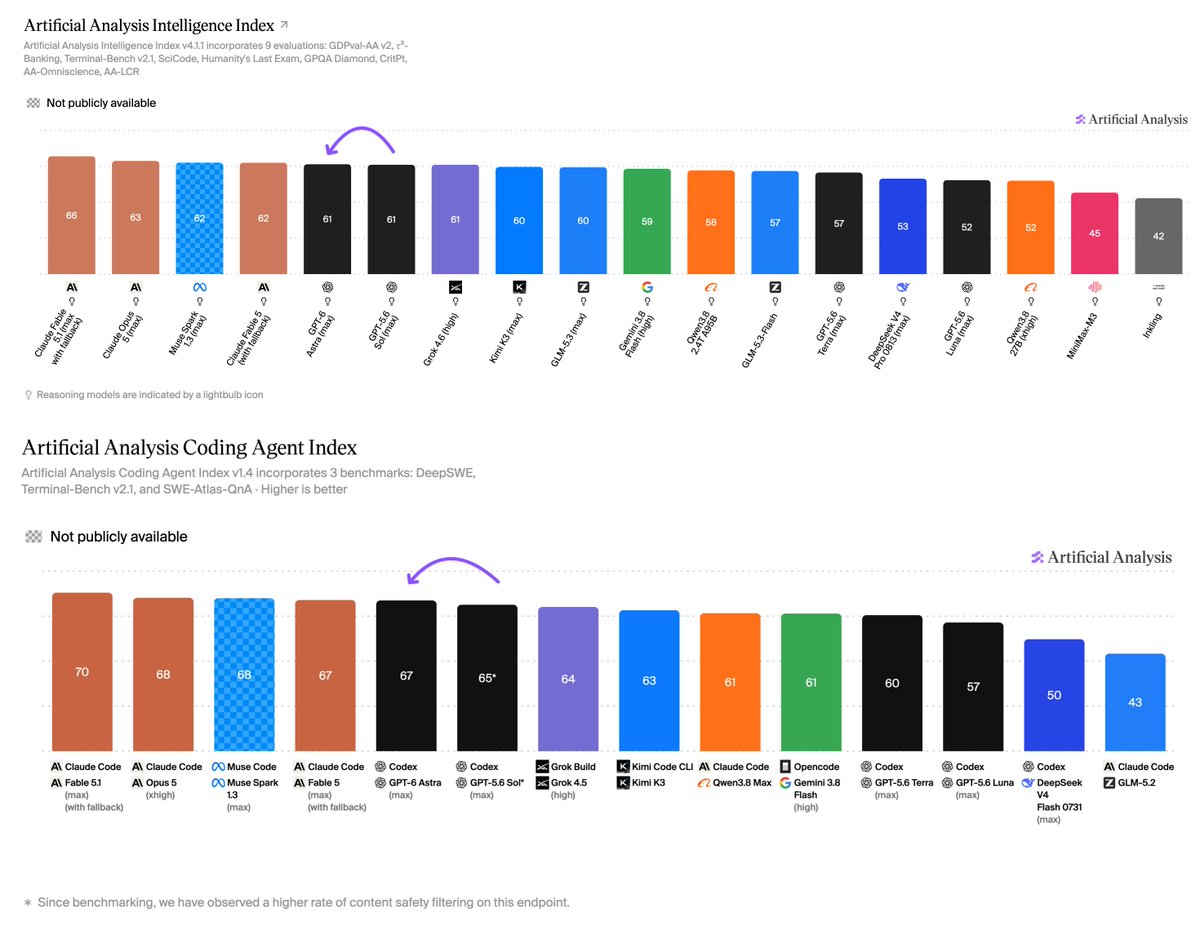
A higher price per token does not raise the bill one-for-one when much less text is generated. Artificial Analysis' GPT-6 Astra evaluation attributes part of OpenAI's cost competitiveness to reduced token use, while still finding higher costs than its predecessor, GPT-5.6 Sol, at maximum effort.
The comparison also separates a standardized model evaluation from coding-agent results produced in each provider's HarnessThe software that sends a model its context, recognizes tool calls, runs or refuses them, returns results and keeps the record.Full definition →. Those are different systems under test. The useful takeaway is to compare the complete configuration and workload: model price, generated volume, effort setting and agent software all shape the observed cost and performance.
Key takeaways · AI-distilled
On the Intelligence Index, Artificial Analysis says GPT-6 Astra (max) scores 53, matching Claude Fable 5.1 at $3.26 versus $7.63 per task, because it uses about 27k output tokens per task against Fable 5.1's 78k; every Astra effort level sits on the cost frontier.
In the Agent modeA mode in which one agent can inspect, edit, run commands, and iterate toward an outcome.Full definition → Index, Astra in Codex scores 62 like Fable 5.1 in Claude Code, at $7.09 per task, about 40% cheaper; its 7-point gain over GPT-5.6 Sol comes from TerminalA program that shows text and accepts typed text.Full definition →-Bench and SWE-Atlas-QnA, partly offset by a lower DeepSWE score (68% vs 72%).
Astra's drop in AA-Omniscience HallucinationGenerated content that is false or unsupported, even when it sounds plausible.Full definition → rate, from 92% to 51% at max effort, came with a 4-point accuracy gain, which Artificial Analysis notes is not always the case when models hallucinate less.
Not every result improved: Astra lost about 45 Elo on GDPval-AA v2 versus GPT-5.6 Sol, using 24 turns per task against 45 for Sol and 60 for Fable 5.1, and its AA-Briefcase gain of about 90 Elo came with lower Presentation Quality Elo.
Terms in this piece · Glossary
Harness — The software that sends a model its context, recognizes tool calls, runs or refuses them, returns results and keeps the record.
Agent mode — A mode in which one agent can inspect, edit, run commands, and iterate toward an outcome.
Hallucination — Generated content that is false or unsupported, even when it sounds plausible.
Terminal — A program that shows text and accepts typed text.