Openai Has The 2 Model In The Intelligence Index With The Release Of Gpt 6 2 Astra And Gpt 6 2 Sol
- Source
- artificialanalysis.ai
- Author
- Artificial Analysis articles
- Date
Context
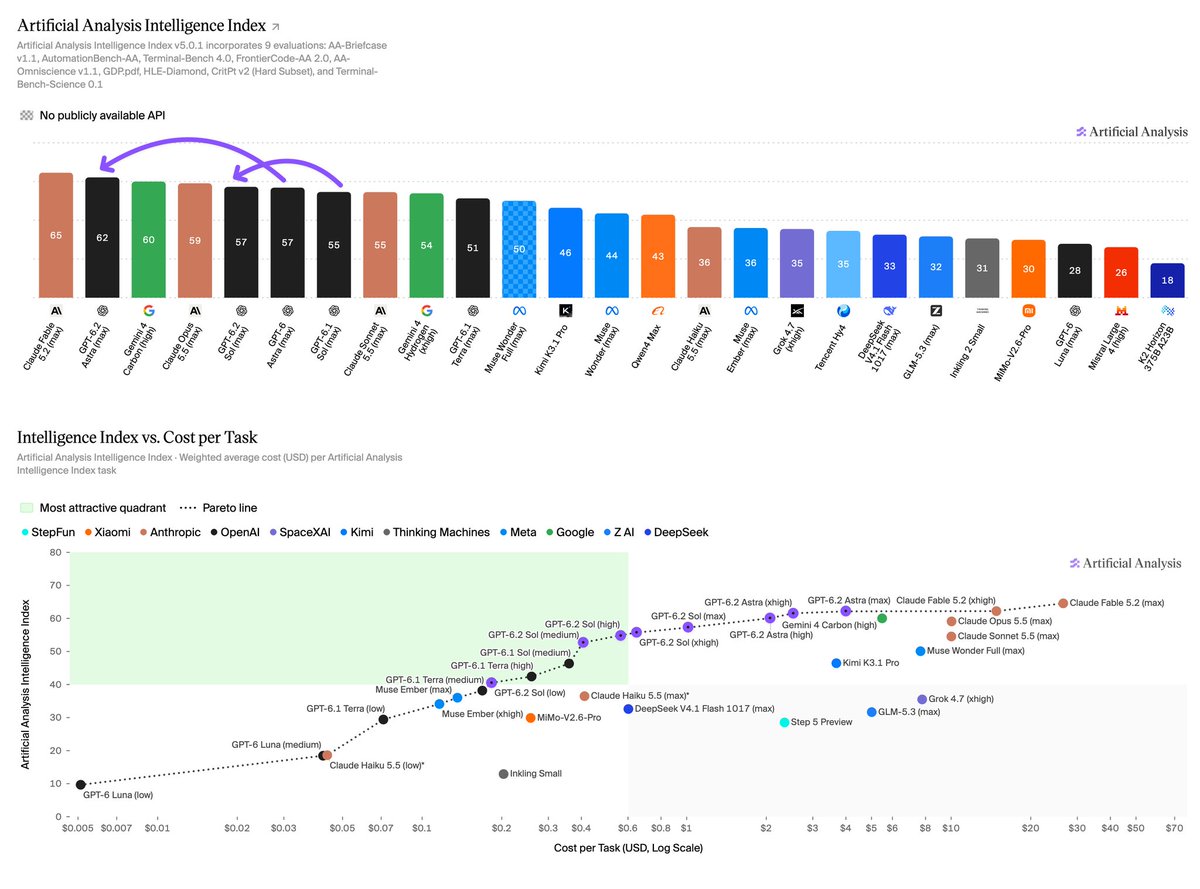
Artificial Analysis, an independent firm that benchmarks AI models, ranks OpenAI's new GPT-6.2 Astra second on its Intelligence Index, behind Anthropic's Claude Fable 5.2. Astra gained 5 points over GPT-6 Astra and passed Google DeepMind's Gemini 4 Carbon (60) and Claude Opus 5.5 (59) at their top effort settings. The firm also posted these findings as an X thread. Its subject-by-subject breakdown shows the two leading models are strong in different places.
Fable 5.2 keeps the lead on knowledge and harder reasoning. Astra places second to it on AA-Omniscience accuracy, a test of factual knowledge, and on HLE-Diamond, a reasoning and knowledge benchmark, and OpenAI's models place second to it on the hard subset of CritPt, which tests physics reasoning. OpenAI pulls ahead on tasks where a model acts rather than answers. Its models lead Terminal-Bench-Science, which covers agentic scientific research workflows. Astra leads AA-3D, where human graders rate how well models build interactive 3D experiences, at 1318 against Fable 5.2's 1271. On AA-Robotics, a research preview of how well language models understand, plan and act in the physical world, Astra and GPT-6.2 Sol score 79 and 78 to Fable 5.2's 75. Artificial Analysis cautions that OpenAI and Anthropic models can already do most of that preview's basic tasks, and it is adding harder ones, so the robotics gap is small on a test whose basic tasks are largely solved.
Two results cut against the new models. On the firm's Coding Index, run in OpenAI's Codex at maximum effort, Astra is flat against GPT-6 Astra and Sol drops 3 points, mostly from a 14-point fall on a test where it more often leaves key facts out of its answers. Hands-on testers at Every reported the same pattern, with Astra seeming to stop too early on real coding builds. Artificial Analysis also measures how often a model guesses when it does not know the answer to a factual question, and at max effort GPT-6.2 Astra and Sol do so 59% and 55% of the time. The article gives no figure for Fable 5.2 or other rivals, so it does not say whether that rate is better or worse than theirs.
- Artificial Analysis scores GPT-6.2 Sol at 57, on par with GPT-6 Astra at about 15% of the Cost per Task, while GPT-6.2 Astra gained 5 points to pass Gemini 4 Carbon (60) and Claude Opus 5.5 (59) at their top effort settings.
- GPT-6.2 Sol's 3-point drop on the Coding Agent Index traces to a 14-point fall on SWE-Atlas-QnA-AA, where Artificial Analysis found it more likely than its predecessor to leave key facts out of answers.
- On AA-Omniscience, GPT-6.2 Astra and Sol hallucinate at 59% and 55% at max effort, a measure of how often a model guesses rather than admitting it does not know a factual answer.
- GPT-6.2 Astra leads the human-graded AA-3D benchmark at 1318 versus Claude Fable 5.2 at 1271, and Artificial Analysis says it is adding harder AA-Robotics tasks because OpenAI and Anthropic models now handle most of the basic ones.
- Beyond the headline price cut, GPT-6.2 Astra's cached input falls from $1.00 to $0.40 per million , while GPT-6.2 Sol stays at $2/$10 per million input/output tokens, unchanged from GPT-6.1 Sol.
- AI agent — An AI system that doesn't just answer once but works toward a goal in a loop — taking actions, reading the results, and deciding what to do next.
- agent harness — The scaffolding around a model that turns it into a working agent — the loop, the tools it can call, and the rules for when to stop.
- hallucination — When a model states something false with full confidence — inventing facts, citations, or APIs that don't exist.
- token — The chunk of text a model reads and writes in — roughly three-quarters of a word — and the unit AI usage is billed in.

Checking sign-in…
Loading comments…