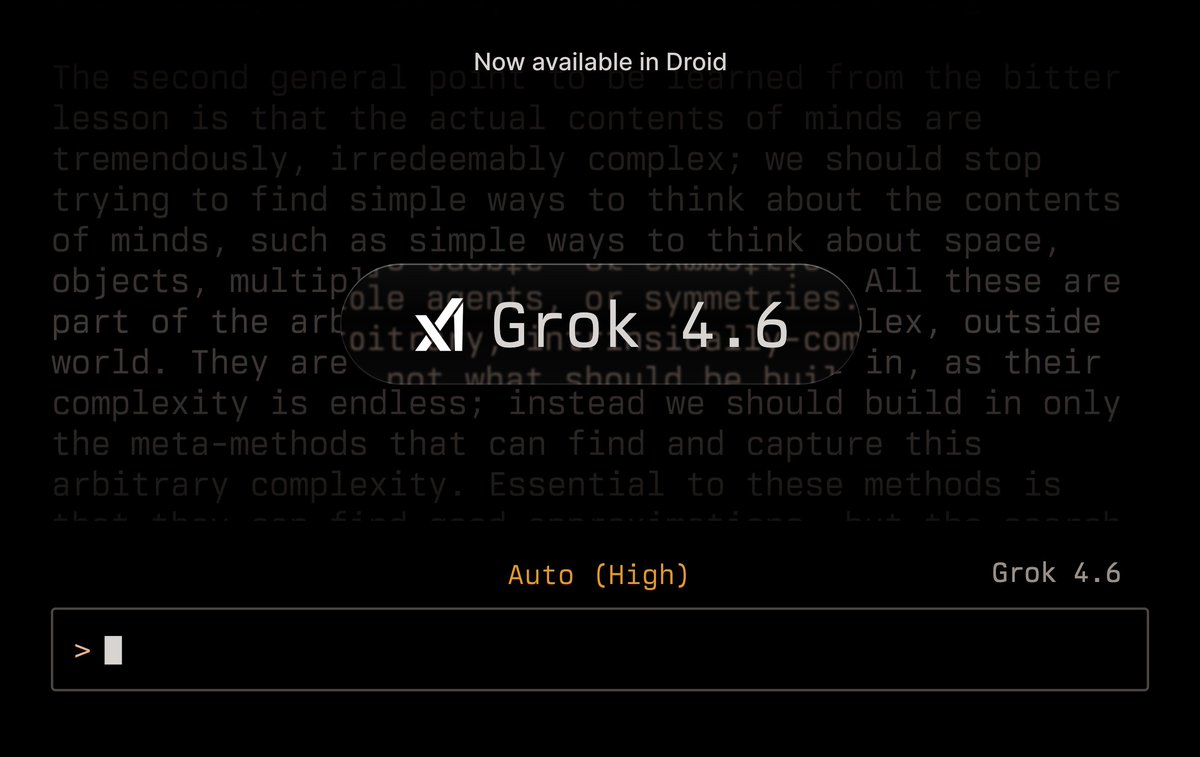
Grok 4.6 by @spacexai has arrived in Droid.
- Source
- x.com
- Publisher
- Factory AI
- Date

Context
Factory announced on August 12 that Grok 4.6 had arrived in Droid, its , the same day SpaceXAI released the model on its API. The company's release notes, which now call it SpaceXSI, describe Grok 4.6 as its frontier model for coding, agentic tasks and knowledge work. It reads text and images, writes text, and has a 500,000-token . On the API it costs $2 per million input tokens, $0.50 for cached input and $6 per million output tokens for prompts under 200,000 tokens, and twice that above. The input and output rates are the same as for Grok 4.5, released on July 8, but cached input costs more: the company's Grok 4.5 page lists $0.30. Grok 4.6 also launched with a fourth reasoning-effort setting, xhigh, above the low, medium and high listed when Grok 4.5 launched, which lets the model reason longer on a request.
In Droid, Grok 4.6 is one more model to pick for a . Factory's current model list offers it with all four reasoning levels, high by default, where Grok 4.5 has only low, medium and high. It carries a 0.8× usage multiplier, the factor that sets how fast a model draws down a Droid plan's usage. That is the same rate as Grok 4.5 and half that of Claude Opus 5.5 at 1.6×. Factory's post says nothing about how the model performs inside Droid. For an independent measure, Artificial Analysis scored Grok 4.6 at 61 on its Intelligence Index, five points above Grok 4.5. SpaceXAI has since released Grok 4.7, on September 21, and Factory lists it at the same 0.8× rate.
- Agent mode — A mode in which one agent can inspect, edit, run commands, and iterate toward an outcome.
- Context and context window — Context is the information available for a generation; the context window is the capacity available to hold it.
- Session — One conversation or piece of work as a harness keeps it: a record of messages, tool calls and observations that can be saved and resumed.
- Model selection — Choosing a model using workload evidence and operating constraints.