Reflection's Beam open-weight model launches on Together AI
Source
together.ai
Author
Together AI
Date
Why it matters
Reflection's Beam is an Apache 2.0, 1M-context windowThe maximum amount of text a model can consider at once — its working memory for the current conversation or task.Full definition →mixture-of-expertsA model built from many specialist sub-networks where only a few activate per token, giving big-model capability at small-model running cost.Full definition → (501B total, 23B active) aimed at coding agents. It is available serverless at $0.40 input and $1.20 output per 1M tokens and is said to work with Claude Code and OpenCode.
Key takeaways · AI-distilled
Beam ships in BF16, FP8 and NVFP4 variants with speculative decodingA speed trick where a small model drafts several tokens ahead and the big model verifies them in one pass, often doubling generation speed.Full definition → support, and Reflection releases an open-source agentic harness plus post-training and RL recipes so its agent behavior reproduces across deployments.
Beam is text-in, text-out with English-focused alignmentThe work of making AI systems actually pursue what their builders and users intend, rather than something subtly or dangerously different.Full definition →; Reflection says every training decision targeted code, tool calls, logs, documents and structured outputs.
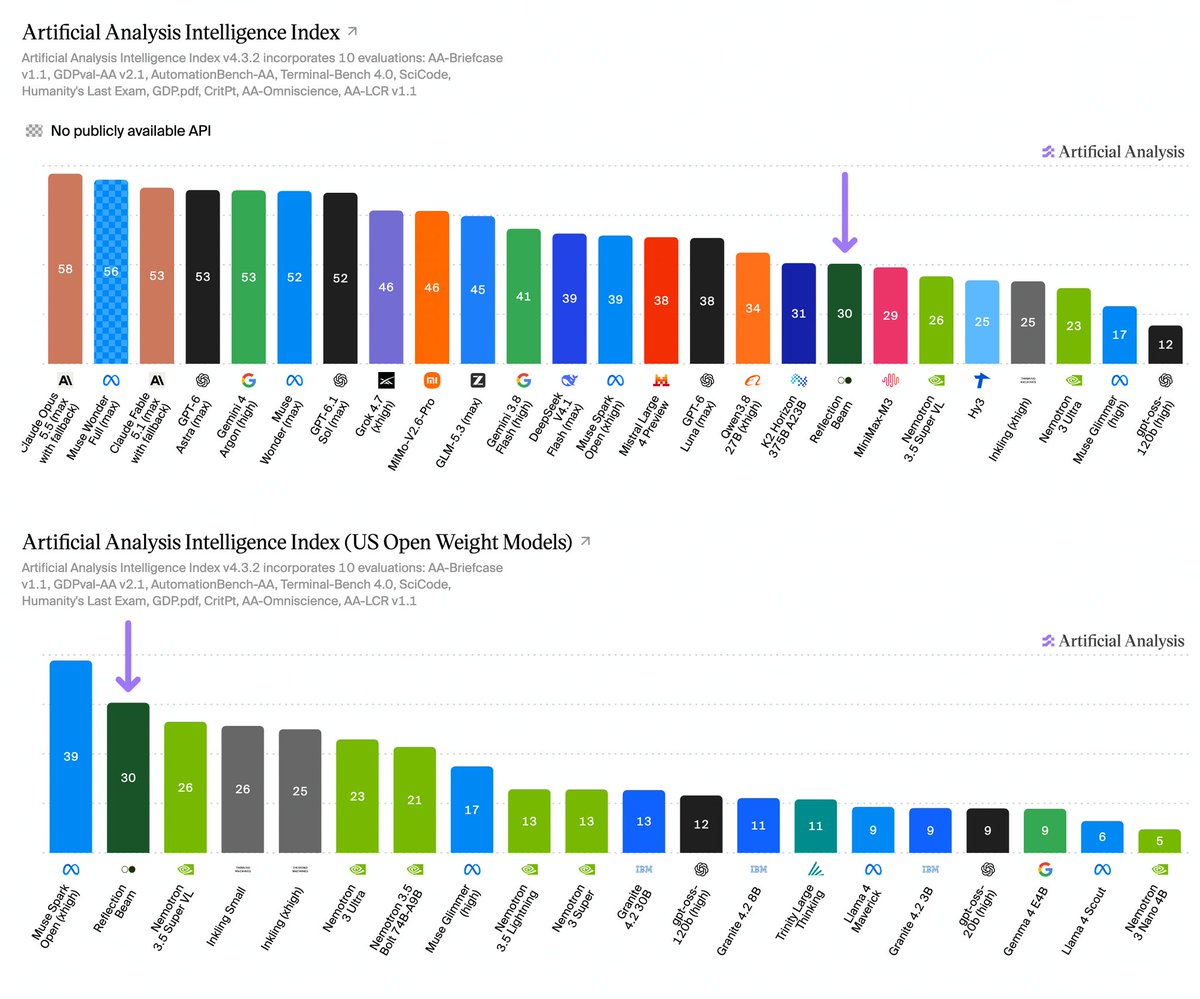
Reflection claims Beam reaches solutions with fewer reasoning tokens than comparable open models, but the Together page lists no benchmark numbers and says the tables arrive with the launch materials.
On Together AI, cached input costs $0.04 per million tokens, a tenth of the $0.40 standard input rate, with a 99.9% SLA on serverless and dedicated infrastructure.
Terms in this piece · Glossary
mixture-of-experts — A model built from many specialist sub-networks where only a few activate per token, giving big-model capability at small-model running cost.
context window — The maximum amount of text a model can consider at once — its working memory for the current conversation or task.
speculative decoding — A speed trick where a small model drafts several tokens ahead and the big model verifies them in one pass, often doubling generation speed.
alignment — The work of making AI systems actually pursue what their builders and users intend, rather than something subtly or dangerously different.