Satya Nadella is chairman and chief executive officer of Microsoft. He became CEO in February 2014 after leading its Cloud and Enterprise business, and his public talks describe the company’s approach to cloud platforms, AI products and organizational change.[1][2]
Start with Satya Nadella: Stanford View From The Top →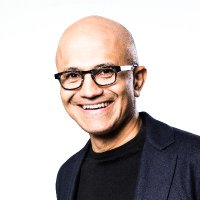
Education


Links
Microsoft biography X · satyanadella
Chief Executive Officer · Microsoft
Chairman · Microsoft
Background
Microsoft’s biography records a bachelor’s degree in electrical engineering from Mangalore University, a master’s in computer science from the University of Wisconsin-Milwaukee and an MBA from the University of Chicago. He worked on Sun Microsystems’ technology staff before joining Microsoft in 1992. The source supplies the qualifications and institutions without graduation years.[1]
Career
Before becoming CEO in February 2014, Nadella led Microsoft’s Cloud and Enterprise group as executive vice president. Earlier responsibilities included research and development in Online Services and a vice-presidential role in the Business Division. His documented contribution is leadership across these businesses and the company’s cloud transition. Microsoft’s AI models, software and infrastructure are built by teams; an executive role does not establish personal authorship of each product.[1]
Ideas
Agency and trust around more capable models
In his October 2026 London keynote, Nadella frames AI adoption around individual control, an organization’s ability to retain the knowledge it creates, and trust in deployed systems. He argues that stronger models need surrounding architecture that can control access and make outcomes accountable. The keynote then connects those concerns to Microsoft’s product strategy, including different interfaces for chat, delegated work and coding. It is an executive’s framework and product presentation, so demonstrations and projections should be understood in that setting.[2]
Culture as part of technical leadership
His Stanford interview discusses purpose and relationships at work alongside organizational culture. It gives a historical view of his leadership approach, complementing the current platform keynote. The two formats serve different needs: one explains how he thinks about leading people, while the other shows how those priorities are expressed in Microsoft’s current AI strategy.[3]
Tools, writing & talks
Writing, research & talks
Start here
Satya Nadella: Stanford View From The Topyoutube.comA 2019 conversation on purpose, relationships and company culture.
Begin with the Stanford conversation for an accessible introduction to his leadership thinking. It needs no technical background; use the newer keynote afterward to connect that thinking to Microsoft’s AI strategy.
Interview guest[3]Microsoft will scale its Maia accelerators to multi-gigawatt deployments starting next calendar year as the primary inference system for its products. It introduces Maia 300 with a claimed 40% tokens-per-watt edge over leading GPU systems. Figures are vendor claims from the announcement post.
Catalog workOriginal sourceMicrosoft's Satya Nadella proposes treating frontier models like insider risks: external deterministic controls, model diversity, tamper-proof action logs, independent auditability, containment with emergency stop, and incident disclosure.
Catalog workOriginal sourceAn article shared by Microsoft CEO Satya Nadella exploring how firms should protect their core intellectual property in the age of AI and intelligence. It references Nobel Prize-winning economist Kenneth Arrow's information paradox and examines its inverse implications for modern businesses.
Catalog workOriginal source- Satya Nadella on AI: @NoPriorsPodcast x Latent Space Crossover Special at Microsoft Build 2026youtube.com
Satya Nadella joins No Priors and Latent Space at Microsoft Build 2026 to discuss platform strategy, letting companies run their own AI as first-class participants, and takeaways from the keynote.
Catalog workOriginal source - Microsoft Frontier Tour London keynotenews.microsoft.com
An October 2026 speech connecting AI products with human control, organizational knowledge and trust.
Keynote speaker[2]