GPT-Live-1 tops the Speech to Speech Index, with latency and cost tradeoffs
- Source
- x.com
- Date
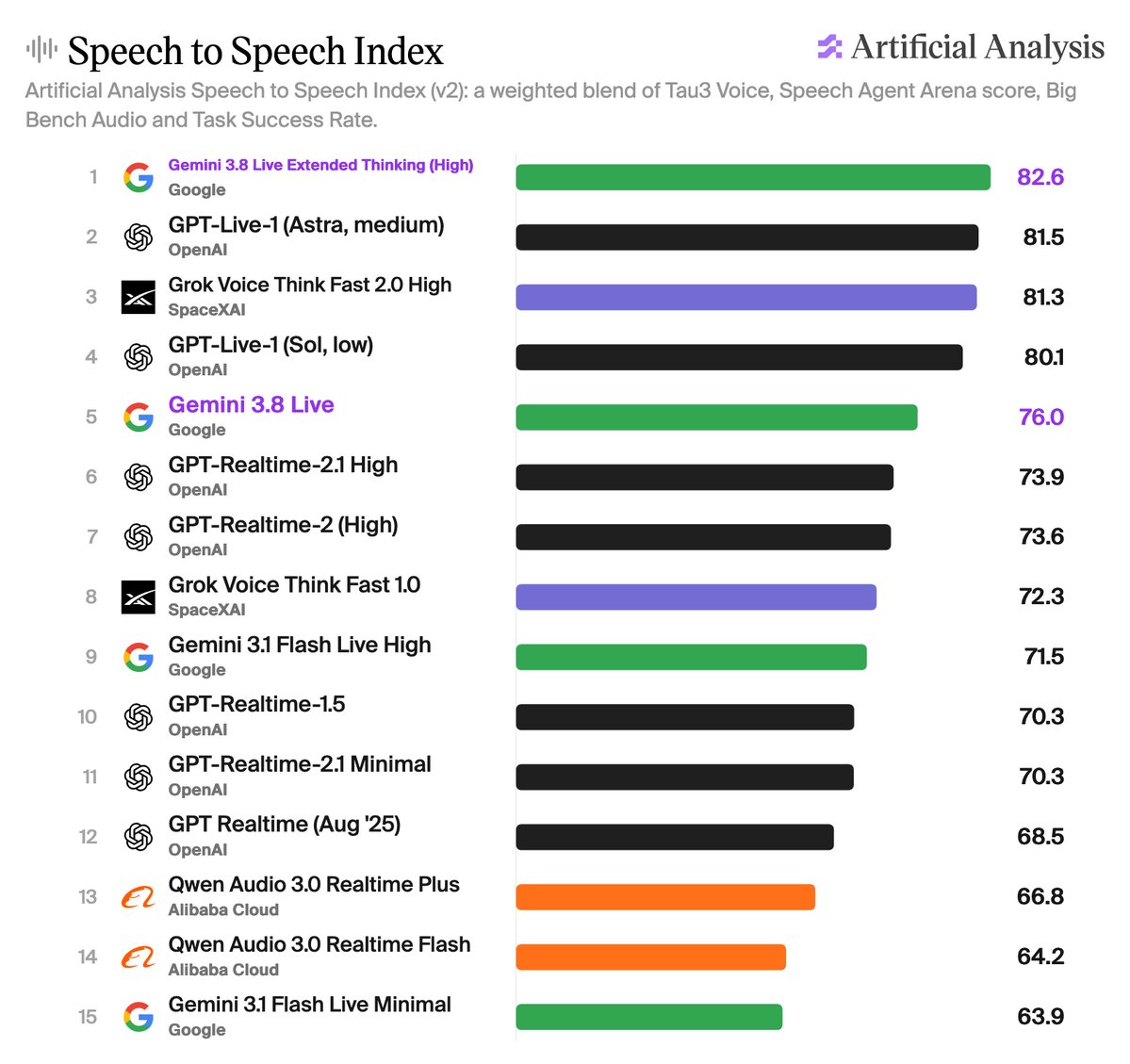
OpenAI's GPT-Live-1 debuted at the top of Artificial Analysis' Speech to Speech Index with a score of 81.5, edging out Grok Voice Think Fast 2.0 for the lead spot. The result comes from an architecture choice rather than a bigger voice model. GPT-Live-1 handles audio streaming and turn taking directly, then delegates reasoning and tool calls to a separately configured backend text model, splitting the job instead of asking one network to do both well. That separation lets OpenAI swap in a stronger text model for complex requests without retraining the voice component, and it explains why the model also cut interruption rates in earlier testing this month. For builders shipping real time voice agents, the pattern is now proven at the top of an independent benchmark. Keep the low latency audio loop thin, and hand anything that needs deep reasoning to a model built for that job.

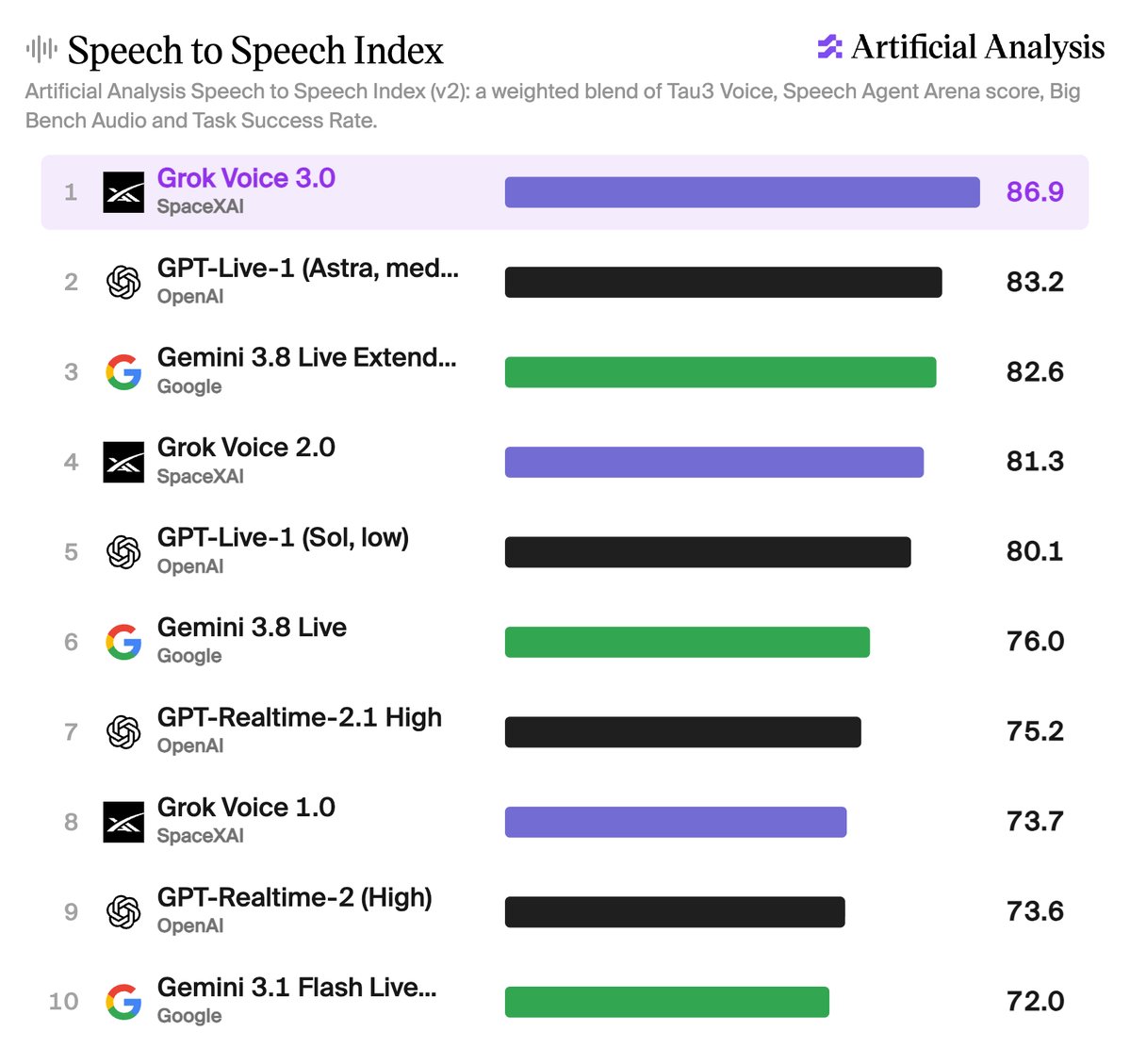
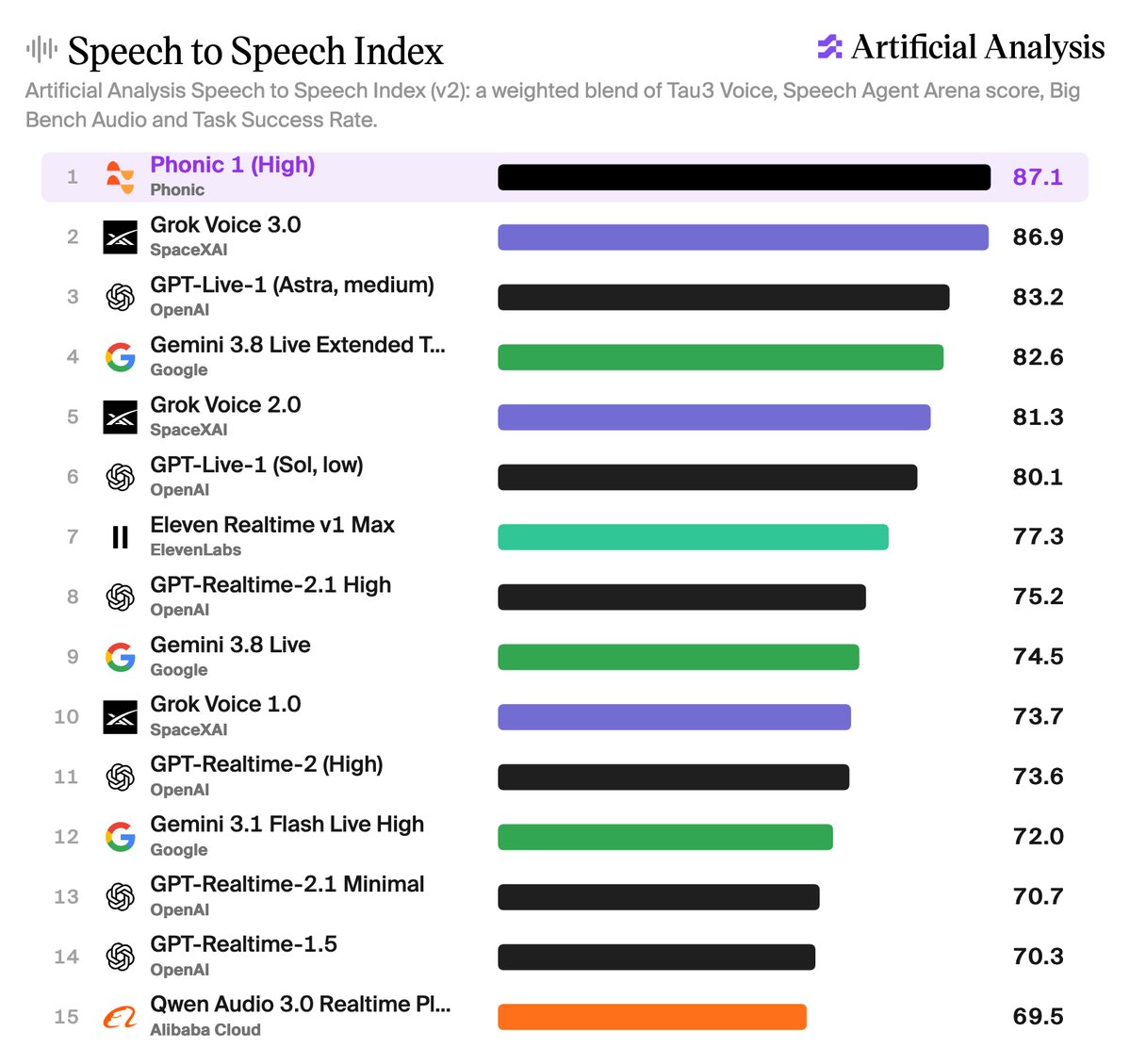
OpenAI’s GPT-Live-1 debuts at #1 on the Artificial Analysis Speech to Speech Index at a score of 81.5 using Astra as its delegated backend model, ahead of Grok Voice Think Fast 2.0 GPT-Live-1 is @OpenAI's new full duplex Speech to Speech model that can delegate reasoning and tool use to a backend text model while continuing the conversation. Developers stream audio in and receive speech back through the API, with the backend text model configured separately. We evaluated two backend configurations: Astra at medium reasoning effort and Sol at low reasoning effort. Key takeaways: ➤ Speech to Speech Index: GPT-Live-1 (Astra, medium) achieves 81.5, ranking #1, while GPT-Live-1 (Sol, low) scores 80.1, ranking #3. Grok Voice Think Fast 2.0 High sits between them at 81.3 ➤ Speech Agent Arena: GPT-Live-1 (Sol, low) ranks #3 in preference at 1,053 Elo with 90.9% Task Success Rate, while GPT-Live-1 (Astra, medium) ranks #4 at 1,048 Elo with 87.4% task success. Gemini 3.1 Flash Live Minimal leads preference at 1,096 Elo, while Grok Voice Think Fast 2.0 High leads task success at 94.6% ➤ Tau Voice: GPT-Live-1 (Astra, medium) and GPT-Live-1 (Sol, low) take the top two spots on our…

Context
GPT-Live-1's first place on the Artificial Analysis Speech to Speech Index is a 0.2-point lead, and the other results Artificial Analysis reports are split. Artificial Analysis reports that OpenAI's new model scored 81.5 when paired with a backend model called Astra at medium reasoning effort, against 81.3 for Grok Voice Think Fast 2.0 High. A second configuration, backed by Sol at low reasoning effort, scored 80.1 and ranked third.
The two configurations exist because of how the model works. Artificial Analysis describes GPT-Live-1 as a full-duplex speech-to-speech model: developers stream audio in and receive speech back through the API, and the model can hand reasoning and to a separately configured text model while it continues the conversation. Which backend a developer picks changes both results and price.
GPT-Live-1 led on Tau Voice, Artificial Analysis's agentic-performance , with 67.9% for the Astra configuration and 59.3% for Sol, ahead of Grok at 56.5%. It trailed elsewhere. On Big Bench Audio, an audio reasoning test, it scored 90.1% and 89.0%, behind Grok at 97.2% and Qwen Audio 3.0 Realtime Plus at 99.2%. Its average time to first audio on that test was 1.34 seconds with Astra and 1.24 with Sol, against 0.70 for Grok. In the Speech Arena, which reports preference as an Elo rating alongside a task success rate, the Sol configuration ranked third at 1,053 with 90.9% task success and Astra fourth at 1,048 with 87.4%; Gemini 3.1 Flash Live Minimal led on preference at 1,096 and Grok led on task success at 94.6%.
Including backend model usage, the Astra configuration cost $5.83 per hour of input audio and Sol $4.47, against $4.80 for Grok, on Artificial Analysis's fixed Big Bench Audio pricing subset. Within GPT-Live-1, the cheaper Sol setup was slightly faster and did better in the arena, while Astra did better on the index and Tau Voice. Against Grok, GPT-Live-1's advantage rests on Tau Voice and the narrow index lead; Grok responded faster and scored higher on audio reasoning and arena task success.
- tool use — A model's ability to call external functions — run code, search the web, edit files — instead of only generating text.
- benchmark — A standard public test set for comparing AI models — the shared scoreboards behind every "model X beats model Y" claim.
- AI agent — An AI system that doesn't just answer once but works toward a goal in a loop — taking actions, reading the results, and deciding what to do next.
Checking sign-in…
Loading comments…