The Dot and the Swarm
- Source
- oneusefulthing.org
- Author
- Ethan Mollick
- Date
In The Dot and the Swarm, Ethan Mollick revises a position he had held: that getting value from many agents depends on humans designing their organization carefully. His updated argument applies the Bitter Lesson to agents. Models now plan, look for information and coordinate with each other well enough that elaborate human-built structure, such as long prompt chains and hand-tuned context pipelines, tends to be overtaken by the next stronger model. The claim is a judgment, not a measurement, and it sits in tension with work like today's bounded-loop paper, which shows structure still matters for checking whether work is done. The practical question it raises for teams is how much to invest in custom orchestration that may need rebuilding at the next model release, versus simpler setups that let the model do more of the coordination.
Context
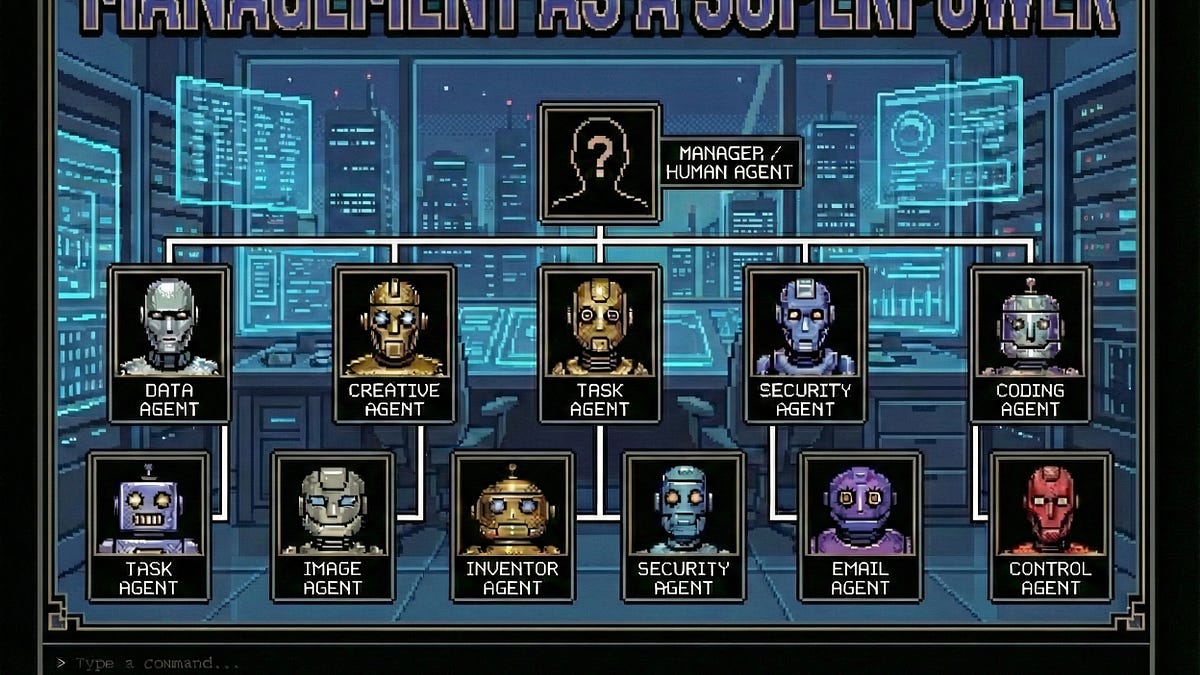
Ethan Mollick, a management educator, argues that organizing AI workers may require less detailed human planning than expected. In the essay, a brainstorming request led OpenAI's Codex to create three agents; a short outline of brainstorming, research and reader teams led it to create thirteen.
The observation concerns delegation: the system filled in parts of the working arrangement from a broad task and a light organizational sketch. Mollick uses it to argue that people may increasingly concentrate on choosing goals and directing effort. The essay leaves open how well these arrangements handle the prolonged, routine work of an actual organization.
- Ethan Mollick says he got a major prediction wrong: he expected people would have to carefully design how teams are organized, like building a company, but now treats organizing agents as one more task models learn, an instance of the Bitter Lesson.
- Mollick says personal agents such as dots and Muse matter less for their task lists than for what you no longer have to tell them: they pick up from your messages, make their own plans, and in his use have started catching his mistakes.
- He describes OpenAI's reported Navier-Stokes proof (not yet formally accepted) as a swarm of thousands of agents under thin coordination: a few groups, one change of direction, and Codex passing ideas between them, with about 2.7 million messages over 88 hours.
- In his own test, a Codex prompt with GPT-6 Astra Ultra spun up three agents; sketching three teams in a few sentences (brainstormers, researchers, a reader panel) produced thirteen, with the model doing the rest of the organizing.
- Mollick argues much of management exists to fix human problems like conflicting incentives, scattered information and costly communication, which agents largely lack, but says principal-agent problems now sit between agents and people, citing OpenAI shelving GPT-6.1 Astra.
- AI agent — An AI system that doesn't just answer once but works toward a goal in a loop — taking actions, reading the results, and deciding what to do next.
- context window — The maximum amount of text a model can consider at once — its working memory for the current conversation or task.


Checking sign-in…
Loading comments…