Meta's Muse Spark Open tops US open-weight benchmarks
- Source
- x.com
- Date

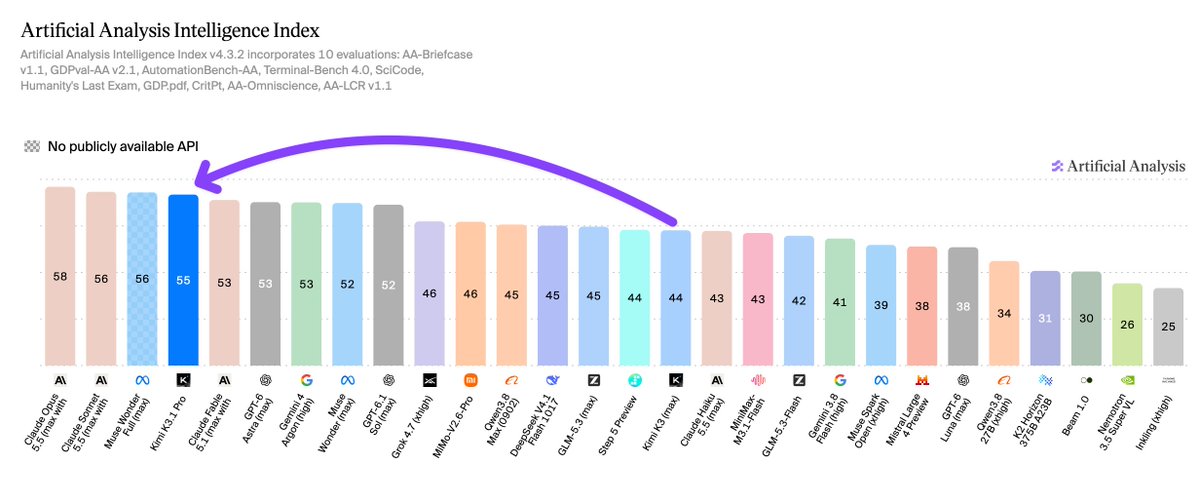
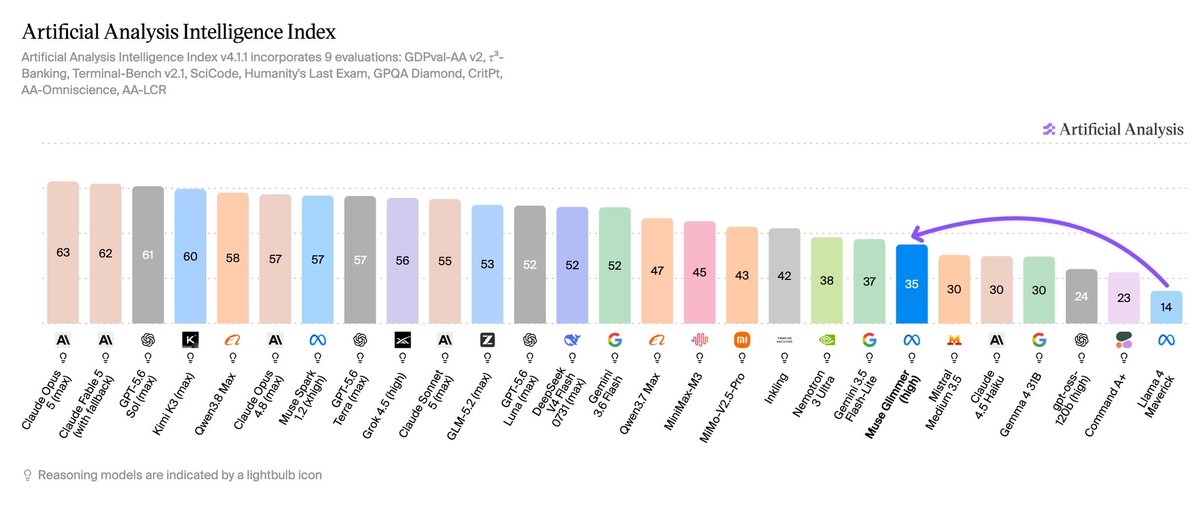
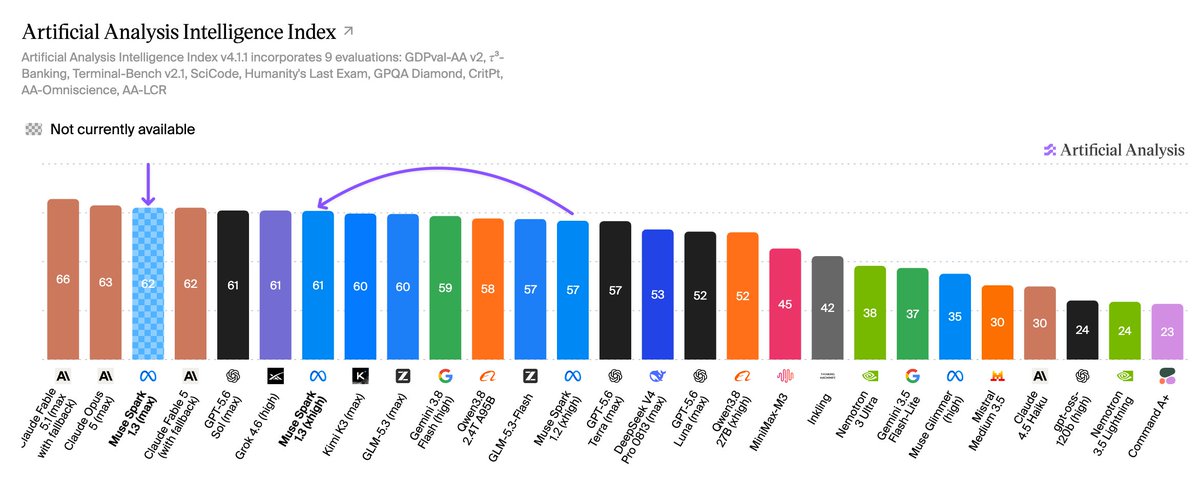
Meta has released Muse Spark Open, an 816B (42B active) open-weights model that scores 39 on the Artificial Analysis Intelligence Index, making it the #1 US open-weights model Muse Spark Open (xhigh) scores 22 points above Muse Glimmer (high, 17), Meta's 30B dense open-weights model from August. It is also ahead of NVIDIA's Nemotron 3.5 Super VL (26), the next highest-scoring US open-weights model, which launched today @AIatMeta shared access with us ahead of public release for benchmarking. Congratulations to @AIatMeta, @finkd, and @alexandr_wang on the release! Key Takeaways: ➤ Open weights at the level of Meta's August flagship. Muse Spark Open scores within a point of Muse Spark 1.2 (xhigh, 40). It is stronger on AutomationBench-AA and has a lower hallucination rate, but weaker on GDPval-AA v2.1, CritPt and AA-Omniscience accuracy. Within Meta's current lineup, it sits 13 points behind Muse Wonder (max, 52) and 17 points behind Muse Wonder Full (max, 56) ➤ Token-efficient, at a moderate cost per task. Muse Spark Open uses 40k output tokens per Intelligence Index task, the fewest among the nine highest-scoring open-weights models: e.g. 16% fewer than Muse Spark 1.2 (xhigh, 48k) and 43% fewer than GLM-5.3 (max, 71k), its closest Chinese peer by size. Together AI, Fireworks and Baseten offer it at launch for $1.25/$4.25 per 1M input/output tokens ($0.15 cached input). At that pricing it costs $0.84 per Intelligence Index task. That is less than Muse Spark 1.2 ($0.97) at the same per-token prices and less than half of GLM-5.3 (max, $2.01), but about three times DeepSeek V4.1 Flash (max, $0.27) ➤ A relative weakness in agentic work compared to Chinese open-weights leaders. Among the nine highest-scoring open-weights models, Muse Spark Open ranks last on the four agentic evaluations in the index but fourth on the other six combined, and it leads all open-weights models on AA-Omniscience (25). GLM-5.3 (max), the closest Chinese model by size, owes all of its 6-point lead to the agentic evaluations ➤ Self-hostable on a single node, or two Mac Studios. BF16 weights are ~1.6TB. Meta's NVFP4 checkpoint quantizes only the 256 experts, cutting the weights to ~530GB. Meta says this runs on four Blackwell Ultra GPUs or eight H200s, or on two 512GB M5 Ultra Mac Studios using MLX. The architecture uses 62 layers with grouped-query attention (16 KV heads), 8 of 256 experts active per token, and a 1.8B-parameter Perception Encoder for vision Other model details: ➤ Parameters: 816B total, 42B active (MoE) ➤ Context window: 1M tokens ➤ License: Muse Model License, a custom license that requires "Built with Muse Spark Open" attribution and a separate agreement with Meta for Model-as-a-Service businesses with over $20M in annual revenue ➤ Input modalities: text, image, video and audio. Output: text ➤ Availability: weights on Hugging Face (BF16 and NVFP4), with API access via Baseten, Fireworks AI, Groq, Modal, Nebius, OpenRouter and Together AI

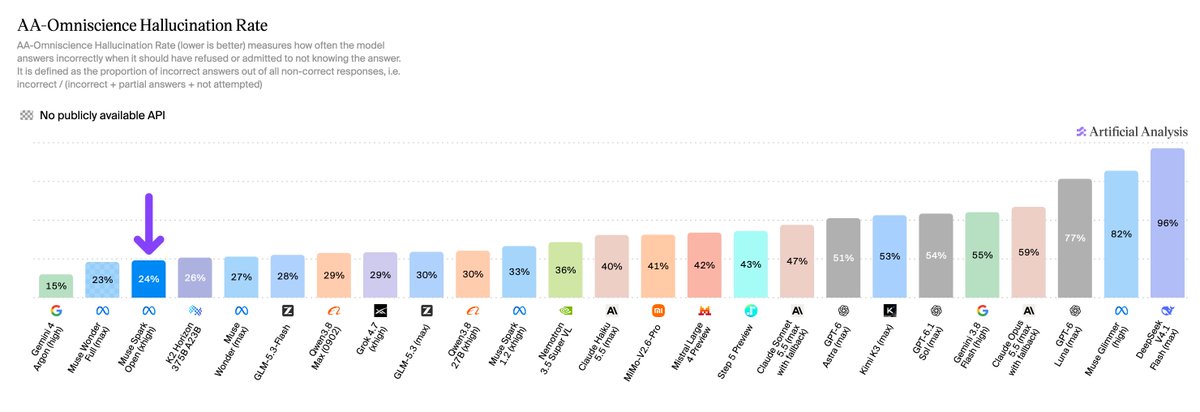
Muse Spark Open (xhigh) leads all open-weights models on AA-Omniscience (25), driven by the lowest hallucination rate of any open-weights model scoring 30 or more (24%)
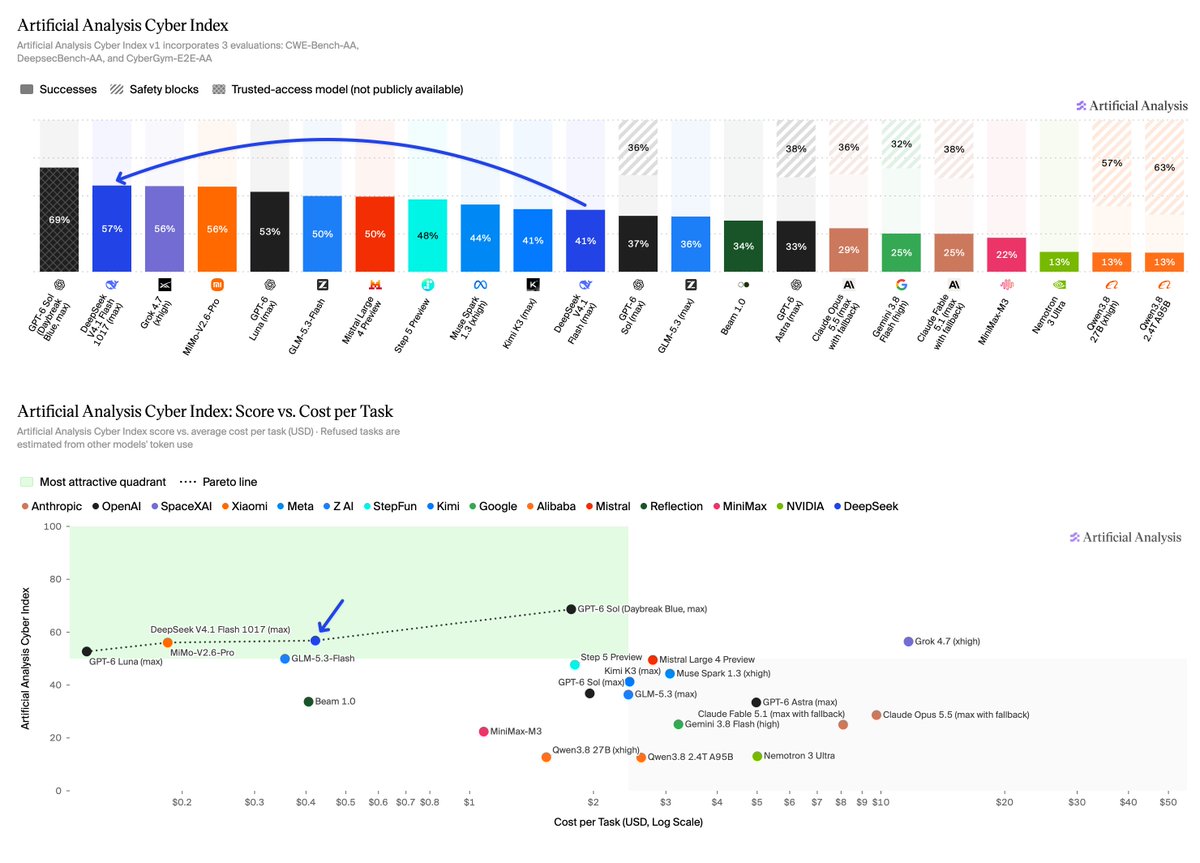
Muse Spark Open costs $0.84 per Intelligence Index task at current API pricing of $1.25/$4.25 per 1M input/output tokens ($0.15 cached input) from Together AI, Fireworks and Baseten - less than half of GLM-5.3 (max, $2.01), but about three times DeepSeek V4.1 Flash (max, $0.27)


Context
Meta's Muse Spark Open is a model with 816 billion parameters, of which 42 billion are active for each : a router sends each token to 8 of 256 expert sub-networks rather than through the whole model. On Artificial Analysis' Intelligence Index, a composite of ten evaluations, it scores 39, which the benchmarker says makes it the highest-scoring US open-weights model (Artificial Analysis). That is 22 points above Muse Glimmer, Meta's 30B open-weights model from August, and ahead of NVIDIA's Nemotron 3.5 Super VL at 26. It is also within a point of Muse Spark 1.2 (40), Meta's August flagship. Meta's current Muse Wonder models score higher still, at 52 and 56. Artificial Analysis tested the model with access Meta gave it before the public release. Meta's own announcement is separate Intel.
The more useful finding is where the score comes from. Among the nine highest-scoring open-weights models, Muse Spark Open ranks last on the index's four agentic evaluations but fourth on the other six combined. It leads all open-weights models on AA-Omniscience (25), helped by a 24% rate, the lowest of any open-weights model scoring 30 or more. Artificial Analysis says Z.ai's GLM-5.3, the closest Chinese model by size, owes all of its 6-point lead over Muse Spark Open to the agentic evaluations. In short, its overall standing rests on the index's non-agentic tests, and it is comparatively weak at the multi-step, tool-using tasks the agentic evaluations measure.
It is also economical with output. It uses 40k output tokens per index task, the fewest among those nine models and 43% fewer than GLM-5.3. At the launch price from Together AI, Fireworks and Baseten ($1.25 per million input tokens, $4.25 per million output tokens), that works out to $0.84 per task. That is less than half of GLM-5.3's $2.01 but about three times DeepSeek's V4.1 Flash at $0.27.
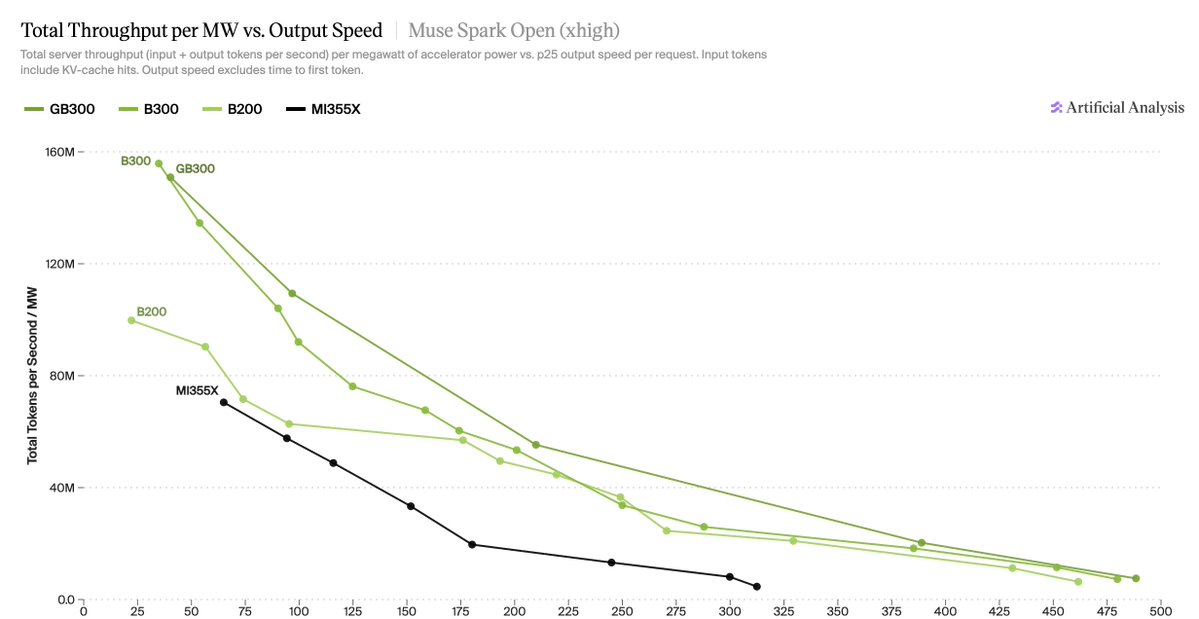
The weights can be run outside Meta's cloud. Artificial Analysis reports that the full BF16 weights are about 1.6TB, and that Meta's NVFP4 checkpoint compresses only the 256 experts to 4-bit, bringing the full set of weights to about 530GB. Meta says that version runs on four Blackwell Ultra GPUs, eight H200s, or two 512GB M5 Ultra Mac Studios. The custom Muse Model License requires a "Built with Muse Spark Open" attribution. Model-as-a-Service businesses with more than $20M in annual revenue need a separate agreement with Meta. All scores here come from one benchmarker's thread; Meta's own claims are reported secondhand, and the chart images with the full results were not read.
- mixture-of-experts — A model built from many specialist sub-networks where only a few activate per token, giving big-model capability at small-model running cost.
- token — The chunk of text a model reads and writes in — roughly three-quarters of a word — and the unit AI usage is billed in.
- hallucination — When a model states something false with full confidence — inventing facts, citations, or APIs that don't exist.
- eval — A repeatable test for AI quality — a set of tasks plus scoring — used the way software teams use test suites, because model output is too variable to judge by eyeballing.
Checking sign-in…
Loading comments…