VLM agents replicate Picbreeder and fall short of human open-endedness
- Source
- pub.sakana.ai
- Author
- Sakana AI
- Date
Context
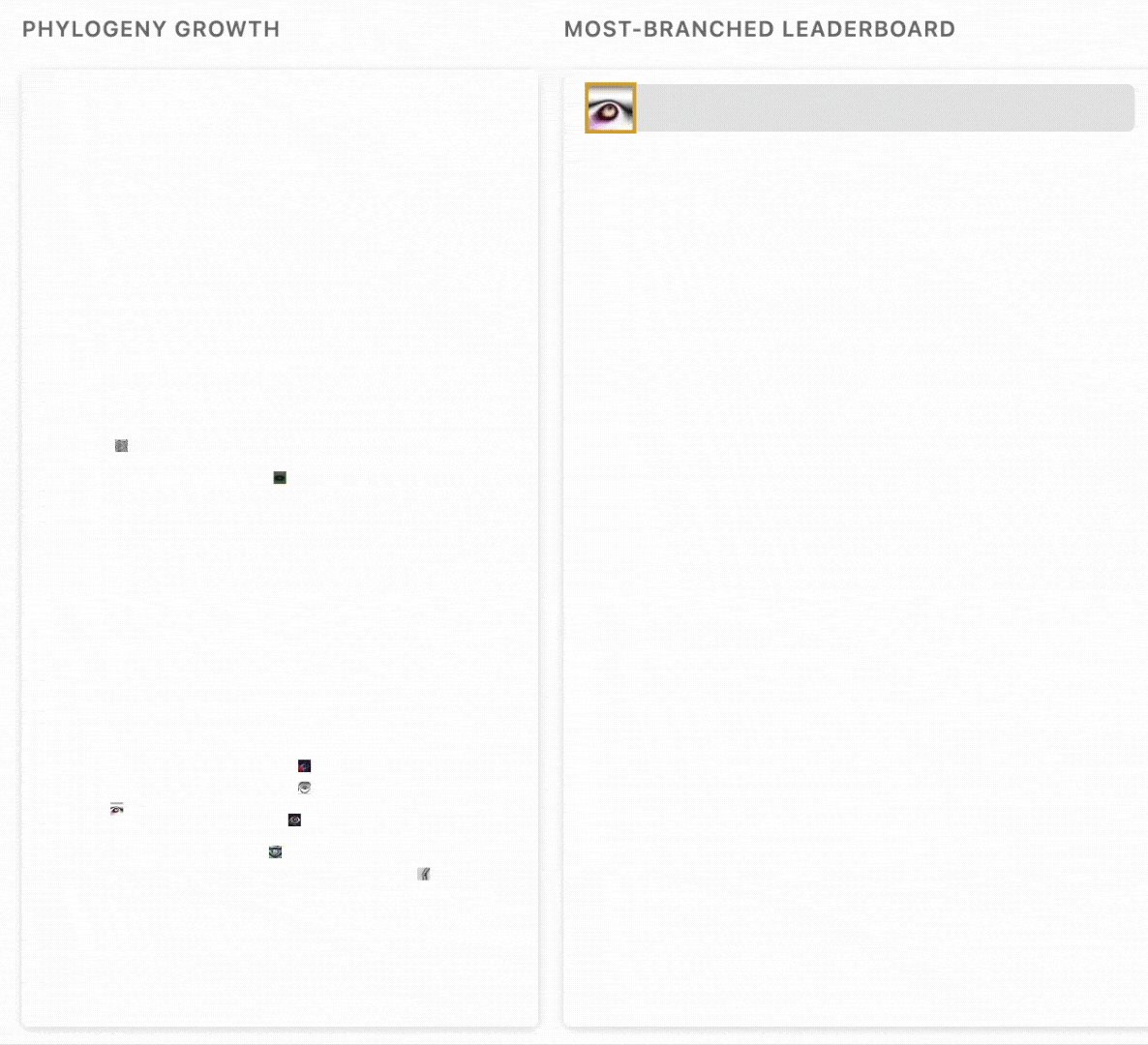
Picbreeder was a website, live from 2008 until around 2016, where people evolved images without any goal. A user picked the pictures they liked from a grid, the site bred and mutated those picks into new candidates, and anyone could branch from an image someone else had published. Each image is drawn by a small neural network that turns pixel coordinates into colors, and the site evolved both the network's weights and its wiring. Across 9,758 published images, recognizable faces, animals, vehicles and skulls emerged that nobody had set out to make. In a GECCO 2026 paper, researchers from Sakana AI, NYU and MIT rebuilt the site's loop with vision-language models, AI systems that read images as well as text, in place of the people, to ask whether such agents can make the same kind of unplanned discoveries.
Mostly they could not. Ten agents, running Google's Gemini 2.5 Pro by default, branched from a shared archive, evolved each image for 20 generations, published and titled a favorite, and rated other agents' work, for 2,000 sessions per run. The human archive outscored the agents' archives on most of the authors' measures of how recognizable and how varied the images were, and the agents' family trees were lopsided: they kept branching from the same few images and rarely started from scratch. Without added randomness, an archive could fill with dozens of minor variations on a few forms, such as fox-like and fishbone-like shapes. More memory did not fix this. Agents that saw only the current generation published duplicates, a single earlier step helped, and longer histories made results worse, with one setting producing near-photorealistic top-down soda cans again and again across runs.
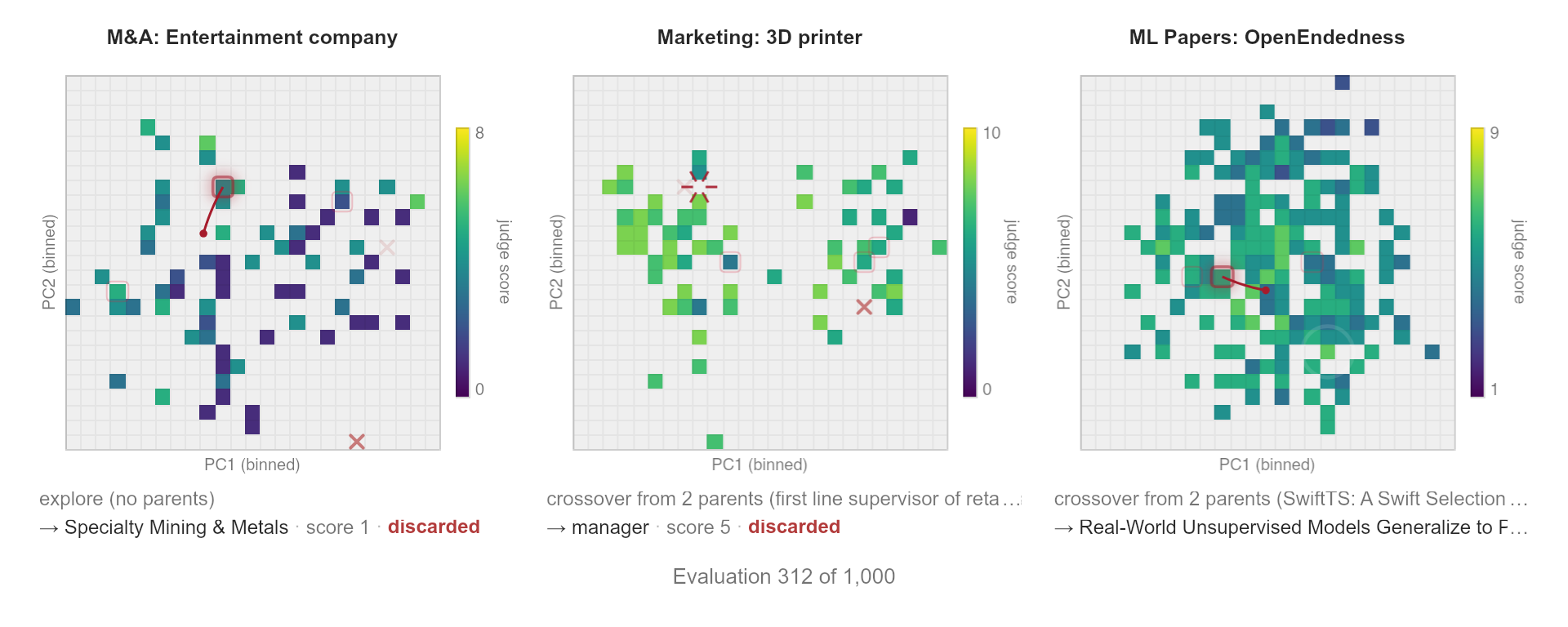
Diversity among the agents helped most, with a catch. The researchers had a write 1,000 personality traits, such as an "searching for the dry red color of terracotta clay," and gave each session one of them. With all 1,000 in play, the archive matched the human one on semantic coverage (0.734 against 0.730, a gap well within the paper's reported margin of error), which measures how varied the images' captioned contents are, and had more balanced family trees than any other agent setting. But 10 to 20% of those archives were high-frequency, uninterpretable patterns that the authors liken to adversarial attacks, and that kind of noise scored highest of all on semantic coverage. The setting that came closest to people on that number is also the one most filled with images a person could not read as pictures. The authors say longer and larger runs, and studies with human judges, are needed to establish how open-ended these models can be; for now, as Sakana's project page puts it, humans seem better at noticing a lucky accident and building on it, while the agents tend to get stuck in their own favorite patterns.
- LLM — A large language model — the neural network behind tools like Claude and ChatGPT, trained on huge amounts of text to predict what comes next.
- AI agent — An AI system that doesn't just answer once but works toward a goal in a loop — taking actions, reading the results, and deciding what to do next.





Checking sign-in…
Loading comments…