How Chinese AI labs earn money despite open weights
- Source
- x.com
- Date

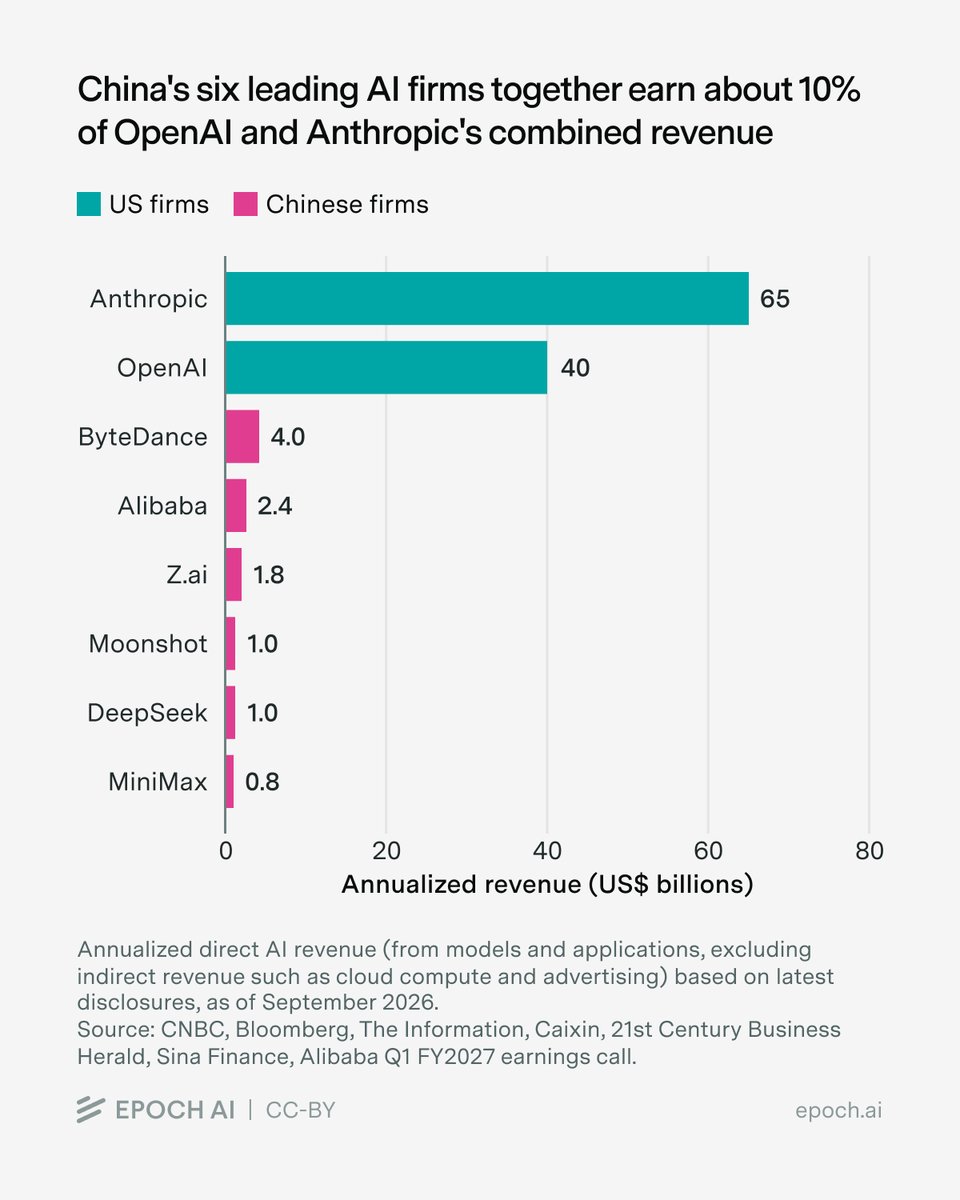
How do Chinese AI firms make money? In a new report, @cherylwoooo and @ansonwhho identify five revenue sources and analyze how much each contributes. 🧵
Context
Epoch AI's report on how Chinese AI companies make money, published October 6, 2026, says API margins are often limited because model weights are publicly released, which reduces pricing power. Its example: after Z.ai released weights for GLM 5.3 Flash, its share of that model's on OpenRouter fell from 88% to 22% in 20 days. Across 21 Chinese models, developers charging a higher premium over the cheapest host captured a smaller share of their own model's tokens.
The report identifies five revenue sources: consumer apps, selling model access, consulting and customizing AI for enterprises and governments, licensing, and complementary products such as hardware and compute. It estimates that six leading firms, Alibaba, ByteDance, Z.ai, Moonshot AI, DeepSeek and MiniMax, together earn about 10% of what OpenAI and Anthropic earn combined from AI as of September 2026.
Epoch notes that the estimates come from different months, from June to September 2026, that some are annualized from interim reports, and that there is little public data on licensing revenue. For another account of how these firms earn revenue despite open releases, see Intel's coverage of an Odd Lots interview.
- token — The chunk of text a model reads and writes in — roughly three-quarters of a word — and the unit AI usage is billed in.
- open weights — A model whose trained parameters are published for anyone to download and run — unlike API-only models you can access but never possess.

Checking sign-in…
Loading comments…