SpireClimb: frontier models now win Slay the Spire via GUI
- Source
- epoch.ai
- Publisher
- Epoch AI
- Author
- EpochAIResearch
- Date
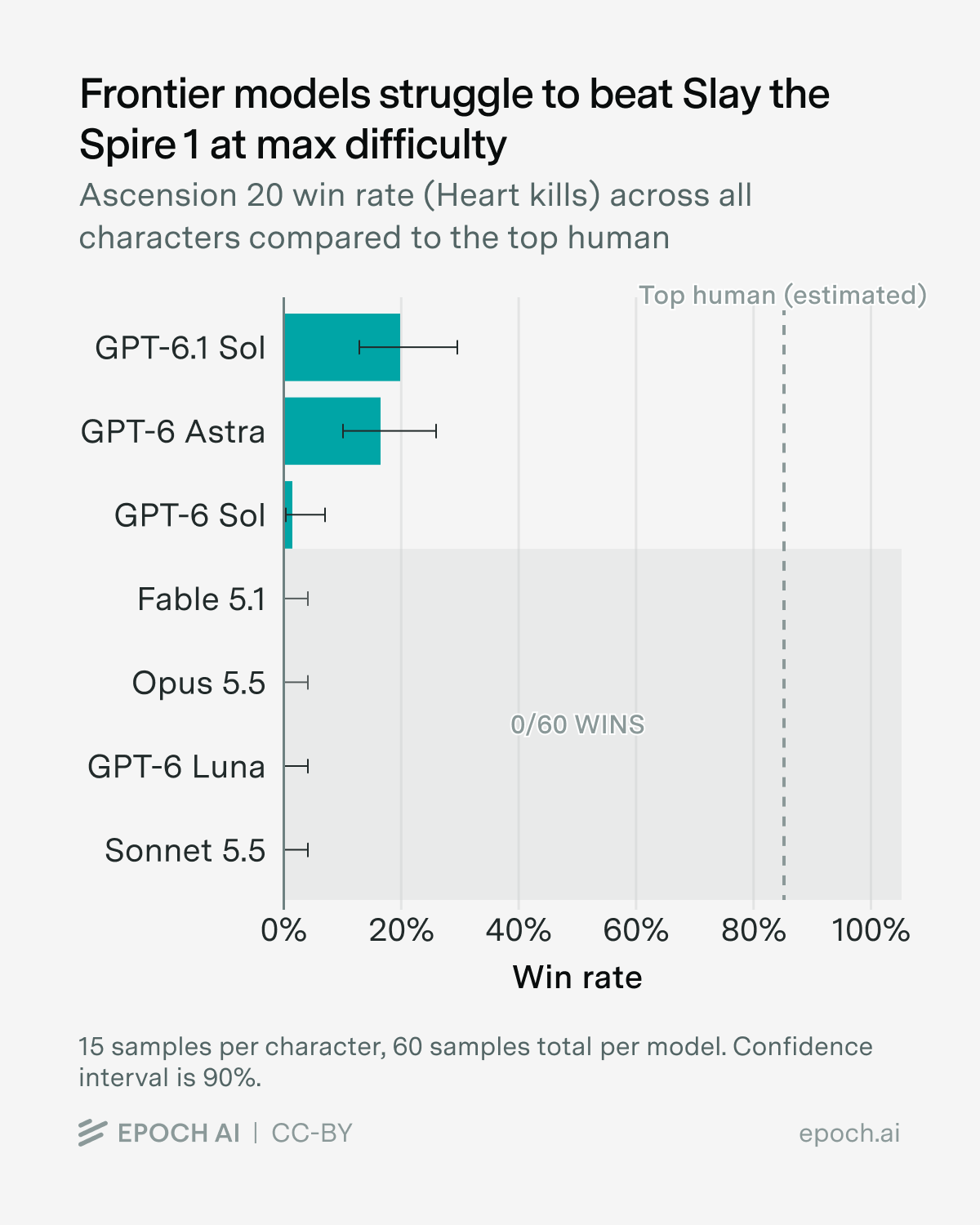
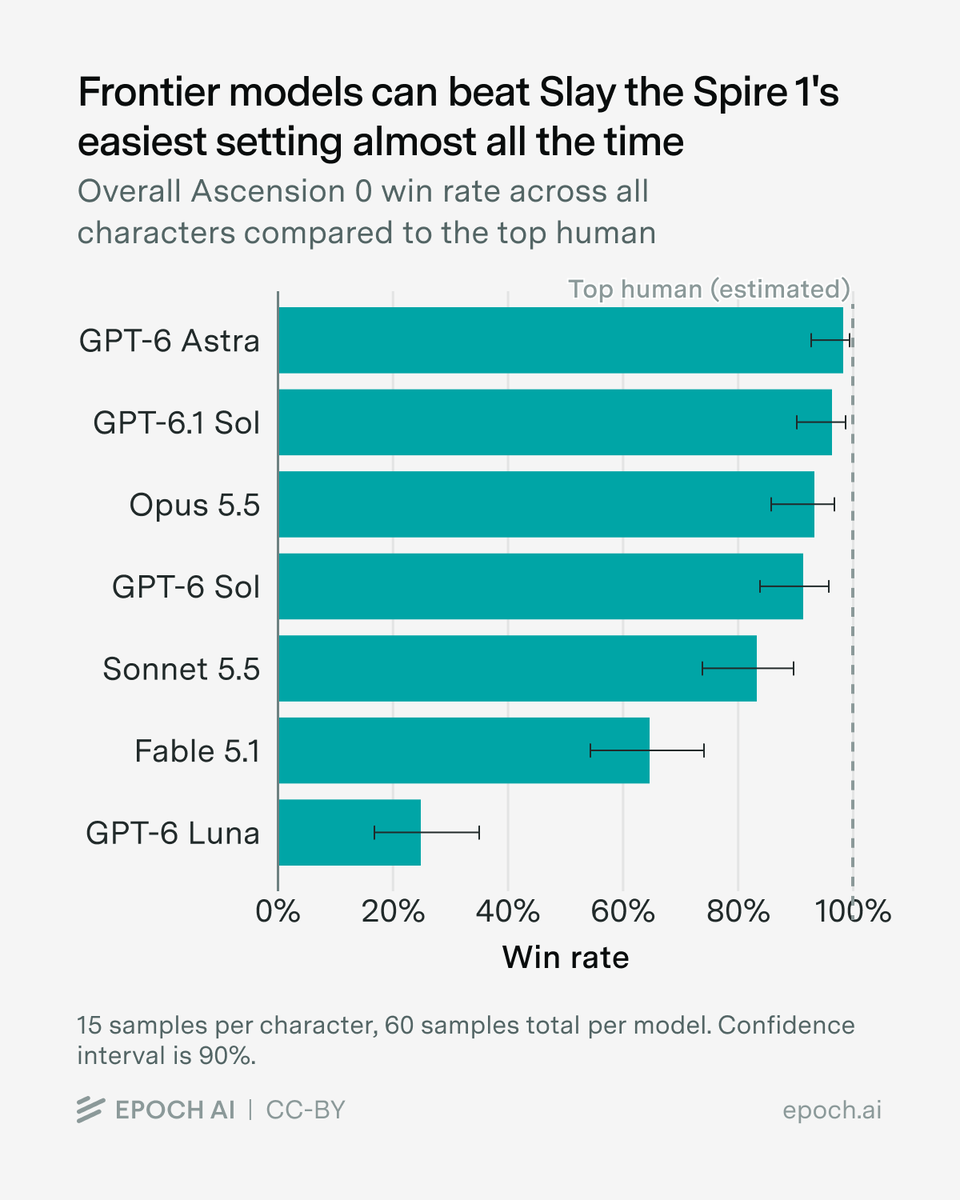
Epoch AI's SpireClimb benchmark has frontier models play the deckbuilding game Slay the Spire using only its graphical interface, with no special API into game state. That makes it a long-horizon computer use test: a run requires many sequential decisions where early choices shape later options. Epoch reports win rates above 90% on the easy setting and about 20% on the hardest difficulty. Epoch describes this as a large jump from results six months earlier, while noting that the hardest setting remains well below top human players. The gap between easy and hard difficulty is the useful part for agent builders. Models now handle long GUI sessions reliably when the margin for error is wide, but still fall off when sustained planning under tight constraints decides the outcome.
Context
Epoch AI built SpireClimb to give Slay the Spire, a card-battling strategy game with randomness and hidden information, a consistent test after earlier attempts used varied harnesses and rules. Models play through the game's graphical interface in a single-agent computer-use built on Inspect ReAct. Each gets 15 independent single-shot attempts per character in each game on a fixed set of seeds, may keep notes that survive , and may consult the game's wiki. Epoch says the aim is roughly what an unskilled user would get by asking a desktop AI app to play the game for them.
On the original game's base difficulty, Ascension 0, frontier models now win at least 90% of the time, where six months earlier they struggled to win at all. The real test is Ascension 20 Heart, the maximum setting, which also requires beating an optional final boss. There, GPT-6.1 Sol won 20% of runs and GPT-6 Astra 17%, up from 0% a few months earlier. Strong human players regularly exceed 50%, the player widely considered best shows 80% to 95% depending on character, and Epoch says top players regularly reach at least 80% at maximum difficulty in both games.
Epoch notes a -data caveat. Every model tested showed detailed prior knowledge of the original game, which was released in 2017, and Epoch attributes the jump to some mix of better computer use, general game-playing ability and perhaps reinforcement learning on the game itself. The sequel is new enough to be largely outside training data. Epoch froze it at version 0.107.1, and it is easier because it lacks an equivalent of the Heart boss. At its maximum setting, Ascension 10, frontier models exceeded 25%, about twice their rate on the original. Epoch reads this as evidence that models take no significant penalty on a less familiar game, while acknowledging that per-character samples are small. It also expects the visual harness to understate pure reasoning, since interface mistakes still occur.
- Setup — The combination of a model, a harness, its connections and the path the task's data takes, considered together for a task.
- Harness — The software that sends a model its context, recognizes tool calls, runs or refuses them, returns results and keeps the record.
- context compaction — Summarizing an agent's earlier conversation to free room in the context window so a long session can keep going.
- Training — The process that adjusts a model using examples and a measure of how well it performs.