What You Need To Know About Ai Data Centers
- Source
- epoch.ai
- Author
- Epoch AI publications
- Date

Context
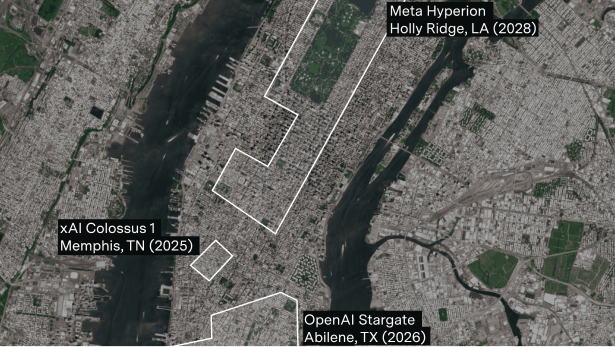
This Epoch AI topic overview by Ben Cottier and Yafah Edelman dates from 2025 and was last updated November 4, 2025 (epoch.ai). Its forward-looking figures are projections made then. The overview opens with OpenAI's Stargate site in Abilene, Texas to show the scale. It will need enough electricity to serve the population of Seattle and more than 250 times the computing power of the supercomputer that trained GPT-4, along with $32 billion in construction and IT equipment and around two years to build. Epoch's separate data insight on buildout speeds tracks construction timelines for several such gigawatt-scale campuses.
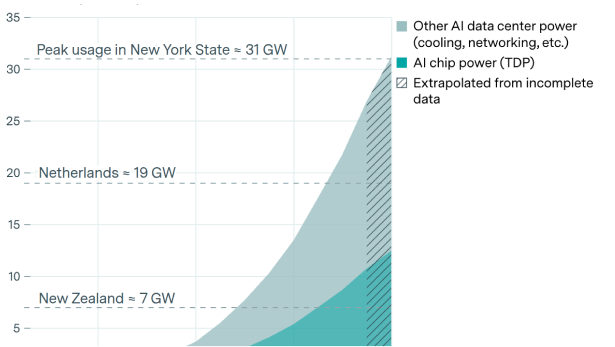
The central argument is that power decides where these facilities go. Epoch estimates US AI data centers will collectively need 20 to 30 gigawatts by late 2027. Thirty gigawatts is about 5% of US power generation capacity and 2.5% of China's, but it would be about 25% of Japan's, 50% of France's and 90% of the UK's. Within the US, that pushes builders toward places like Texas, with plentiful natural gas and less regulatory red tape. Distance to users barely matters. Generating a response takes orders of magnitude longer than sending data across the globe, so even a data center on the Moon might spend longer on processing than on transmission.
What makes the buildings unusual is power density. GPUs are packed tightly into racks so they can exchange data quickly. An NVIDIA NVL72 rack holds 72 GPUs and draws over 100 kilowatts, while racks in non-AI data centers commonly use about 10 kilowatts. Fans and air conditioning cannot remove that much heat, so these sites pipe liquid coolant over the chips and then expel the heat outdoors through chillers and sometimes evaporative cooling towers. That is why AI data centers are said to use a lot of water. It also makes them hard to hide: the cooling equipment is large and visible in satellite imagery, which the authors say makes the Manhattan Project comparison somewhat inapt.
On climate, the authors say AI's broad impact is not very big yet. AI data centers use about 1% of US power, compared with 12% for air conditioning and 8% for lighting. US data centers directly used around 17.4 billion gallons of water in 2023, while agriculture used about 36.5 trillion, roughly 2,000 times more. Local effects could still be significant in regions with less energy available, and Epoch projects AI data centers could demand 5% of US electricity generation in 2027. It concludes that broad climate effects could arrive within the next decade if trends continue and the facilities keep relying on fossil fuels.
- Epoch AI estimates US AI data centers will need 20 to 30 GW by late 2027. That is about 5% of US generation capacity, but 30 GW would be roughly 25% of Japan's, 50% of France's and 90% of the UK's, which favors the US and China for gigawatt-scale sites.
- Distance to users barely matters: Epoch calculates Texas-to-New York transfer at about 12.5 ms, while generating a 1,000-word response takes on the order of 10 seconds, so builders pick sites for power, not proximity to cities.
- Power density drives the design. An NVL72 GB200 rack draws over 100 kW in about 0.5 square meters, against roughly 10 kW for a typical non-AI rack. That forces liquid cooling, the reason AI data centers are associated with heavy water use.
- Epoch judges AI's broad climate effect small so far: AI data centers use about 1% of US power, versus 12% for air conditioning, and all US data centers used 17.4B gallons of water in 2023 against agriculture's 36.5 trillion. It projects 5% of US electricity by 2027.
- Gigawatt sites are hard to keep secret: thousands of workers from several organizations build them, and their large outdoor cooling equipment is visible in satellite imagery, which Epoch says weakens the Manhattan Project analogy.
Checking sign-in…
Loading comments…