Ant Group Releases Health-Focused MoE Model Ling-3.0-flash-Sante
- Source
- x.com
- Date

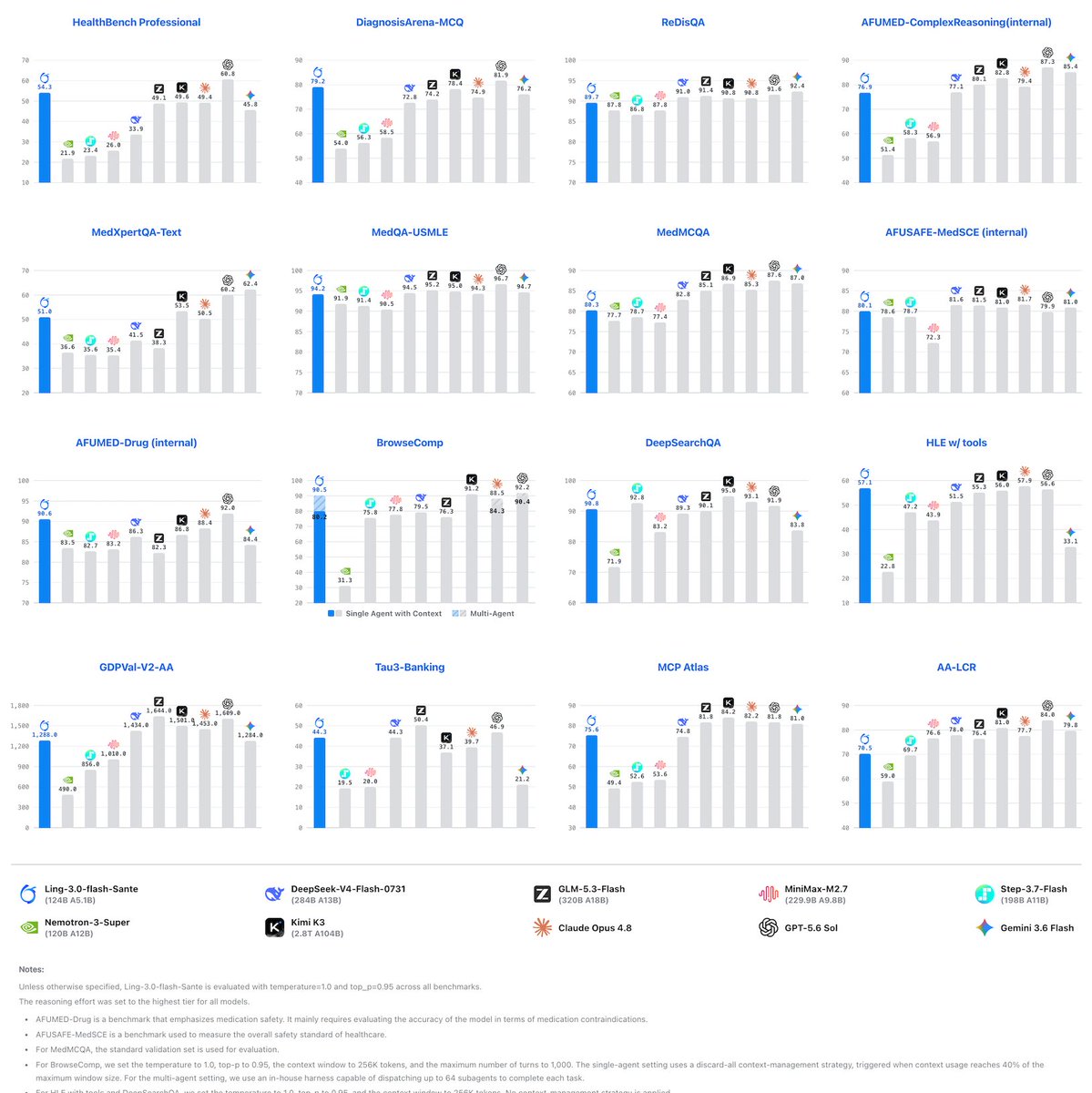
Today, we’re introducing Ling-3.0-flash-Sante — an MoE model enhanced for health and medicine, built on Ling-3.0-flash. Inspired by the French word “santé,” meaning “health,” Sante is built for real-world healthcare tasks spanning medical reasoning, professional healthcare tasks, deep research, and evidence-based retrieval. Sante shows competitive results across MedXpertQA-Text, DiagnosisArena-MCQ, AFUMED-Drug, HealthBench Professional, and BrowseComp, with leading performance among open-source models and results competitive with flagship models. Here’s to better health — Santé! More below ↓

Context
Ant Ling, the team behind Ant Group's Ling models, introduced Ling-3.0-flash-Sante on September 4 as a version of its Ling-3.0-flash model tuned for health and medicine. According to the model card, it has 124 billion parameters but activates only 5.1 billion for each . It is a model, which routes each token through a small subset of its parameters, so it runs with the per-token compute of a much smaller model. The card says it is built for medical reasoning, healthcare research, deep research and tool-assisted workflows.
The announcement says Sante leads open-source models and is competitive with flagship models on five benchmarks, including MedXpertQA-Text, AFUMED-Drug and HealthBench Professional. Its text gives no scores, the post's attached image was not read for this summary, and the model card shows its results only as a figure, so the claim stands as Ant's own summary rather than an independent result. The card's evaluation notes, published with the weights in October, show how Ant ran the tests: every model in the comparison used its highest reasoning effort, AFUMED-Drug checks accuracy on medication contraindications, and the BrowseComp runs allowed up to 1,000 turns, with a setting that used Ant's in-house to dispatch up to 64 sub-agents per task.
The card also sets the terms for using it. It calls Sante "a research model, not a medical device," says it must not independently diagnose, prescribe or triage, and says benchmark results do not guarantee real-world clinical performance. The weights came later: Ant Ling open-sourced the model in October, about seven weeks after the announcement. It follows the same pattern as Ling-3.0-flash-Fin, a finance version of the same base model.
- token — The chunk of text a model reads and writes in — roughly three-quarters of a word — and the unit AI usage is billed in.
- mixture-of-experts — A model built from many specialist sub-networks where only a few activate per token, giving big-model capability at small-model running cost.
- multi-agent — Using several AI agents on one problem — splitting work in parallel, checking each other, or filling different roles like planner and reviewer.
- agent harness — The scaffolding around a model that turns it into a working agent — the loop, the tools it can call, and the rules for when to stop.

Checking sign-in…
Loading comments…