Ant Ling open-sources Sante, a 5.1B-active healthcare agent model
- Source
- x.com
- Date

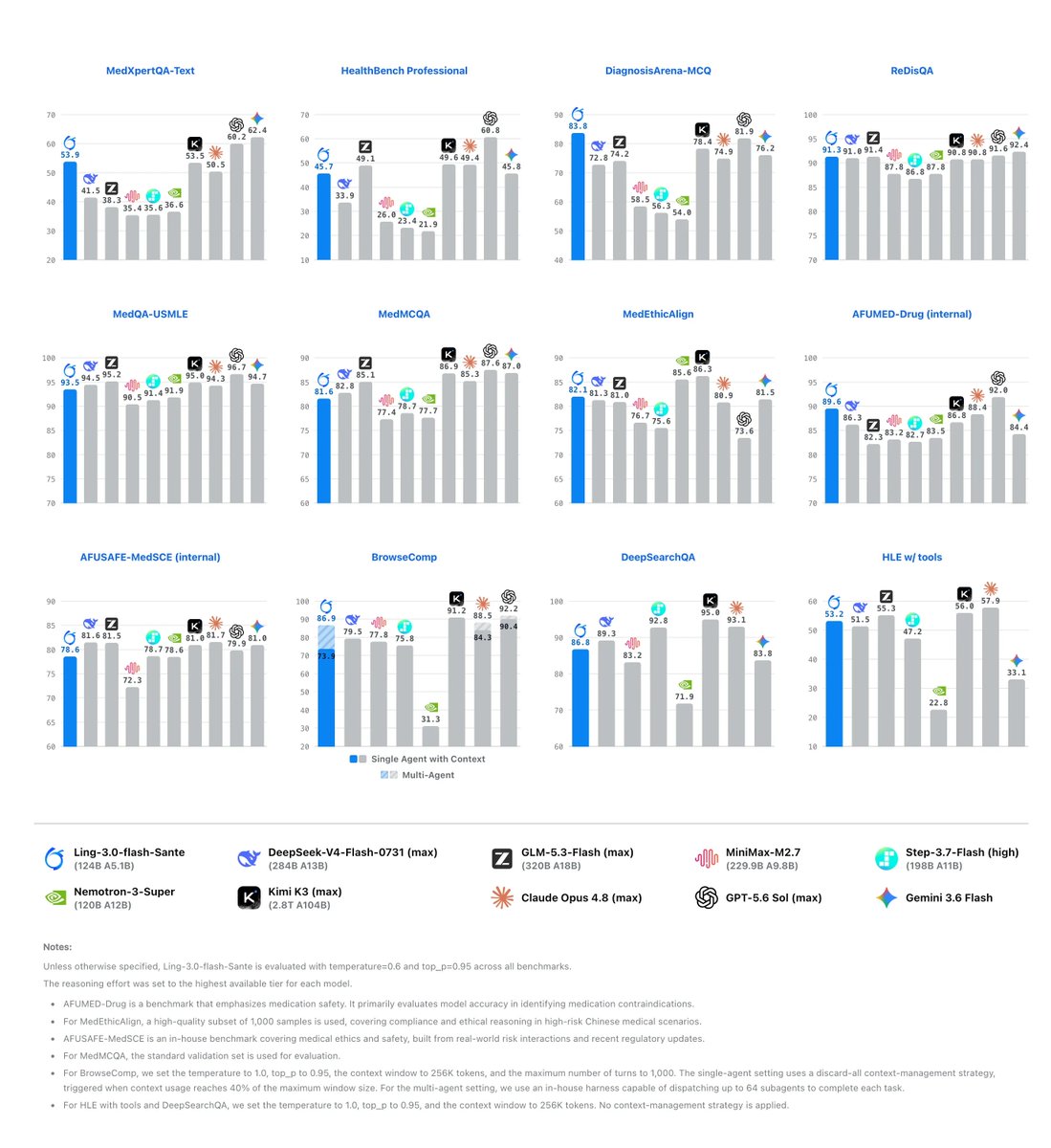
Today, we’re officially open-sourcing Ling-3.0-flash-Sante. Sante is a healthcare-enhanced MoE model with 124B total parameters and only 5.1B active parameters per token, delivering leading performance among similarly sized models on professional healthcare tasks and complex medical reasoning. Beyond answering medical questions, Sante is built for real-world healthcare research and workflows, with strengthened capabilities in deep research, multi-agent collaboration, and tool use. The model weights are now available — we welcome researchers, developers, and healthcare practitioners to explore Sante and build with it. More below ↓

Context
Ant Ling, whose models are published under the inclusionAI name on Hugging Face, has released the weights of Ling-3.0-flash-Sante, a healthcare-tuned version of its Ling-3.0-flash model. The team introduced Sante in September, and it was offered then as a hosted model, including free on Vercel's AI Gateway. With this release, anyone can download and run it. The model card lists an MIT license and puts the weights on Hugging Face and ModelScope.
Sante is a model: it has 124 billion parameters in total, but only 5.1 billion of them are active for each token. The model card still calls for serious hardware to host it, giving examples on four 141GB-class GPUs or eight 80GB GPUs with a 256K-token . Ant Ling says the model is built for more than answering medical questions, with stronger deep research, and collaboration, and the card lists intended uses such as literature search, evidence synthesis and long-document extraction. It also states plainly that Sante is a research model, not a medical device, and must not diagnose, prescribe or make treatment decisions on its own.
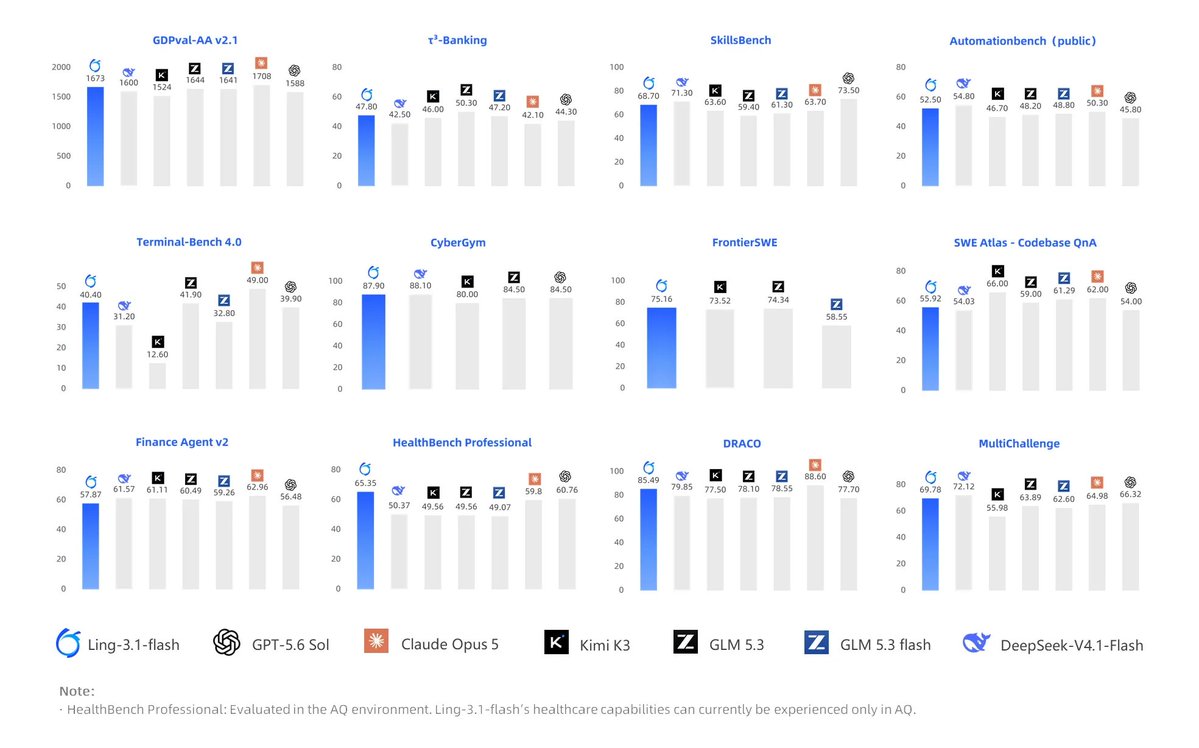
The performance claim is the lab's own. The post says Sante leads similarly sized models on professional healthcare tasks and complex medical reasoning, and its chart compares it with nine other models across 16 benchmarks, three of them internal to the lab. On HealthBench Professional, Ant Ling reports 54.3, against 21.9 to 33.9 for the four open models in the comparison with 120 billion to 284 billion total parameters (Nemotron-3-Super, Step-3.7-Flash, MiniMax-M2.7 and DeepSeek-V4-Flash), and above Claude Opus 4.8 at 49.4 but below GPT-5.6 Sol at 60.8. The lead is not uniform: on MedMCQA and MCP Atlas, several larger models score higher, and the model card notes that benchmark results do not guarantee real-world clinical performance.
- mixture-of-experts — A model built from many specialist sub-networks where only a few activate per token, giving big-model capability at small-model running cost.
- context window — The maximum amount of text a model can consider at once — its working memory for the current conversation or task.
- tool use — A model's ability to call external functions — run code, search the web, edit files — instead of only generating text.
- multi-agent — Using several AI agents on one problem — splitting work in parallel, checking each other, or filling different roles like planner and reviewer.


Checking sign-in…
Loading comments…