Developing Nemotron 3.5 Lightning NVFP4 with QAD Using NVIDIA Model Optimizer
- Source
- developer.nvidia.com
- Author
- Tanya Lenz
- Date
Context
Compressing a model can reduce accuracy because its learned numerical values must fit a coarser representation. NVIDIA's Nemotron 3.5 Lightning work adds training after that compression: the compressed model experiences simulated while learning to match the original model's outputs. This gives it a way to adapt to compression errors. The technical article describes the two-stage process.
For one aggressively compressed intermediate checkpoint in the evaluation tables, median -score recovery rose from 96.33% to 99.72% of the original model's scores, with the same 21.19 GB checkpoint size. The final, more conservative recipe had mixed results and a slightly lower median after the added training. The strongest evidence is that this training can recover losses from aggressive compression; the benefit depends on the recipe and workload.
- quantization — Shrinking a model by storing its numbers less precisely — like rounding — so it runs faster and fits on smaller hardware, at a small quality cost.
- eval — A repeatable test for AI quality — a set of tasks plus scoring — used the way software teams use test suites, because model output is too variable to judge by eyeballing.
- benchmark — A standard public test set for comparing AI models — the shared scoreboards behind every "model X beats model Y" claim.
- distillation — Training a small, cheap model to imitate a big one's outputs, keeping much of the capability at a fraction of the cost.
 articleScaling NVIDIA TensorRT Performance Optimization Beyond a Single Build Route with the Global Performance Tuner, Part 2
 articleAccelerating Mamba-2 with High-Performance Forward Pass Kernels in NVIDIA CUDA Tile
 articleScale Agentic Coding Workflows with Meta’s Muse Spark Open on NVIDIA GB300 NVL72
 articleOptimizing Agent Reliability and Tool Calling Efficiency for Chip Design Using NVIDIA NeMo Gym
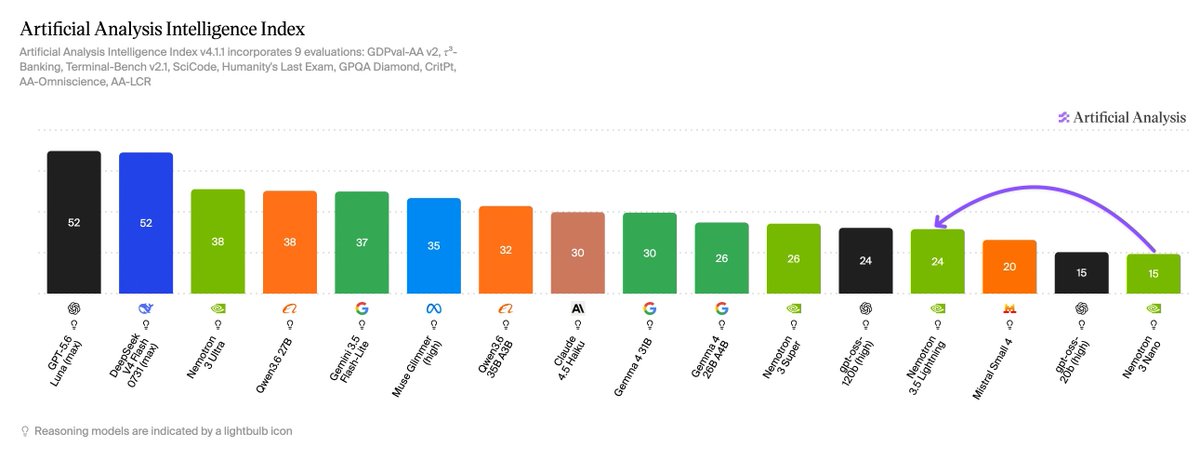 postNVIDIA has just released the first Nemotron 3.5 model: Nemotron 3.5 Lightning,…Artificial Analysis
 articleFrontier Reasoning Reaches the Edge: How to Deploy and Optimize Models on NVIDIA JetsonElizabeth Goodman
 articleHow Full-Stack NIM Optimizations Deliver 2.5x More Users on Nemotron 3 UltraElizabeth Goodman
Checking sign-in…
Loading comments…