What a Claude Code task costs on Opus 5.5
- Source
- claude.dev
- Author
- ClaudeDevs
- Date
Context
A lower price per does not translate one-for-one into a cheaper task, and this guide from Anthropic, written by Addy Osmani, shows why. A Claude Code task is a loop. The model reads the conversation, calls a tool, reads the result and goes around again, and every turn resends the whole conversation so far. Most of that resent text is billed as a cache read, a cheap rate for text the model has already seen. The model's thinking is billed as output, the most expensive kind of token. So the number of turns and the amount of thinking can move a bill as much as the price list does.
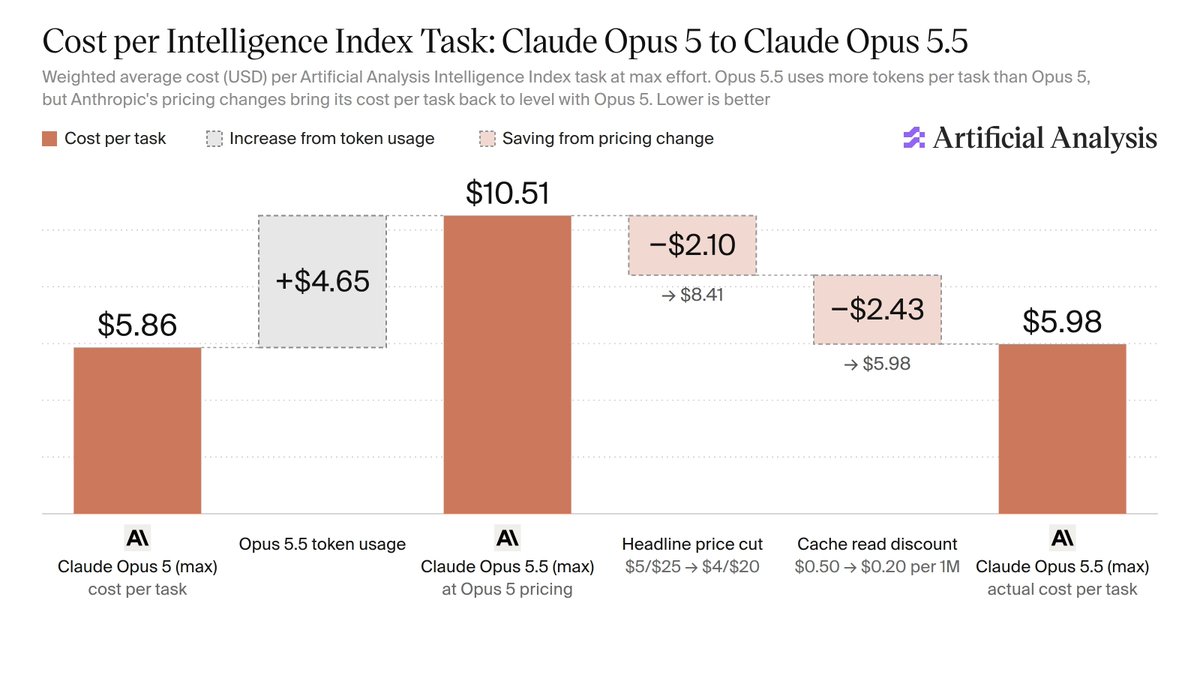
Opus 5.5's API list prices are $4 per million input tokens, $20 per million output tokens and $0.20 per million cache reads. That is 20% below Opus 5 for input and output and 60% below for cache reads. In the guide's illustrative session, with 2 million cached tokens, 200,000 fresh input tokens and 60,000 output tokens, the same token counts cost $3.50 on Opus 5 and $2.40 on Opus 5.5, about 31% less. The cache line shows the largest drop, from $1.00 to $0.40. That is why the cut matters most for long agentic sessions, which spend most of their input on cache reads. The guide puts the range at up to 60% savings on input for a session that is mostly cache reads, and up to 20% for a short question with a long answer, where output dominates. On Pro, Max and Team plans, Anthropic says the lower price makes usage limits go about 25% further.
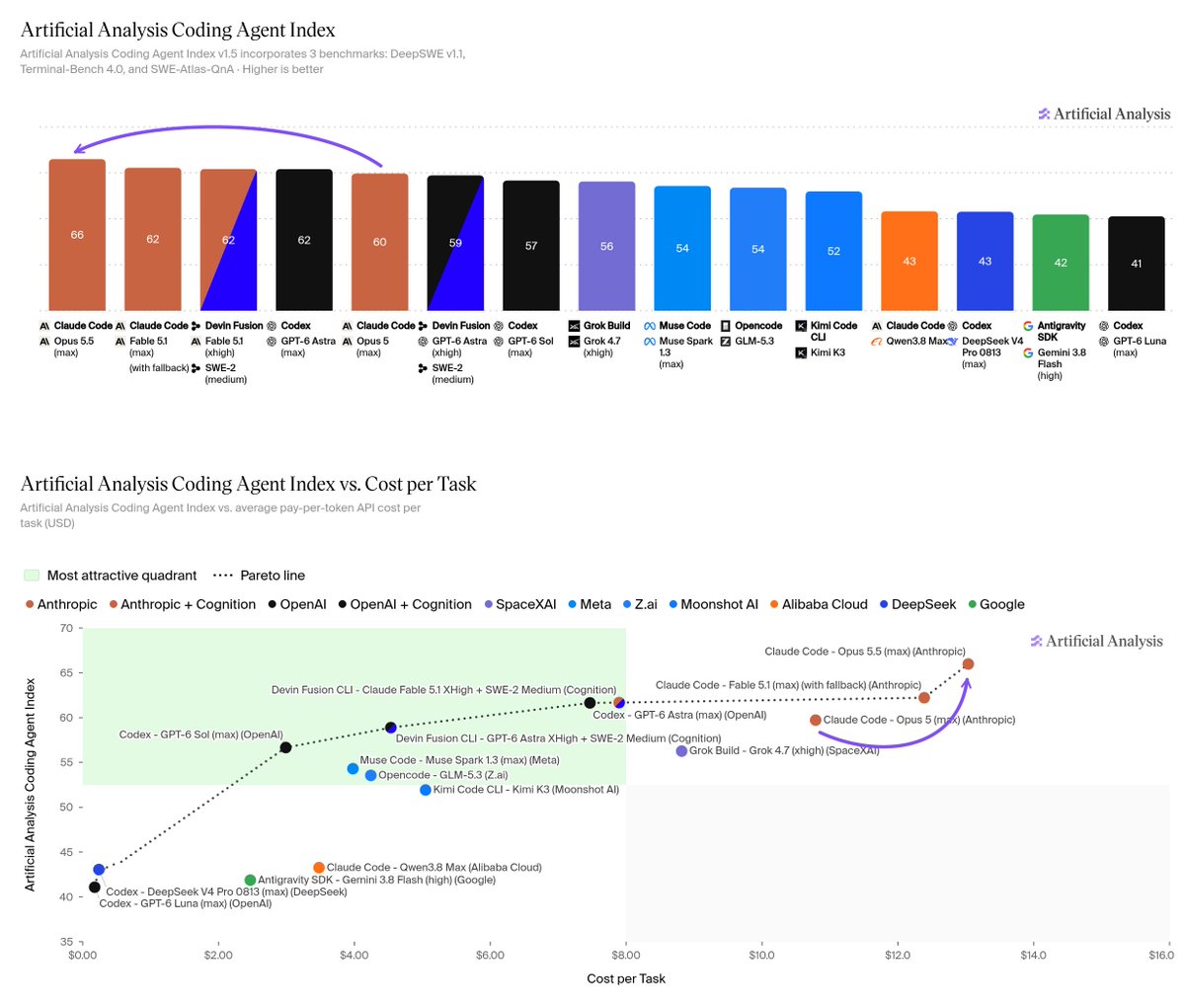
The 40% figure that has circulated is a different claim. Anthropic calls it an estimate for typical workloads at default settings. It assumes Opus 5.5 also uses fewer tokens per task at its default medium effort, so it is not a 40% cut to the price of a token. The guide warns that this part can go the other way: Opus 5.5 always thinks before replying, and at a given effort level it thinks more per turn than Opus 5. Its default effort is one level lower, medium instead of high. The post expects the gap to be small on well-scoped tasks, where both models take about the same number of turns. It expects the gap to be biggest on open-ended tasks, where a model can waste turns on a wrong idea. Its calculator therefore leaves the change in token use as the reader's own assumption, starting at 0%. Anthropic asks readers to fill it from the /usage figures of the same real task run on both models. For an outside measurement that reported a higher cost per task for Opus 5.5, see Artificial Analysis's Coding Agent Index result.
- token — The chunk of text a model reads and writes in — roughly three-quarters of a word — and the unit AI usage is billed in.
- AI agent — An AI system that doesn't just answer once but works toward a goal in a loop — taking actions, reading the results, and deciding what to do next.
- multi-agent — Using several AI agents on one problem — splitting work in parallel, checking each other, or filling different roles like planner and reviewer.
- context compaction — Summarizing an agent's earlier conversation to free room in the context window so a long session can keep going.

Checking sign-in…
Loading comments…