Why Opus 5.5 cost per task barely moved despite price cuts
- Source
- x.com
- Date
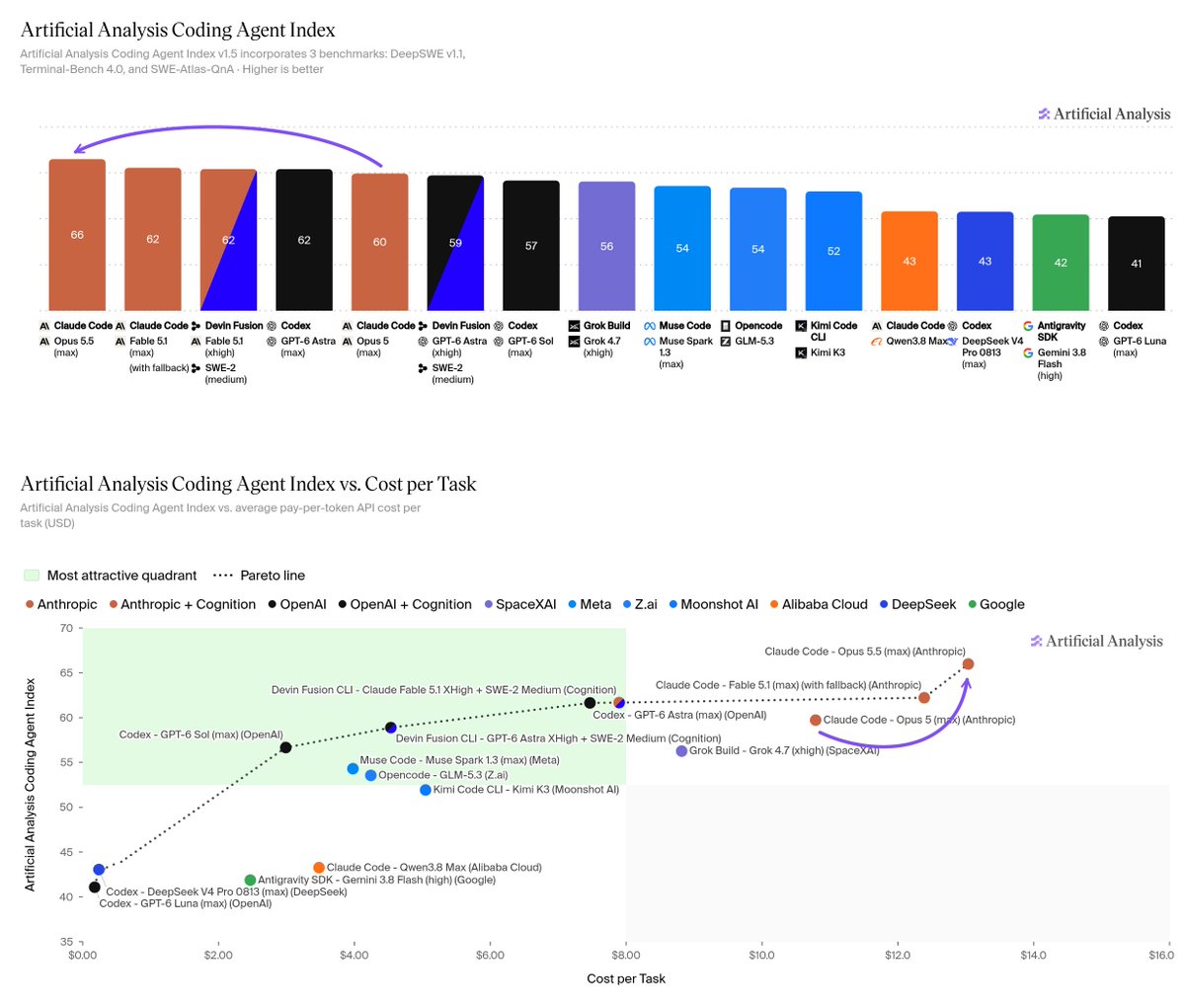
When Opus 5.5 launched, the story was lower list prices. Artificial Analysis has now measured what those prices mean per task. On its Intelligence Index, a 20% token price cut and cheaper cache reads nearly offset an increase of about 80% in tokens used per task, leaving cost per task close to Opus 5. On its Coding Agent Index the picture is sharper: Opus 5.5 set a new high score of 66, with gains on Terminal-Bench, DeepSWE and SWE-Atlas-QnA, but cost per task rose 21% to $13.04, driven by roughly 2.4 times more output tokens. The practical lesson is that price sheets are a poor guide to spend on reasoning models. Teams planning a switch should measure tokens per completed task on their own workloads before assuming the upgrade saves money.

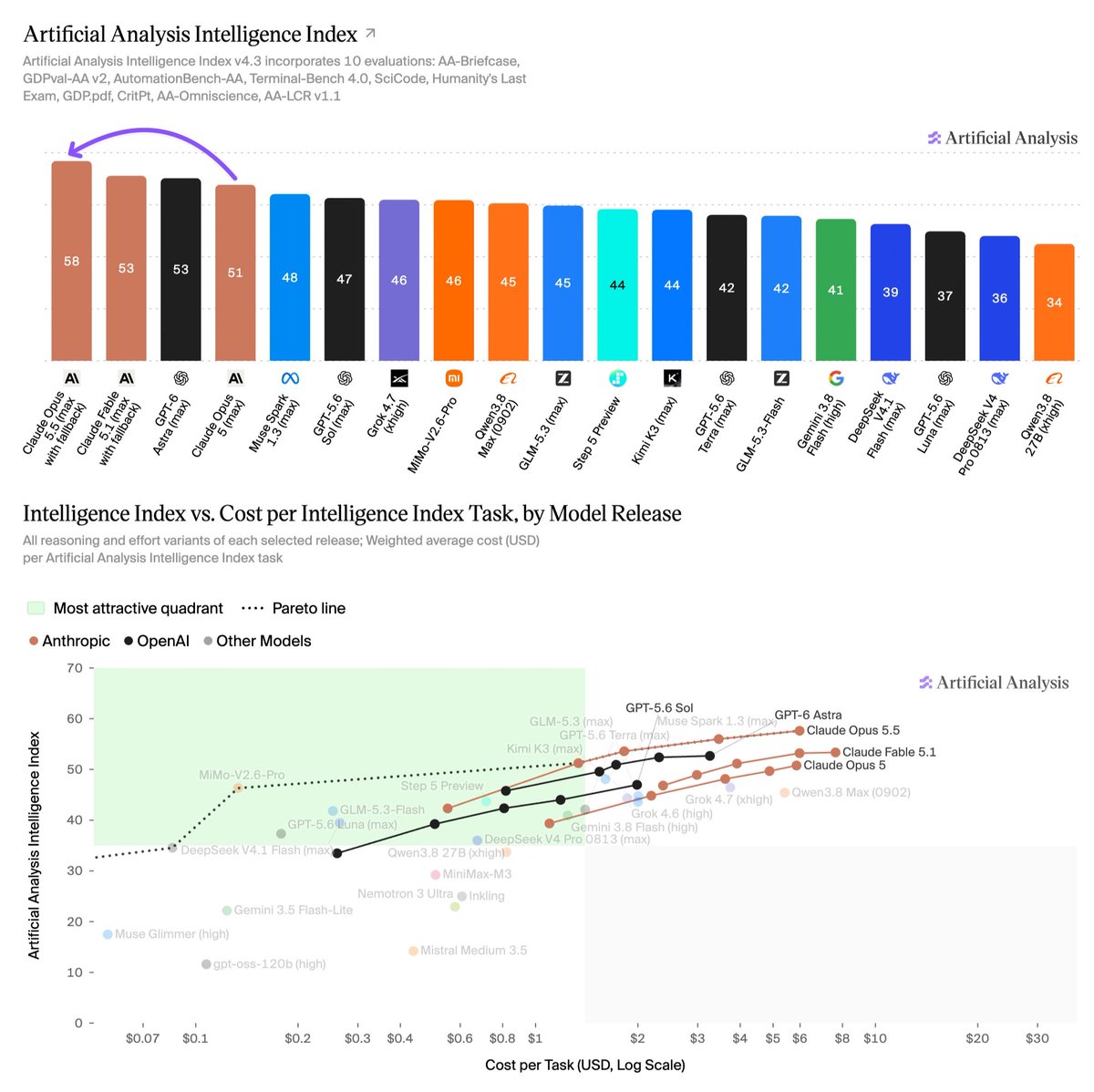
Claude Opus 5.5 (max) costs $5.98 per Intelligence Index task, which is similar to Opus 5 (max) at $5.86, but this bundles a significant token usage increase with Anthropic’s price reductions Compared to Opus 5, Opus 5.5’s increased token usage would drive an ~80% increase in cost per task to $10.51. However, the 20% cut to base prices takes that to $8.41, and then cutting cache reads further to $0.20 takes it to $5.98 (an additional 29% cut)

Context
Claude Opus 5.5 at its maximum effort setting uses so many more than Opus 5 that Anthropic's price cuts only bring a task's cost back to where it was. Artificial Analysis, which benchmarks AI models, puts the cost at $5.98 per task in its Intelligence Index for Opus 5.5 (max), against $5.86 for Opus 5 (max). The measure is what it costs to have a model complete one task in the firm's own suite, so it reflects both the price per token and how many tokens the model spends getting to an answer.
The firm splits the change into three steps. At Opus 5's prices, Opus 5.5's extra token usage alone would raise the cost per task by about 80%, to $10.51. The 20% cut to base prices brings that to $8.41. Lowering the price of cache reads to $0.20 then removes a further 29%, landing at $5.98. Cache reads are charges for input the model has already processed and stored, such as a long conversation or codebase it re-reads on each step. A price cut can remove no more than the charge it applies to, so cache reads must have made up at least 29% of the $8.41 cost before that last cut.
So the cheaper token prices that Artificial Analysis covered in its launch-day post on Opus 5.5 do not mean cheaper work at max effort: they pay for the model's heavier token use. These are the firm's figures for its own index at max effort only. Workloads that lean less on cached input, or that run the model at a lower effort setting, could see a different balance, and the post does not give those numbers.
- token — The chunk of text a model reads and writes in — roughly three-quarters of a word — and the unit AI usage is billed in.
- eval — A repeatable test for AI quality — a set of tasks plus scoring — used the way software teams use test suites, because model output is too variable to judge by eyeballing.
Checking sign-in…
Loading comments…