Lower the Cost of Building and Running Visual AI Agents with NVIDIA VSS Blueprint 3.3
- Source
- developer.nvidia.com
- Author
- Elizabeth Goodman
- Date
Context
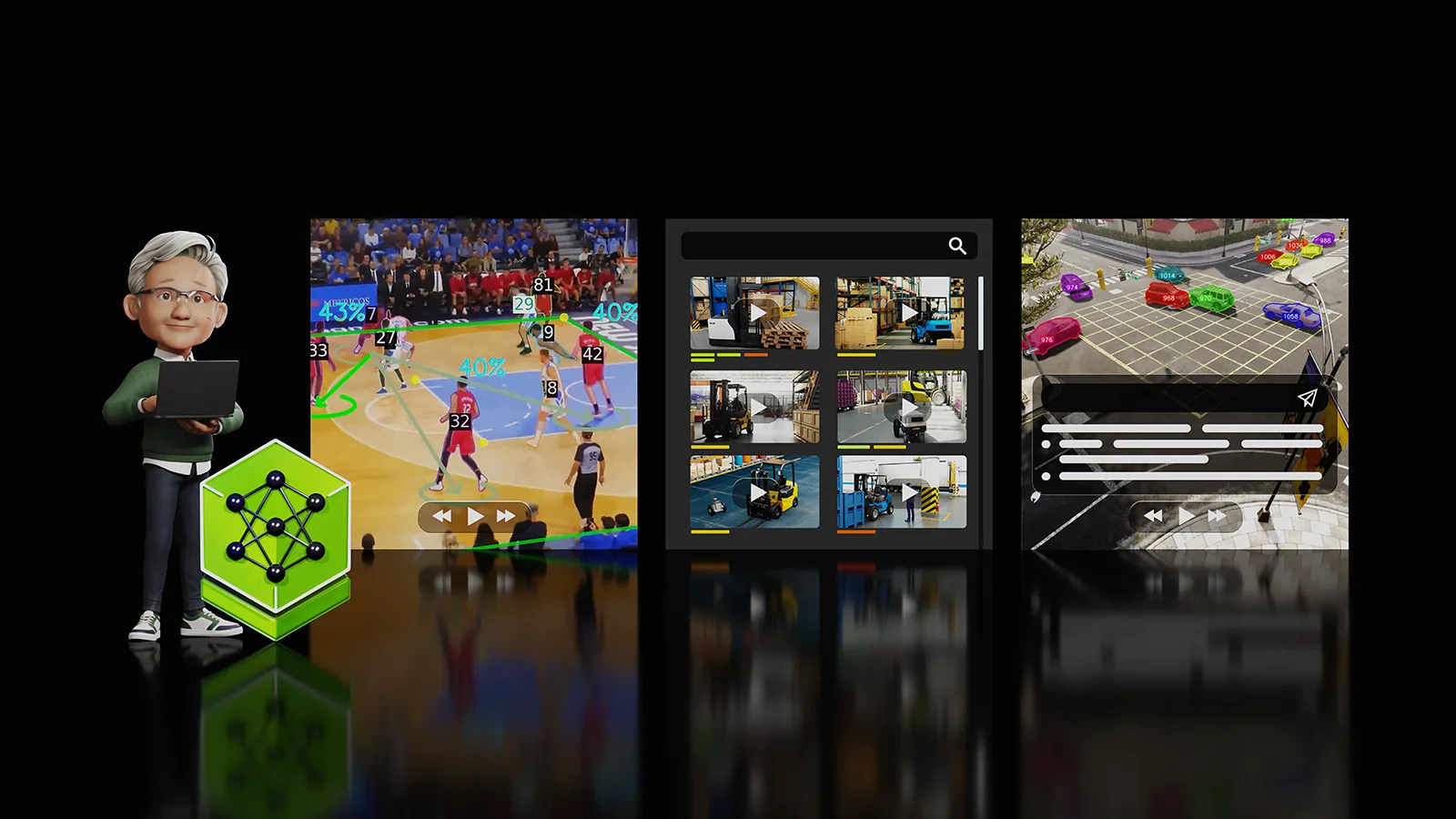
NVIDIA's VSS Blueprint 3.3 reduces video-processing work by filtering out visual information that has barely changed. Its Adaptive Efficient Video Sampling compares patches of each frame with the preceding frame, drops unchanged patches before the processes them, and groups processing around activity.
On an RTX PRO 6000 Blackwell running Cosmos 3 Super at FP8 precision, NVIDIA reports an increase from 13 to 19 concurrent real-time streams. The plausible mechanism is that less redundant visual input leaves capacity for more streams, which matters most for cameras repeatedly showing the same surroundings. The article says results vary with scene motion, chunk length, and similarity threshold, so representative footage is needed to judge the benefit.
- NVIDIA says the Build Vision starts from the closest of four tested profiles (base captioning and Q&A, alerts, long video summarization, search) and adds only the service delta, so two workflows needing a detector or Kafka share one instance.
- The Build Vision Agent skill writes a self-contained build under _builds/<name>/ (override.env, compose.yml and a flattened resolved.yml), never edits the repo's deploy/docker tree, and shows an architecture diagram for review before deploying anything.
- Adaptive EVS compares each patch with the prior frame by cosine similarity and drops unchanged ones; clips keeping about 70% of are batched as events, those under about 30% dropped or flushed. Fixed-rate EVS already ships in vLLM and Cosmos NIM.
- On an RTX PRO 6000 Blackwell with Cosmos 3 Super FP8, NVIDIA reports alert contextualization latency fell from 1,021 ms to 844 ms and concurrent real-time VLM streams rose from 13 to 19, with results varying by scene motion, chunk length and threshold.
- NVIDIA says Adaptive EVS helps most when a VLM reads many frames and writes short answers, helps less for long outputs from few frames, only runs inside the RT-VLM container rather than against remote endpoints, and is optional, enabled in override.env.
- LLM — A large language model — the neural network behind tools like Claude and ChatGPT, trained on huge amounts of text to predict what comes next.
- agent skill — A reusable instruction file that teaches an agent how to do one job well — the procedure, the tools, and what counts as done.
- token — The chunk of text a model reads and writes in — roughly three-quarters of a word — and the unit AI usage is billed in.
 articleHow NVIDIA OpenShell Reference Architecture Secures and Governs AI Agent Workloads at Scale
 articleCode, Test, and Deploy on One Machine with NVIDIA RTX Spark
 articleHow to Rewrite Apache Spark UDFs for GPU Acceleration with AI Agents
 articleHow SWE-Serve Exposes the Gap Between Local Tests and Live Serving

Checking sign-in…
Loading comments…