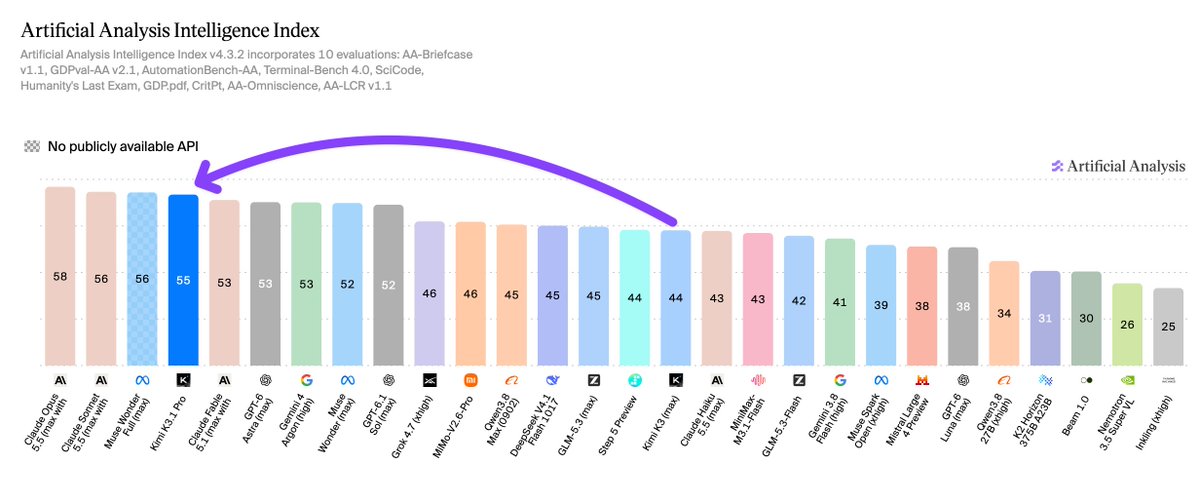
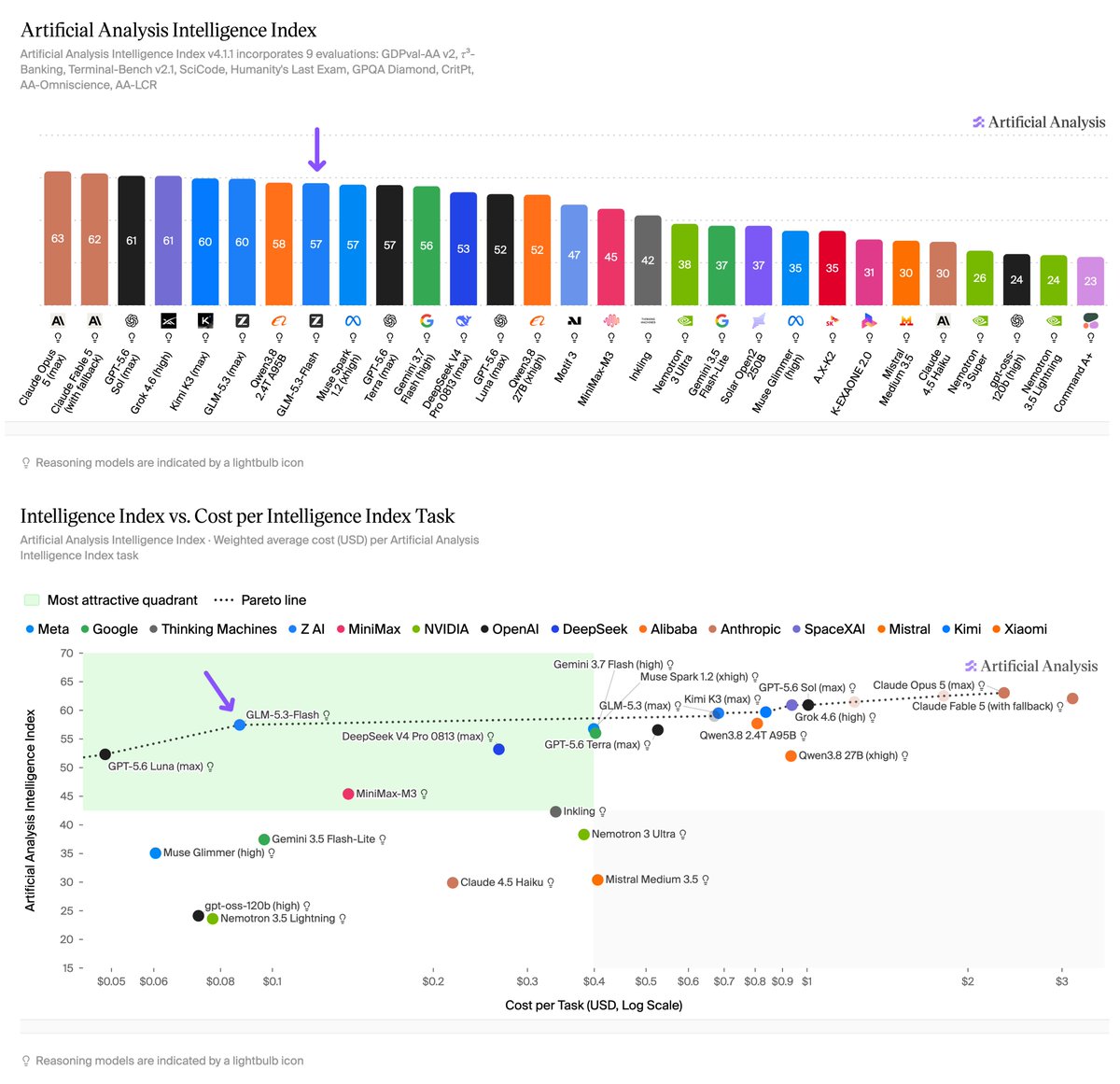
GLM-5.3 achieves 60 on the Artificial Analysis Intelligence Index, on par with K
- Source
- artificialanalysis.ai
- Author
- ArtificialAnlys
- Date
Context
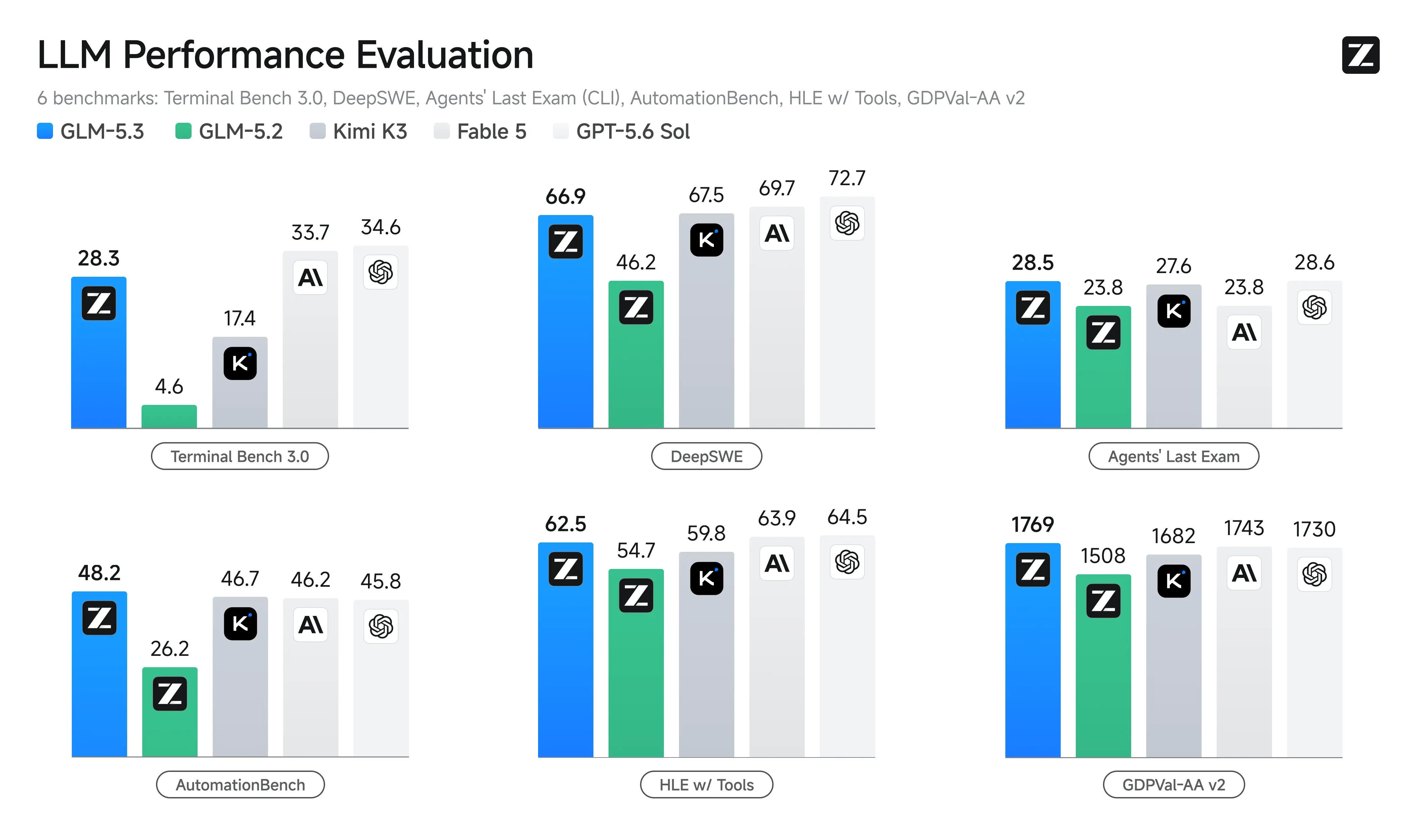
Artificial Analysis reported that Z AI's GLM-5.3 scored 60 on its Intelligence Index, tying Moonshot AI's Kimi K3 as the highest-scoring open-weights model, up 7 points from GLM-5.2. At the time, that ranking carried a condition: the weights had not yet been released, and the model was available only through Z AI's own API, with the company saying the weights would follow within about a week.
The post says the biggest gain was in agentic work. On GDPval-AA v2, Artificial Analysis's test of real-world agentic knowledge work scored as an Elo rating, GLM-5.3 rose from 1524 to 1770, putting it second among all models behind Claude Opus 5 and more than 100 points ahead of Kimi K3. The model kept GLM-5.2's size of 753 billion total parameters with 40 billion active per , a design in which only part of the network runs for each token, so the improvement did not come from a bigger model.
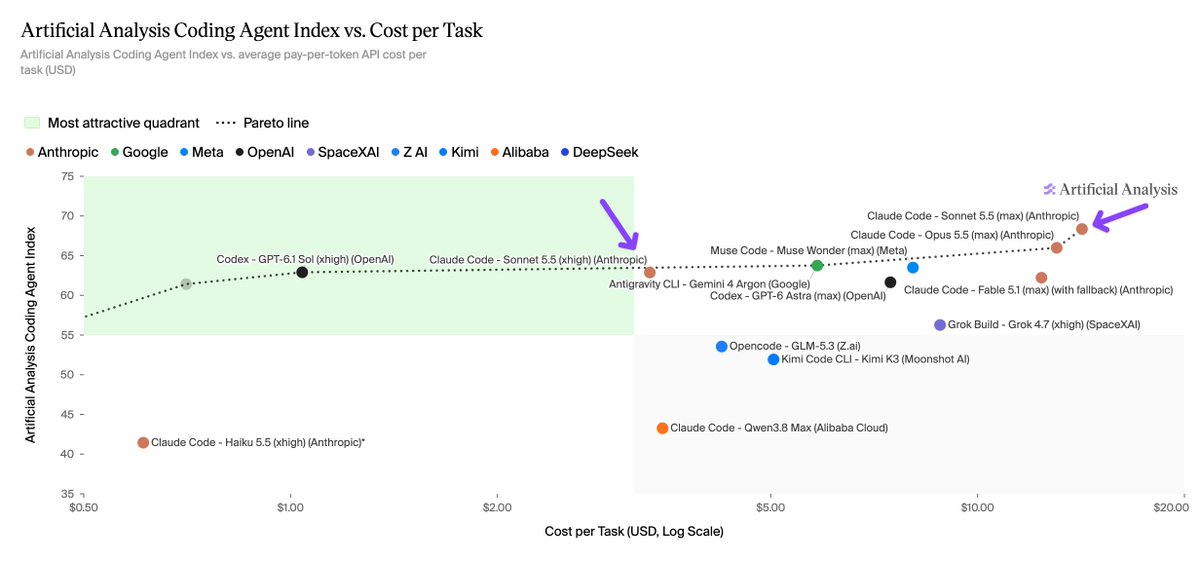
The trade-off is in tokens and cost. GLM-5.3 used roughly 18,700 output tokens per index task, about 20% more than GLM-5.2, and cost $0.68 per task against GLM-5.2's $0.44, though the post says it was still cheaper than other models in its tier, including Kimi K3 at $0.84. It also improved on the AA-Omniscience knowledge test, where both its accuracy and attempt rates went up, but its rate rose from 26% to 30%.
The weights have since appeared on Hugging Face. The post listed the license as MIT, but Artificial Analysis's GLM-5.3 page now lists a GLM-5.3 License that allows commercial use with restrictions, and its current figures differ from those in the original post, so check the license text before relying on either.
- token — The chunk of text a model reads and writes in — roughly three-quarters of a word — and the unit AI usage is billed in.
- mixture-of-experts — A model built from many specialist sub-networks where only a few activate per token, giving big-model capability at small-model running cost.
- hallucination — When a model states something false with full confidence — inventing facts, citations, or APIs that don't exist.
- eval — A repeatable test for AI quality — a set of tasks plus scoring — used the way software teams use test suites, because model output is too variable to judge by eyeballing.
Checking sign-in…
Loading comments…