Kimi K2 5 Everything You Need To Know
- Source
- artificialanalysis.ai
- Author
- Artificial Analysis articles
- Date
Context
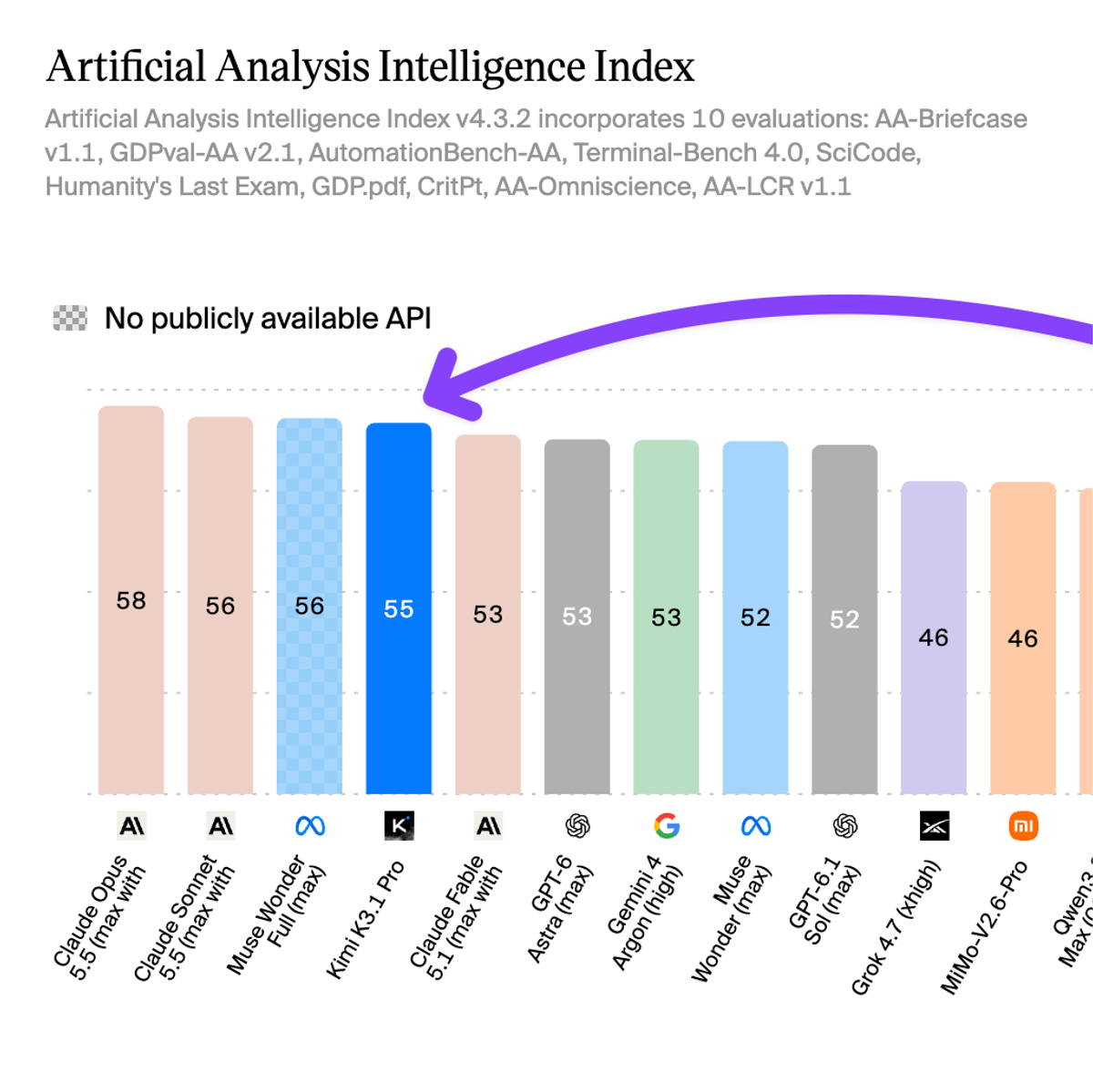
Moonshot AI's Kimi K2.5 is, in Artificial Analysis's January 27, 2026 analysis, the new leading model, with only OpenAI, Anthropic and Google models ahead of it on the firm's Intelligence Index. The clearest evidence is agentic work. On GDPval-AA, where models are given shell access and web browsing to complete realistic knowledge work tasks such as preparing presentations and analysis, Kimi K2.5 reached an Elo of 1309, behind only OpenAI and Anthropic models and ahead of GLM-4.7, DeepSeek V3.2 and Gemini 3 Pro. Artificial Analysis says that rating implies a 66% win rate against GLM-4.7, the prior open weights leader (artificialanalysis.ai).
The article treats the second change as just as significant. Kimi K2.5 is Moonshot's first flagship model to take image and video input, and the first time the leading open weights model has accepted images at all, which Artificial Analysis describes as removing a critical barrier to adopting open weights models instead of proprietary ones. Artificial Analysis says this sets Kimi K2.5 apart from the other open weights leaders it names: DeepSeek V3.2, GLM-4.7, MiniMax M2.1 and MiMo-V2-Flash. On MMMU Pro, a visual reasoning benchmark, it scored 75%, slightly behind Gemini 3 Pro and in line with GPT-5.2 and Claude Opus 4.5.
Its weights are also compact for its size. Kimi K2.5 is a model with 1T total and 32B active parameters, released like Kimi K2 Thinking in native INT4 precision rather than FP8 or BF16, so the weights are only about 595GB. It merges Moonshot's reasoning and non-reasoning models into one, and Artificial Analysis evaluated it with reasoning on. Running the index cost $371, more than 4 times cheaper than Claude Opus 4.5 and GPT-5.2 but more than 5 times the cost of DeepSeek V3.2 and gpt-oss-120b. Its AA-Omniscience score of -11, on the firm's measure of knowledge accuracy and , rests mainly on a hallucination rate of 64%, down from Kimi K2 Thinking's 74%, which Artificial Analysis reads as a slightly greater tendency to abstain rather than fabricate.
- Its GDPval-AA Elo of 1309 implies a 66% win rate against GLM-4.7, the prior open-weights leader, on knowledge-work tasks run with shell and web access through Artificial Analysis's Stirrup .
- K2.5 scores 75% on the MMMU Pro visual reasoning benchmark, slightly behind Gemini 3 Pro and in line with GPT-5.2 and Claude Opus 4.5, while open rivals DeepSeek V3.2, GLM-4.7, MiniMax M2.1 and MiMo-V2-Flash lack image input.
- It merges Moonshot's reasoning and non-reasoning lines into one hybrid model; Artificial Analysis benchmarked it with reasoning on and said reasoning-off results would follow.
- Its hallucination rate fell to 64% from K2 Thinking's 74%, which drives the -11 AA-Omniscience score: the model abstains slightly more often instead of fabricating answers when uncertain.
- It used about 82M reasoning tokens on the Intelligence Index, below K2 Thinking (~95M) and GLM-4.7 (~160M). Its $371 run cost is over 4x cheaper than Opus 4.5 and GPT-5.2 but over 5x DeepSeek V3.2 and gpt-oss-120b.
- open weights — A model whose trained parameters are published for anyone to download and run — unlike API-only models you can access but never possess.
- mixture-of-experts — A model built from many specialist sub-networks where only a few activate per token, giving big-model capability at small-model running cost.
- hallucination — When a model states something false with full confidence — inventing facts, citations, or APIs that don't exist.
- agent harness — The scaffolding around a model that turns it into a working agent — the loop, the tools it can call, and the rules for when to stop.


Checking sign-in…
Loading comments…