Fish Audio Drama 3
- Source
- fish.audio
- Author
- Fish Audio editorial sitemap
- Date
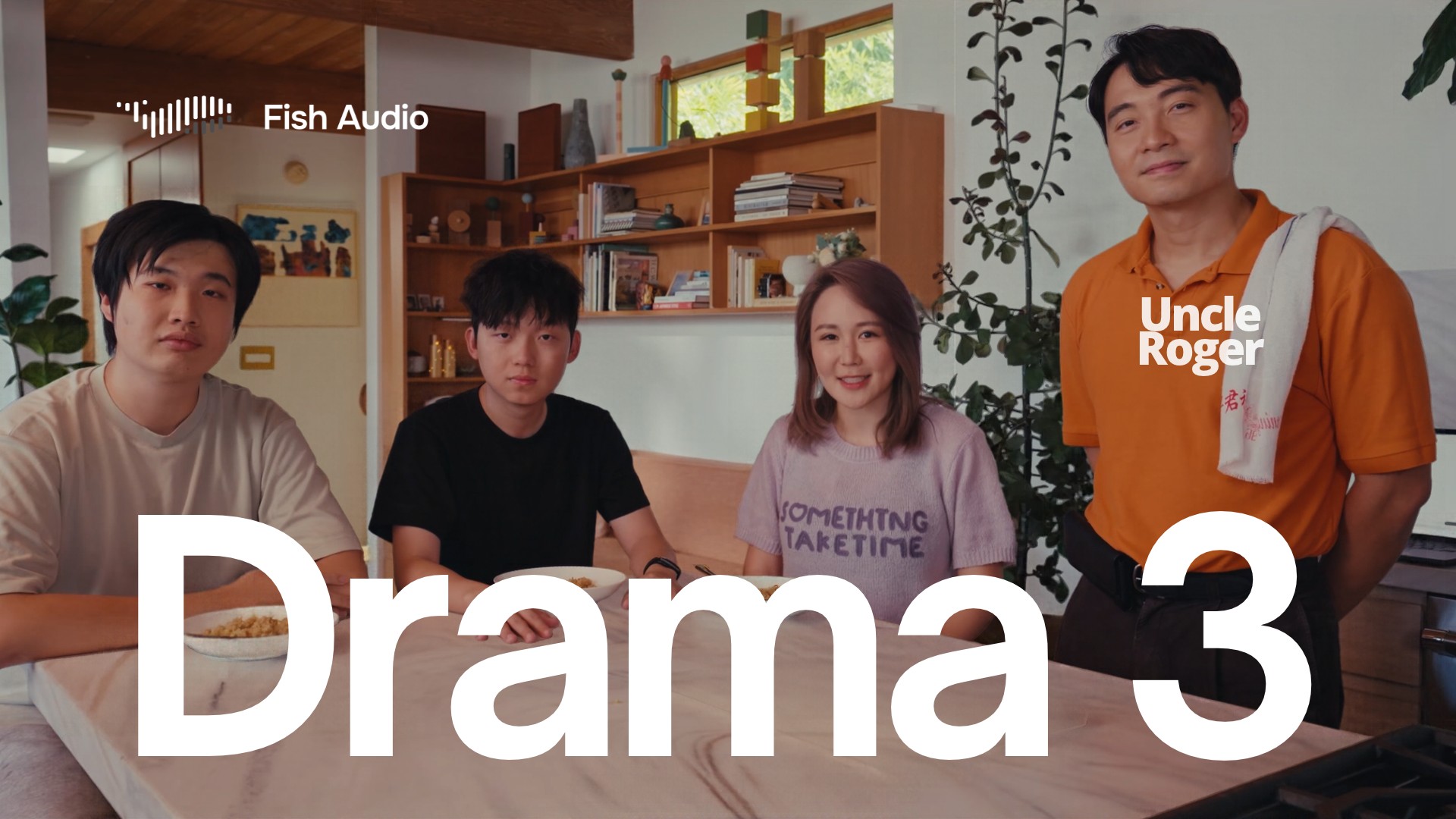
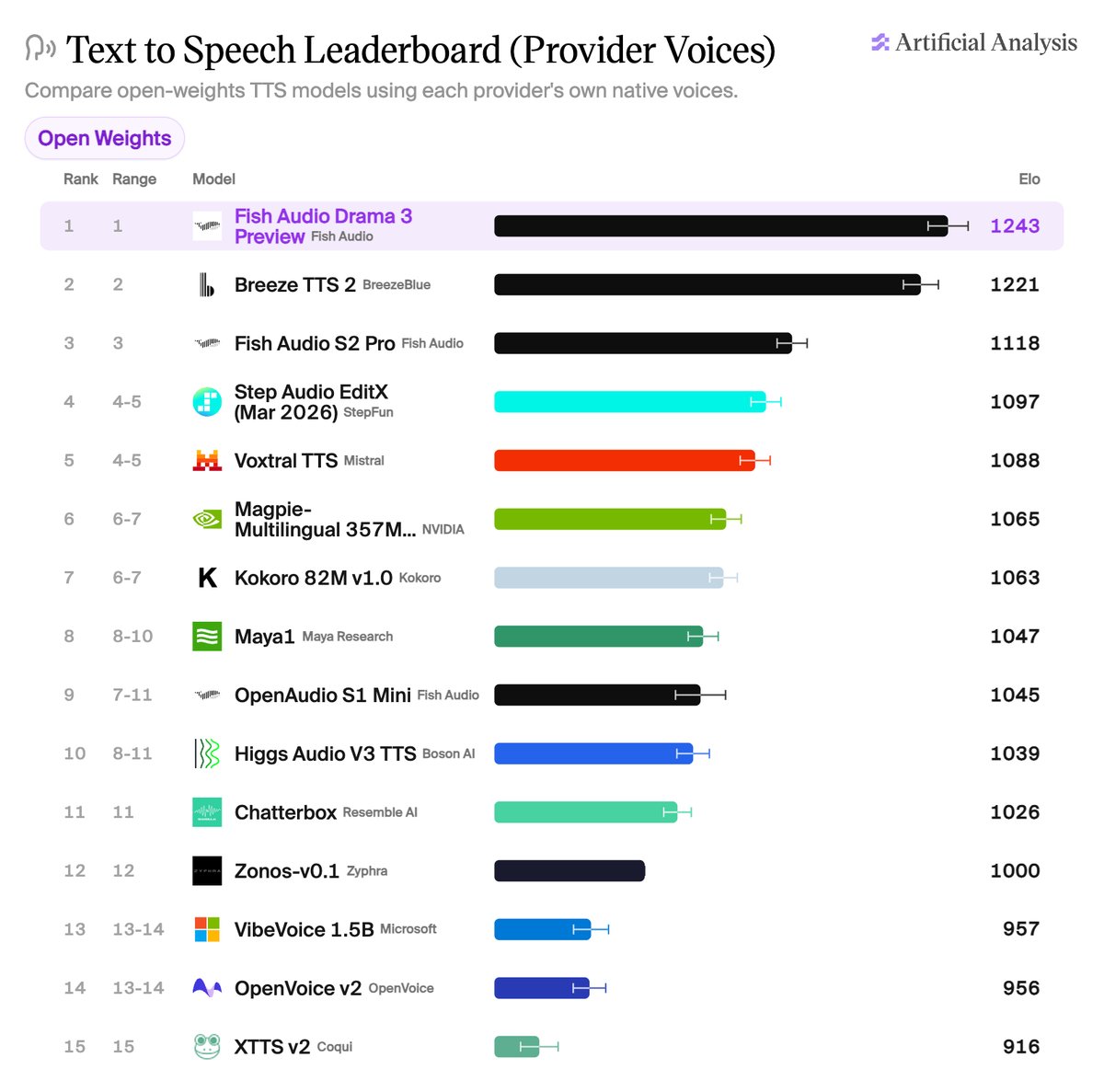
Fish Audio released Drama 3, a text-to-speech model directed with plain-language cues in square brackets, such as a whisper or a laugh placed mid-line. On Artificial Analysis' independent Pronunciation Robustness benchmark it reads 93.2% of hard words correctly, against 88.1% for S2.1 Pro, with the largest gains on brand names and context-dependent words. Exact sequences such as file paths and email addresses remain its weakest category at 86.3%. Fish Audio says it tuned the model with a single learned human-preference reward instead of transcription and similarity rewards, which tend to penalize the expressive delivery a script asks for. The backbone is a 35B mixture-of-experts with about 3B active parameters, and Fish Audio reports 271 frames per second on one H200 against 177 for S2. The license allows commercial use under US$500,000 in revenue, requires a separate license to resell it as a service, and bans cloning a real person's voice without consent. The API lists at $50 per million characters, discounted to $10 until November 12.
Context
The two earlier previews of Drama 3 (September and October) said the text-to-speech model could be directed in plain language, even mid-line, but offered no tests and no account of how. With the full release, Fish Audio published a technical report whose central change is in how the model was taught to follow direction. Speech models are often refined by reinforcement learning, which pushes the model toward whichever of its takes scores best, and the scores are usually automatic: transcription errors counted by a speech recognizer, and closeness to a reference voice clip. Fish Audio's earlier S2 used both. The report's point is that a laugh changes what the recognizer hears and a whisper sounds less like a neutral reference, so these rewards mark down exactly the delivery a director asked for.
Drama 3 drops every rule-based reward and uses one learned reward instead: a smaller speech model of Fish Audio's own, trained on human judgments of which of two takes was better. Because it reads the script and voice references too, accuracy and likeness still count. On recordings of real speakers reading the same sentences plainly and in other styles, a similarity score preferred the default reading over the whispered one in 99.7% of pairs. The reward model preferred the whispered reading in 62.2% of pairs when the whisper was written into the script as a direction, against 10.6% without it, and the laughing reading in 64.4% against 27.1%. Leaving out the transcription reward did not cost intelligibility on Fish Audio's measure: on an English test set, the word error rate of first takes, before the system automatically retries outputs that fail basic checks, fell from 3.49% before reinforcement learning to 2.20% after. These are Fish Audio's own measurements, and the reward model's scores are not listener tests of the finished model; the demo audio was not heard for this explanation.
The independent figure measures something else: whether hard words are read correctly. Artificial Analysis's Pronunciation Robustness benchmark, in which human listeners check each difficult word, scored Drama 3 Preview at 93.2%, first overall, a result covered here earlier along with its more modest arena rankings. Fish Audio's launch post presents the same 93.2% for the released Drama 3, against 88.1% for S2.1 Pro. Neither source says whether the measured preview and the release are the same weights.
Underneath is a 35-billion-parameter model, which sends each token through a few specialist sub-networks so only about 3 billion parameters work at each step, built from the of Qwen's Qwen3.5-35B-A3B. The weights are on Hugging Face under a new Fish Audio Community License. Research and non-commercial use are free, and commercial use is free while you and your affiliates earn under US$500,000 a year. Offering the model to others as a text-to-speech, voice-cloning or inference service needs a separate license at any revenue, though producing finished audio for clients does not. The license also forbids imitating an identifiable person's voice without that person's consent.
- Fish Audio says speech models are usually tuned with rewards for being easy to transcribe and matching the reference clip, which penalize a requested laugh or whisper; Drama 3 instead uses one learned human-preference reward, trained with GRPO and no KL penalty.
- Drama 3 is a 35B mixture-of-experts with about 3B parameters active per token, initialized from Qwen3.5-35B-A3B; three of every four layers are Gated DeltaNet with constant-size state, so only one layer in four keeps a .
- Despite having more than seven times S2's parameters, Drama 3 decodes a single stream at 271 frames per second on one H200, against 177 for S2, according to Fish Audio.
- On Artificial Analysis' Pronunciation Robustness test, Drama 3 is weakest on exact sequences such as codes, paths and emails at 86.3% (up from 79.4% for S2.1 Pro), against 95.9% on brand, place and technical names.
- The Fish Audio Community License v1.0 allows free commercial use only below US$500,000 in annual revenue including affiliates; offering Drama 3 as a TTS, voice-cloning or inference service needs a separate license, and cloning a real person's voice without consent is banned.
- mixture-of-experts — A model built from many specialist sub-networks where only a few activate per token, giving big-model capability at small-model running cost.
- Large language model — A model trained on large amounts of data to process and generate language.
- attention — The mechanism that lets a model weigh which earlier words matter for the word it's currently processing — the core operation of a transformer.
- KV cache — The memory a model keeps about text it has already read, so generating each new token doesn't require reprocessing the whole conversation.

Checking sign-in…
Loading comments…