Ant Ling releases Ling-3.2-flash, a 560B multimodal agent model
- Source
- x.com
- Date

Introducing Ling-3.2-flash, Ant Ling's native multimodal model: 560B total / 25B active parameters. Stronger complex visual understanding, long-horizon multimodal agents, 3D understanding & interaction, and medical intelligence. Outscores Opus 5 (max) in release evaluations: - OmniDocBench1.5: 92.21 vs 90.56 - ZEROBench(Sub): 43.71 vs 39.52 - Vision2Web: 85.86 vs 80.20

Context
Ling-3.2-flash beats Claude Opus 5 on the three tests Ant Ling quotes, but its own release chart shows it behind Opus 5 on six of the nine other tests where both appear. Ant Group's Ling team introduced the model as a native model, meaning it takes images as well as text, with 560 billion parameters in total of which 25 billion are active for each . The post lists three results against Anthropic's Opus 5 at maximum effort: 92.21 to 90.56 on OmniDocBench 1.5, a document-parsing test, 85.86 to 80.20 on Vision2Web, and 43.71 to 39.52 on a subset of the ZEROBench visual reasoning test.
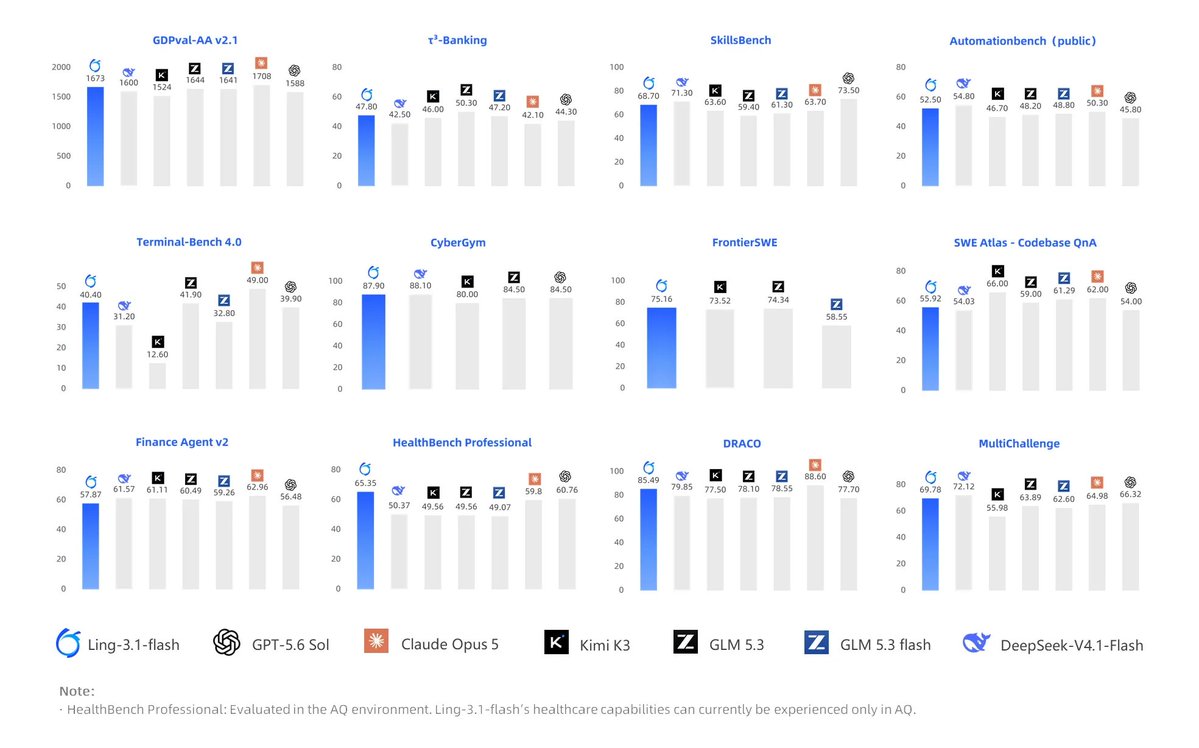
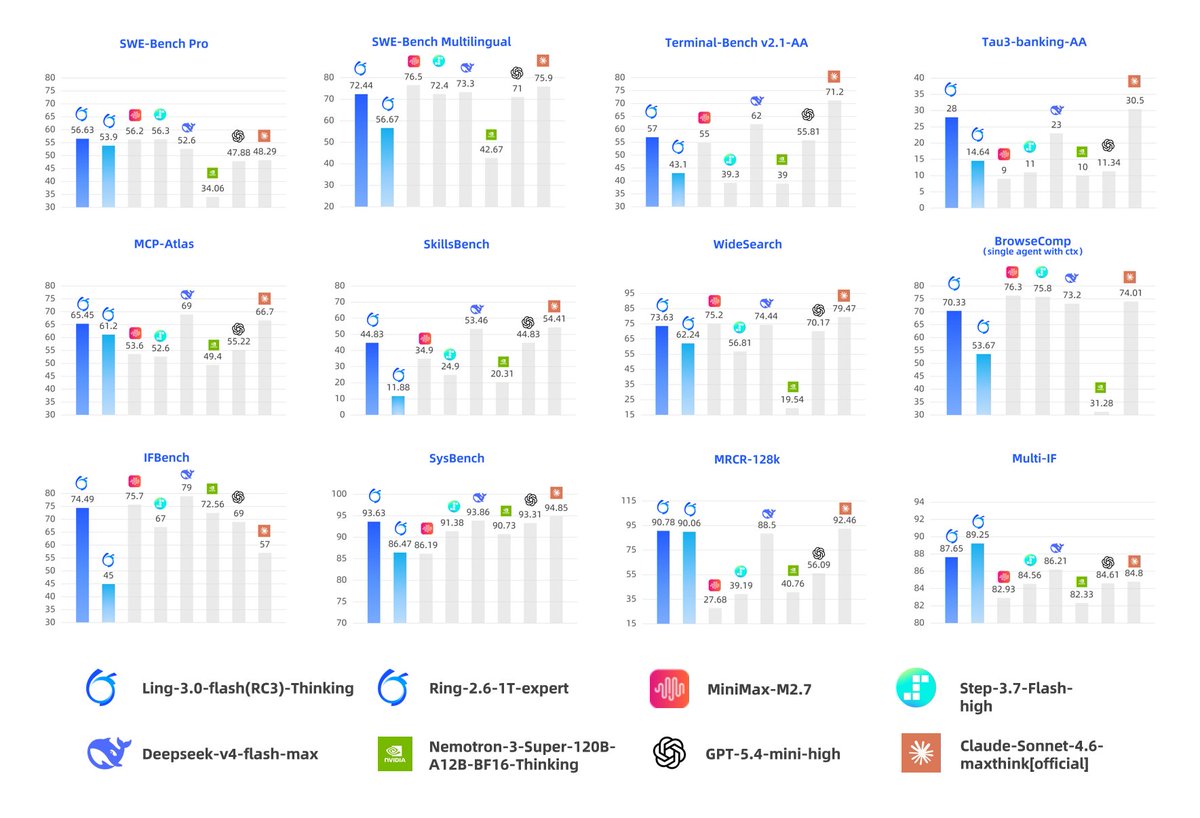
The chart attached to the post compares the model with Opus 5, OpenAI's GPT-5.6 Sol, Kimi K3, GLM-5.3-Flash and DeepSeek-V4.1-Flash across twelve panels. On the full ZEROBench, rather than its subset, Ling-3.2-flash scores 18.00 against 26.00 for Opus 5 and 30.00 for GPT-5.6 Sol. On the multimodal part of Humanity's Last Exam it scores 30.12 against 42.69 and 43.86, and it also trails Opus 5 on BabyVision, CharXiv, AndroidWorld and BlenderBench. It edges Opus 5 on MathVision, MedXpertQA-MM and GDP.pdf, and leads all six models on OmniDocBench and Vision2Web. Every figure comes from Ant Ling; the chart's note says the starred competitor scores were collected through the vendors' APIs under official test settings, and the post links no model card or technical report describing how Ling-3.2-flash itself was run. On Ant Ling's own numbers, the model is ahead of Opus 5 on some multimodal tasks, document reading among them, and behind it on others, rather than ahead in general.
- multimodal — A model that works with more than text — reading images, audio, or video, and sometimes generating them too.
- token — The chunk of text a model reads and writes in — roughly three-quarters of a word — and the unit AI usage is billed in.
- benchmark — A standard public test set for comparing AI models — the shared scoreboards behind every "model X beats model Y" claim.

Checking sign-in…
Loading comments…