Reflection's Beam: strong on workflows, weak in the terminal
- Source
- x.com
- Date

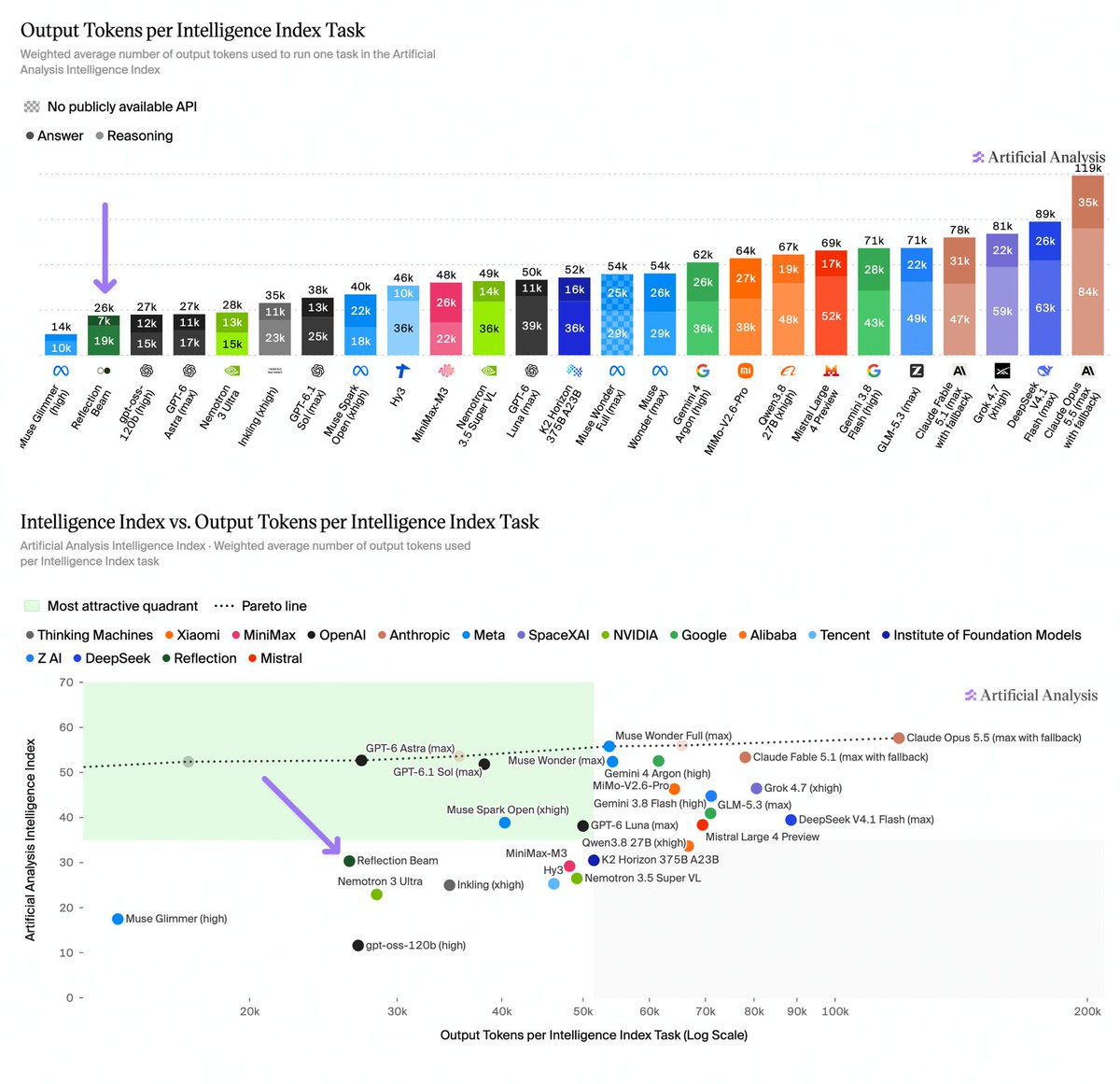
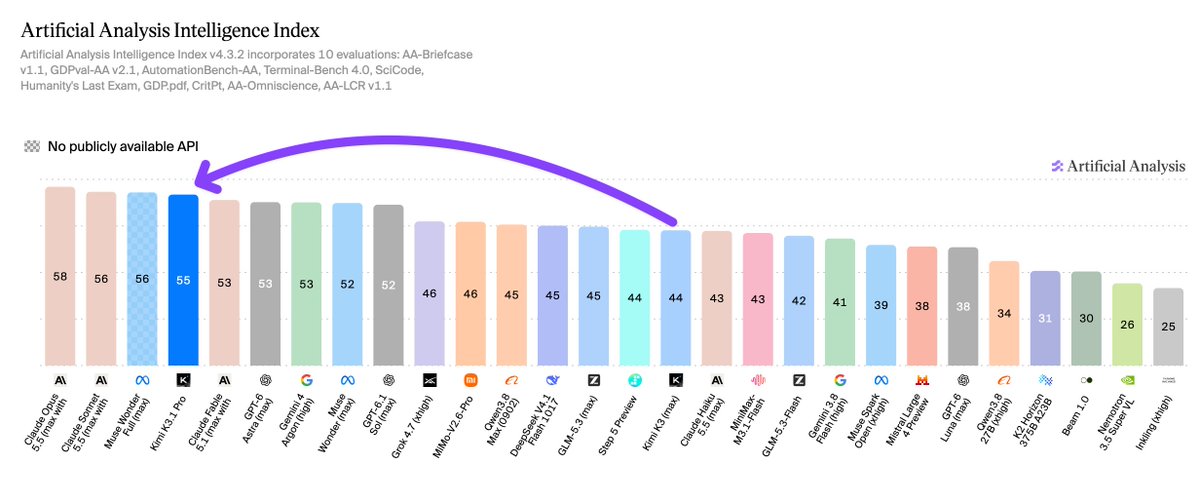
Reflection’s first model, Beam, scores 30 on the Artificial Analysis Intelligence Index, placing it #2 among US open weights models Beam is an open weights model with 501B total and 23B active parameters, released on @huggingface Congratulations to @reflection_ai on the release! Key takeaways: ➤ Second among US open weights models: Beam scores 30, behind only Meta's Muse Spark Open (39) and ahead of yesterday’s NVIDIA Nemotron 3.5 Super VL (26) release. Outside China, only Muse Spark Open and the UAE's K2 Horizon (31) score higher ➤ Token efficient for its intelligence: Beam uses ~26k output tokens per Intelligence Index task compared to K2 Horizon, one point ahead, which uses twice as many (~52k). Proprietary models still set the frontier, with GPT-6 Astra (max) scoring 53 on the same budget (~27k) ➤ Strong on agentic workflows, weaker in the terminal: Beam scores 48.5% on AutomationBench-AA, 11 percentage points ahead of K2 Horizon (37.2%) and level with Qwen3.8 27B (48.2%). Terminal-Bench 4.0 is a weak point, where Beam scores 3.0%, behind Qwen3.8 27B (5.6%) and Muse Spark Open (8.1%) ➤ Knows more, guesses more: On AA-Omniscience it answers 33% of questions correctly, well ahead of K2 Horizon (18%) and Qwen3.8 27B (16%). But its hallucination rate is 47%, against 26% for K2 Horizon and 30% for Qwen3.8 27B, giving Beam a net index score of 1.5, ahead of both peers (−3.0 and −10.0) Other model details Context window: 1M tokens Modalities: Text Parameters: 501B / 23B

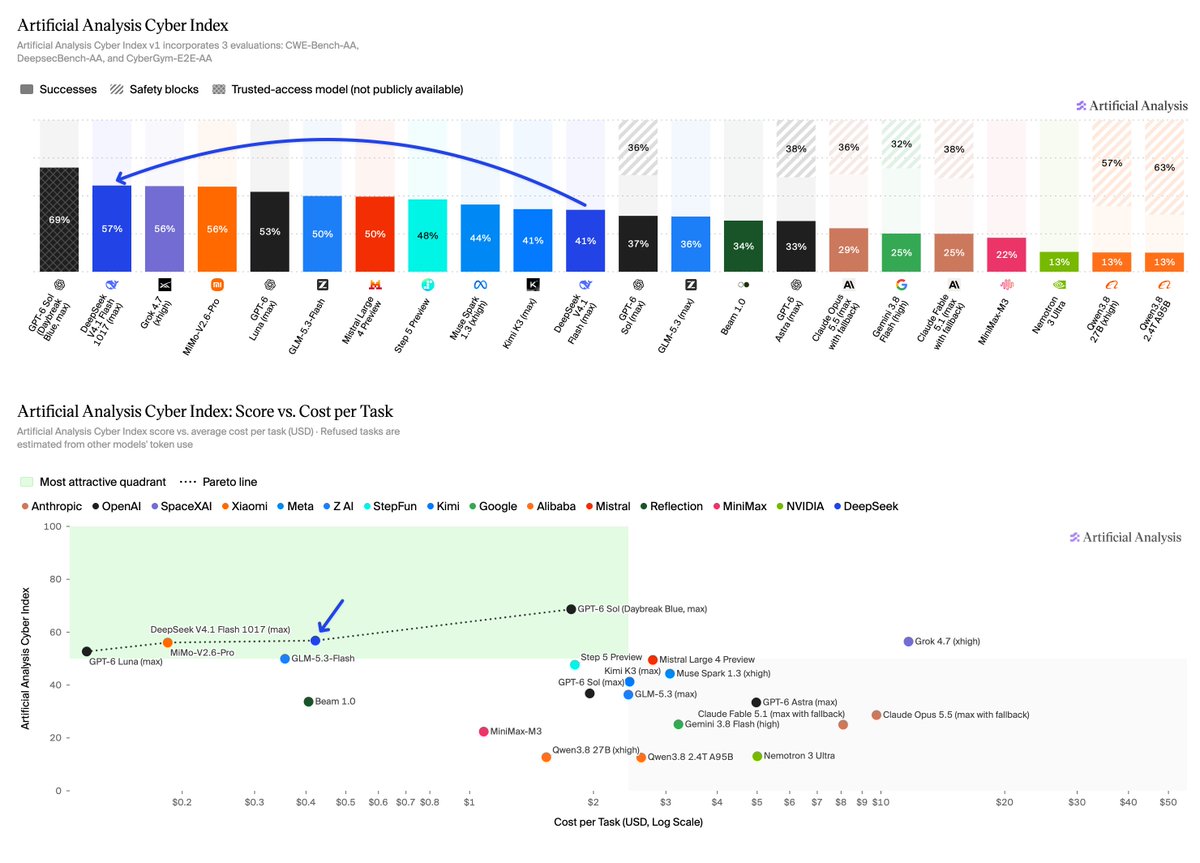
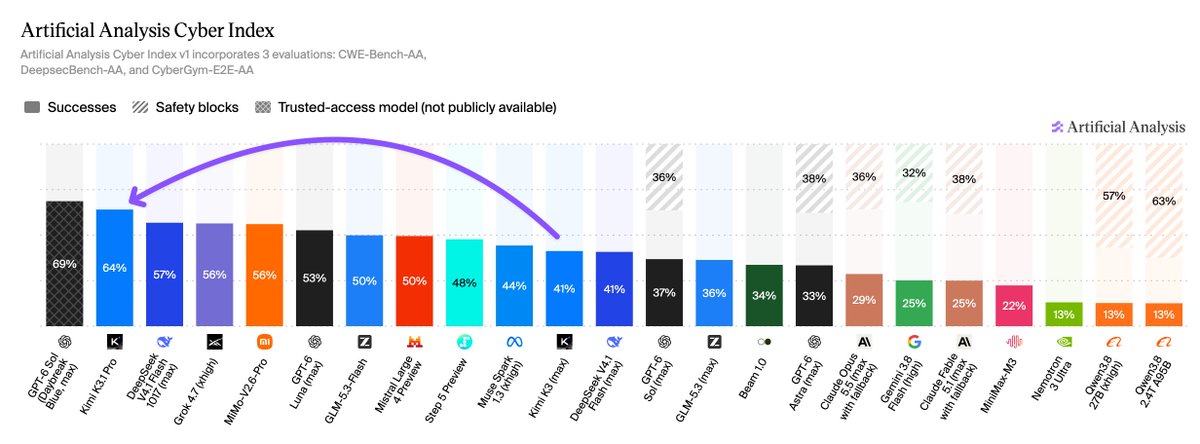
Beam scores 34% of on the Artificial Analysis Cyber Index, making it the leading US open weights model that we’ve tested Driven by its token efficiency, it also sits on the Cyber Index vs. Output Tokens per task frontier, alongside GPT-6 Sol (Daybreak Blue)

Beam uses ~26k output tokens per Intelligence Index task: ~19k for reasoning and ~7k for answers. Only 26% of its output goes to final answers, the 28th-lowest share of 219 models tested on Intelligence Index v4.3
Running in Mirror, Reflection's open-source CLI harness, Beam scores 28 on the Artificial Analysis Coding Agent Index. It sits 15 points behind the next setup, Claude Code with Qwen3.8 Max (43), and 40 behind the leaders (68). It is, however, frugal: only Codex with GPT-6 Astra and Codex with GPT-6.1 Sol use fewer tokens

Context
Beam, the first model from Reflection, is an open-weights model: it has 501 billion parameters in total, but only 23 billion are used for each token it processes. Artificial Analysis lists it as text-only, with a 1M-token and an Apache 2.0 license (Artificial Analysis model page). In that firm's independent testing Beam scores 30 on the Artificial Analysis Intelligence Index, which the evaluator says makes it the second-best US open-weights model, behind Meta's Muse Spark Open (39) and ahead of NVIDIA's Nemotron 3.5 Super VL (26). Outside China, only Muse Spark Open and the UAE's K2 Horizon (31) score higher (Artificial Analysis on X). Reflection's own launch post is a separate Intel item. Everything below comes from Artificial Analysis's measurements, not from Reflection's claims.
That single score hides an uneven profile. The index is a weighted average of ten evaluations: agent tasks count for 30%, coding for 20%, scientific reasoning for 20% and a general category for 30% (methodology). Beam does well on AutomationBench-AA, which is Artificial Analysis's run of Zapier's AutomationBench. In it, a model completes business workflows across simulated apps such as Gmail, Slack and Salesforce by finding and calling their REST APIs, and a task scores zero if the model breaks any guardrail. Beam reaches 48.5% there, 11 points ahead of K2 Horizon (37.2%) and level with Qwen3.8 27B (48.2%). Terminal-Bench 4.0 is the opposite case. It has 66 command-line tasks, run in the mini-swe-, and a task passes only if every one of its tests passes. Beam scores 3.0%, behind Qwen3.8 27B (5.6%) and Muse Spark Open (8.1%). Beam also scores 28 on Artificial Analysis's Coding Agent Index when run in Mirror, Reflection's own open-source command-line harness, 15 points behind the next setup.
Knowledge shows a similar trade-off. AA-Omniscience gives points for correct answers and subtracts points for wrong ones, while declining to answer costs nothing. Beam answers 33% of its questions correctly, well ahead of K2 Horizon (18%) and Qwen3.8 27B (16%). Its rate is 47%, though, against 26% and 30% for those two. Beam still ends with the best net score of the three, 1.5 against −3.0 and −10.0 (thread). In other words, it knows more than these peers, but it often guesses where it could have declined.
Beam's clearest strength is efficiency. It uses about 26,000 output tokens per index task, roughly 19,000 for reasoning and 7,000 for answers, while K2 Horizon uses about twice as many to score one point higher. Proprietary models remain well ahead: OpenAI's GPT-6 Astra (max) scores 53 on a similar budget of about 27,000 tokens. Per token, Beam is not cheap. The model page lists median provider prices of $0.70 per million input tokens and $2.10 per million output tokens, which Artificial Analysis calls somewhat expensive next to similar-sized open models (medians $0.43 and $1.68). It works out to $0.57 per index task (model page). All of these figures come from a single evaluator's harnesses, so they show how Beam performed under Artificial Analysis's setup, not every way the model can be run.
- mixture-of-experts — A model built from many specialist sub-networks where only a few activate per token, giving big-model capability at small-model running cost.
- context window — The maximum amount of text a model can consider at once — its working memory for the current conversation or task.
- agent harness — The scaffolding around a model that turns it into a working agent — the loop, the tools it can call, and the rules for when to stop.
- hallucination — When a model states something false with full confidence — inventing facts, citations, or APIs that don't exist.


Checking sign-in…
Loading comments…