Minimax M2 5 Everything You Need To Know
- Source
- artificialanalysis.ai
- Author
- Artificial Analysis articles
- Date
Context
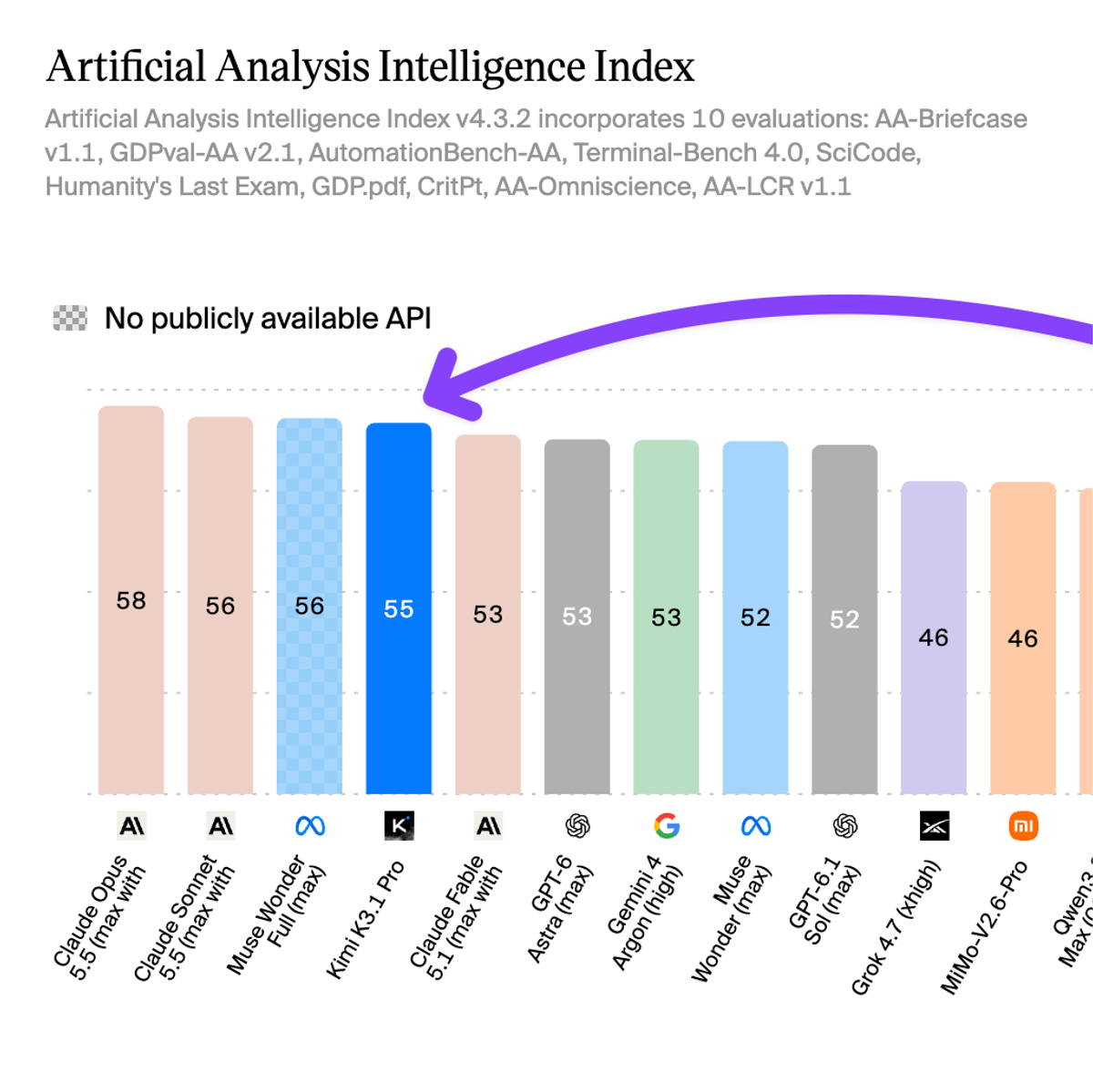
MiniMax's M2.5 moved only 2 points on Artificial Analysis's Intelligence Index over M2.1, reaching 42 and tying GLM-4.7 and DeepSeek V3.2 for third to fifth place among models, behind GLM-5 (50) and Kimi K2.5 (47). This February 13, 2026 analysis shows that the small net change hides two larger moves in opposite directions, on a model that kept the same 229B total, 10B active parameter design as M2.1 (artificialanalysis.ai).
The gain is in agentic work. Artificial Analysis's Agentic Index for M2.5 rose to 56 from 47, driven by GDPval-AA, where its Elo climbed to 1215 from 1079. GDPval-AA has models produce outputs for realistic knowledge work tasks, such as presentations and analysis, using a terminal environment and web access; the outputs are compared against each other by an automated pipeline that turns those matchups into Elo scores. On that measure M2.5 ranks third among open weights models, behind GLM-5 and Kimi K2.5.
The loss is in knowledge reliability. On AA-Omniscience, which weighs accuracy against , M2.5's index fell to -41 from M2.1's -30. According to the article, M2.1 had improved by abstaining more, cutting its hallucination rate to 67%; M2.5 reverses that, with the rate back at 88%, close to the original M2's 89%. Accuracy rose slightly, to 25% from 22%, but not enough to offset the extra wrong answers. Token use was roughly flat at about 56M output tokens to run the Intelligence Index versus about 58M for M2.1, which the article says makes M2.5 one of the more token-efficient open weights reasoning models at its level.
- Artificial Analysis puts MiniMax-M2.5's Agentic Index at 56, up from M2.1's 47, which makes it the third-ranked open weights model on GDPval-AA, behind GLM-5 and Kimi K2.5.
- M2.5 reverses M2.1's hallucination fix: M2.1 had cut its rate to 67% by abstaining more often, and M2.5 returns to 88%, near M2's 89%. Accuracy rose only from 22% to 25%, so its AA-Omniscience Index fell from -30 to -41.
- M2.5 used about 56M output tokens to run the Intelligence Index, versus about 167M for GLM-4.7 and 61M for DeepSeek V3.2, which share its score of 42, making it one of the more token-efficient open reasoning models at that level.
- Its modified MIT license requires attribution for commercial use. Besides MiniMax's own API, it is served by third parties including Fireworks, Novita and GMI Cloud.
- open weights — A model whose trained parameters are published for anyone to download and run — unlike API-only models you can access but never possess.
- mixture-of-experts — A model built from many specialist sub-networks where only a few activate per token, giving big-model capability at small-model running cost.
- hallucination — When a model states something false with full confidence — inventing facts, citations, or APIs that don't exist.
- context window — The maximum amount of text a model can consider at once — its working memory for the current conversation or task.


Checking sign-in…
Loading comments…