Ling 3.1 Flash 1019: open weights, stronger agents, heavier token use
- Source
- x.com
- Date

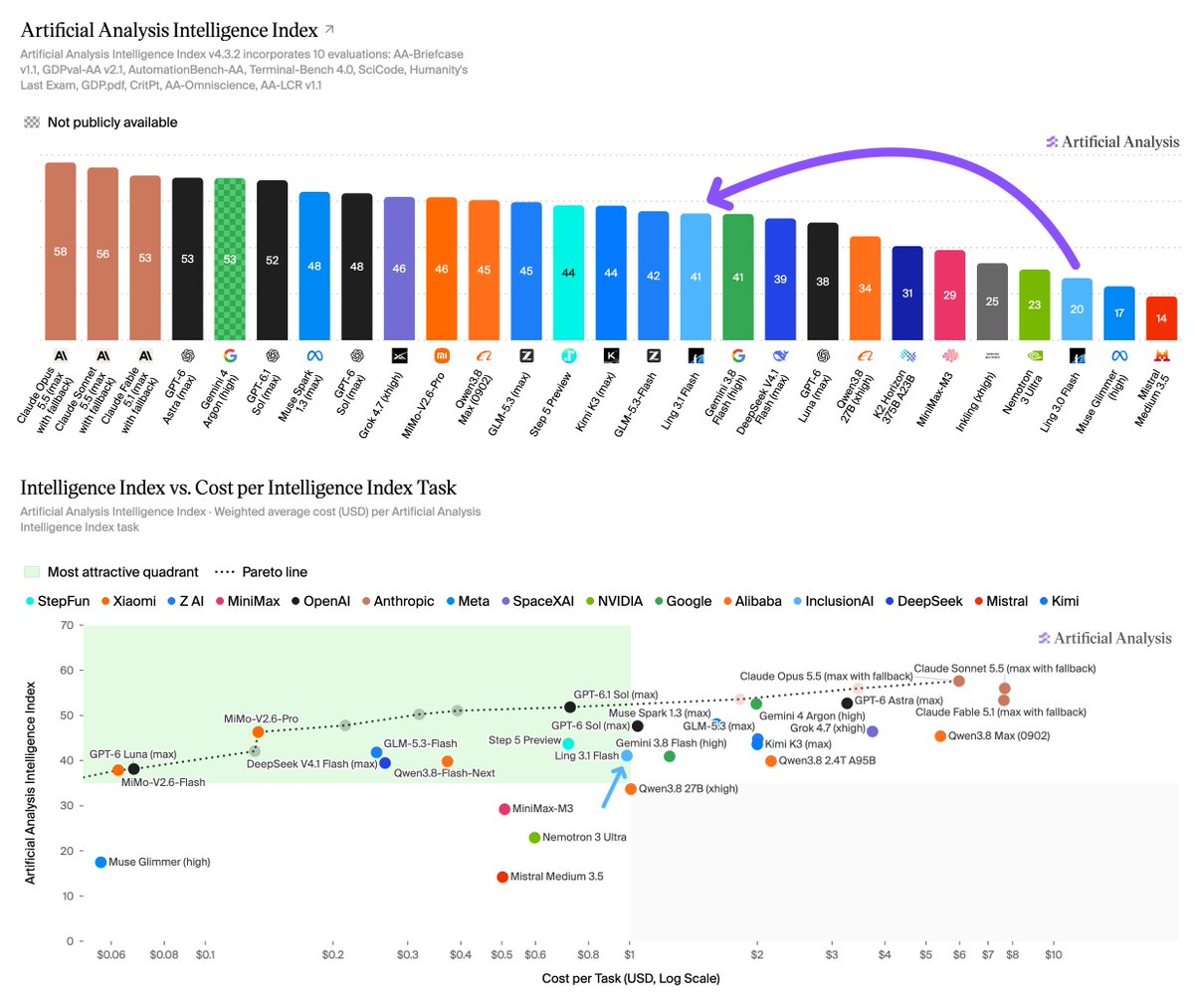
Ling 3.1 Flash 1019, an open weights model and successor to Ling 3.1 Flash, scores 44 on the Artificial Analysis Intelligence Index v4.3, up from 41 @AntLingAGI has released Ling 3.1 Flash 1019, an update to Ling 3.1 Flash, their reasoning model with 560B total parameters, 25B active parameters, and a 1M token context window. It scores 44 on the Artificial Analysis Intelligence Index v4.3, up from 41 from Ling 3.1 Flash. Like Ling 3.1 Flash, Ling 3.1 Flash 1019 is open weights. Key results: ➤ Ling 3.1 Flash 1019’s agentic capabilities improve over Ling 3.1 Flash. On AA-Briefcase v1.1, Ling 3.1 Flash 1019’s Elo is 1521, up 124 points from 1397 for Ling 3.1 Flash. Its Elo on GDPval-AA v2.1 is 1653, up from 1617 for its predecessor, an increase of 36 points. On AutomationBench-AA, Ling 3.1 Flash 1019 scores 68%, a 6 point increase from Ling 3.1 Flash’s score of 62% ➤ Ling 3.1 Flash 1019’s makes gains in scientific reasoning compared to its predecessor. Ling 3.1 Flash 1019 scores 43% on Humanity’s Last Exam, a 4-point improvement from 39% for Ling 3.1 Flash. It scores 26% on CritPt, an 8-point increase from 18%. ➤ Ling 3.1 Flash 1019 uses more output tokens per task than Ling 3.1…

Context
Artificial Analysis measured Ling 3.1 Flash 1019 at 44 on its Intelligence Index v4.3, three points above the 41 it gave the original Ling 3.1 Flash in its earlier test, and its results post shows the update uses considerably more output to get there. The model is an open-weights from Ant Ling with 560B total parameters, 25B of them active for each , and a 1M-token . It is released under the MIT license on Hugging Face and is also served through InclusionAI's own API.
The reported gains fall in two areas. On agentic tests, where a model has to carry out multistep work, its Elo rating on AA-Briefcase v1.1 rose 124 points to 1521 and on GDPval-AA v2.1 rose 36 points to 1653, while its AutomationBench-AA score went from 62% to 68%. On scientific reasoning it scored 43% on Humanity's Last Exam, up from 39%, and 26% on CritPt, up from 18%.
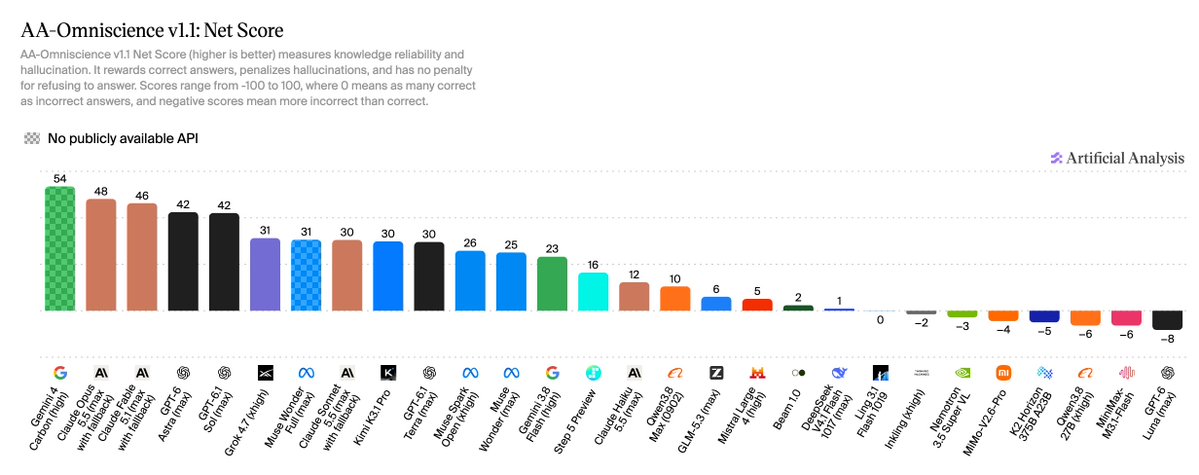
The cost of those gains is length. Ling 3.1 Flash 1019 used 145k output tokens per Intelligence Index task against 103k for its predecessor, more than 40% more, and Artificial Analysis says that extra output is the main reason its cost per task, $1.49, is higher than Ling 3.1 Flash's. Its list price is $0.30 per million input tokens and $0.90 per million output tokens, so longer answers show up directly in the bill. Artificial Analysis still puts it below models such as Mistral Large 4 Preview and GLM 5.3 on cost per task.
For anyone choosing between the two versions, the measured trade is a three-point index gain and better agentic results in exchange for substantially more output per task. The post does not give the predecessor's cost per task, so the dollar size of the increase is not stated.
- reasoning model — A model trained to think — generating extended internal reasoning before answering — trading time and tokens for accuracy on hard problems.
- token — The chunk of text a model reads and writes in — roughly three-quarters of a word — and the unit AI usage is billed in.
- context window — The maximum amount of text a model can consider at once — its working memory for the current conversation or task.


Checking sign-in…
Loading comments…