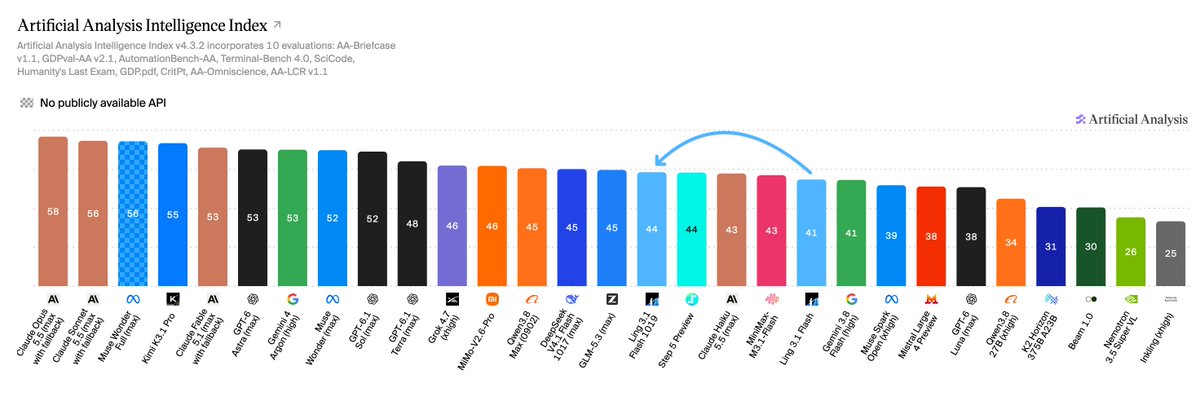
Ling 3.1 Flash doubles its Intelligence Index score to 41
- Source
- x.com
- Date

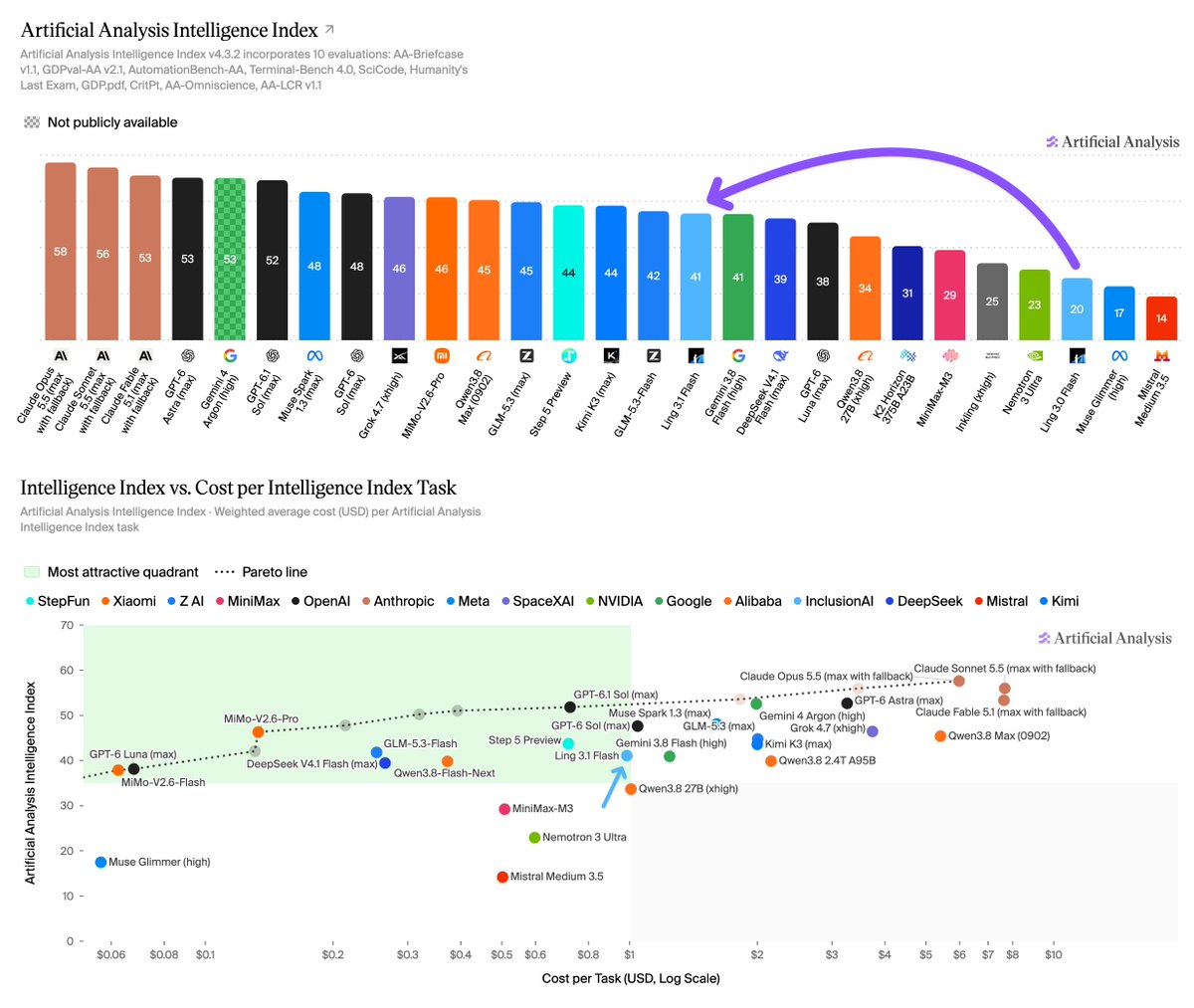
Ling 3.1 Flash makes large gains in intelligence over its predecessor, scoring 41 on the Artificial Analysis Intelligence Index with particular improvement in agentic capabilities @AntLingAGI has released Ling 3.1 Flash, a reasoning model with 560B total parameters, 25B active parameters, and a 1M token context window. It scores 41 on the Artificial Analysis Intelligence Index v4.3, up from 20 from Ling 3.0 Flash, which launched in August. Ling 3.1 Flash is expected to be open weights, with Ant Group releasing the weights soon. Key results: ➤ Ling 3.1 Flash improves agentic capabilities over its predecessor. With a GDPval-AA v2 Elo of 1,622 and an AA-Briefcase Elo of 1,400, the model rivals peer models such as GLM-5.3-Flash, Gemini 3.8 Flash (high) and DeepSeek V4.1 Flash (Max). Ling 3.1 Flash also shows notable gains on AutomationBench-AA (62%) and Terminal-Bench v4.0 (33%). ➤ Ling 3.1 Flash scores +2 on AA-Omniscience, a 22 point improvements from Ling 3.0 Flash (-18). Compared to its predecessor, its accuracy rate rose from 18% to 29% while the hallucination rate fell from 44% to 38% at a similar attempt rate (56% to 58%), demonstrating the gain comes primarily from knowing…
Context
Ling 3.1 Flash's doubled score comes with a much bigger and more expensive model, so on these figures it reads as a new, pricier tier more than a free upgrade. The model, a from the Ling team at Ant Group, scores 41 on version 4.3 of Artificial Analysis's Intelligence Index, against 20 for Ling 3.0 Flash, according to Artificial Analysis's October 6 post. It has 560 billion parameters in total, of which 25 billion are active for any given , against 124 billion and 5.1 billion for its predecessor. Its listed price is $0.30 per million input tokens and $0.90 per million output tokens, about four times Ling 3.0 Flash's $0.075 and $0.22.
The clearest evidence of what improved is on AA-Omniscience, Artificial Analysis's factual-knowledge test, where the score can fall below zero. Ling 3.1 Flash moves from minus 18 to plus 2. Its accuracy rose from 18 to 29 percent and its rate fell from 44 to 38 percent, while the share of questions it attempted barely changed, from 56 to 58 percent. That last figure matters because a model can lower its error rate simply by declining more questions; since this one answered about as often, Artificial Analysis concludes that the gain comes mainly from knowing more. The post also reports stronger agentic results. It says the model's Elo ratings of 1,622 on GDPval-AA v2 and 1,400 on AA-Briefcase put it alongside GLM-5.3-Flash, Gemini 3.8 Flash (high) and DeepSeek V4.1 Flash (Max), and it notes gains on AutomationBench-AA, at 62 percent.
Cost per task is where the bigger model shows. Ling 3.1 Flash used 16 percent fewer output tokens than its predecessor to run the index, 218 million against 261 million, but at the higher price it still costs $0.99 per task, against $0.42 for GLM-5.3-Flash and $0.32 for DeepSeek V4.1 Flash (Max), though below Gemini 3.8 Flash (high) at $1.24. One caution on the headline comparison: when Ling 3.0 Flash launched in August, Artificial Analysis reported it at 38 on the Intelligence Index, not 20. This post does not explain the difference, so the doubling should be read as a comparison within index version 4.3 rather than against the earlier published figure. Artificial Analysis says the model is available through Novita AI and that Ant Group is expected to release the weights soon.
- reasoning model — A model trained to think — generating extended internal reasoning before answering — trading time and tokens for accuracy on hard problems.
- token — The chunk of text a model reads and writes in — roughly three-quarters of a word — and the unit AI usage is billed in.
- hallucination — When a model states something false with full confidence — inventing facts, citations, or APIs that don't exist.
- context window — The maximum amount of text a model can consider at once — its working memory for the current conversation or task.


Checking sign-in…
Loading comments…